



Step-by-Step Guide to Wiring a UK BS1363 3‑Pin Plug Safely
Wiring a BS1363, 3-Pin Plug Safely and Correctly
What is a UK 3-Pin Plug?
A UK plug is also known as British Plug, Type G Plug or BS1363 Standard Plug by IEC = International Electrotechnical Commission) is a three pin plug used to power up electrical appliances and devices. There are multiple types of three pin plugs e.g. Type A, B, C, D, E, F, G, H, I, J, K, L etc, but the G type 3-pin plug is most common in United Kingdom, Singapore, Hong Kong, Malta, Malaysia, Ireland, Cyprus, Qatar, Oman, Kuwait, KSA, UAE, Israel, and other countries following fully or partial of IEC regulations.
Inside a 3-Pin Power Plug
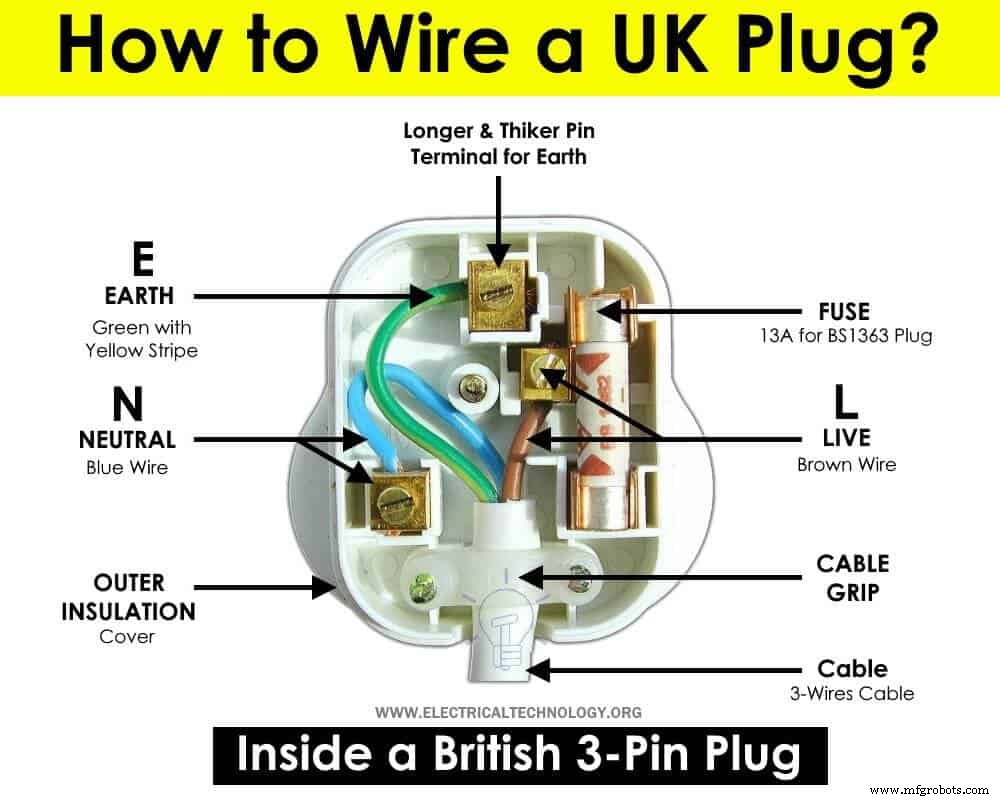
There are three terminals and a fuse (rating are different which depends on the load circuit requirements) inside a UK three pin power plug as follow:
Live Terminal = L
The live terminal should be connected to the brown color wire (from the cable). It will carry voltage (& current) from the source to the load point. Live terminal is also known as Hot, Line or Phase terminal. The live terminal screw is electrically connected & bonded to the input of the safety fuse while the output of the fuse is connected to the live Pin.
Neutral Terminal = N
The Neutral terminal should be connected to the blue color wire. Neutral wire provides a returning path to the current when the circuit is completed.
Earth Terminal = E
The Earth terminal is longer and thicker for safety purposes. For this reason, the green with yellow stripe earth wire should be connected to the earth terminal.
Fuse
There is a built-in standard fuse (normally 13A) in a BS1363 plug. The rating of the ceramic fuse in the UK plug can be different as it depends on the current capacity and types of protected load. The main function of the fuse in a British plug is to protect the power cord, connected appliance & cables and wires in case of overheating, overload & overcurrent.
For example, a 13A fuse with 230V, 50Hz home supply voltage is equivalent to almost 3000 watts (3kW). If the load current increases the limit of fuse rating (in case of fault e.g. short circuit), it will blow or trip the RCD / MCB circuit breaker in the main consumer unit.
Good to Know: Fuse in the three pin power plug should be rated according to BS1363 standards. For example, If a low power device (1100W or 700W) has to be used instead of previous high power device (2.5-3kW having 13 Ampere fuse in the power plug), the fuse rating must be reduced according to the load current capacity e.g. 3A for 700W & 5A for 1100W appliances.
Cable Grip
Cable grip is used to prevent the tension on the cable in normal operation and pulling out the wire strands from the screw terminals. Cable grip or strain relief should be tightly fitted around the cable after connecting the wire strands in the appropriate terminals.
Safety Features of BS1363 Plug
Good to know: BS-1363 Plug aka UK plug is the safest plug in the world due to the following reasons.
- It has a built-in fuse.
- It has insulated pins.
- The earth Pin is thicker and longer i.e. the earth pin is the first pin which makes contact before other pins. The thickness of the pin prevents to insert the wrong pin in other slots i.e. Neutral in the Live, or Earth in the Live terminal etc. In short, it can not be inserted in the live or neutral slot.
- Shuttered outlets on sockets are used for 3-Pin power plugs which prevents the children from inserting the nails or other conducting material in the socket outlet. The longer earth pin helps to open the other two slots for Live and Neutral wires.
- The grip helps to remove the power plug easily.
- Can’t be used as upside-down or in the reverse direction to mix-up the Live or Phase with Neutral.
Tools Needed
The following basic tools are required while wiring a 3-pin power plug.
- A 3-Pin UK plug
- Flat bladed screwdriver
- Phase tester
- Wire snips, side cutters, scissors, knife or simple wire striper.
Wiring a UK 3-Pin Plug
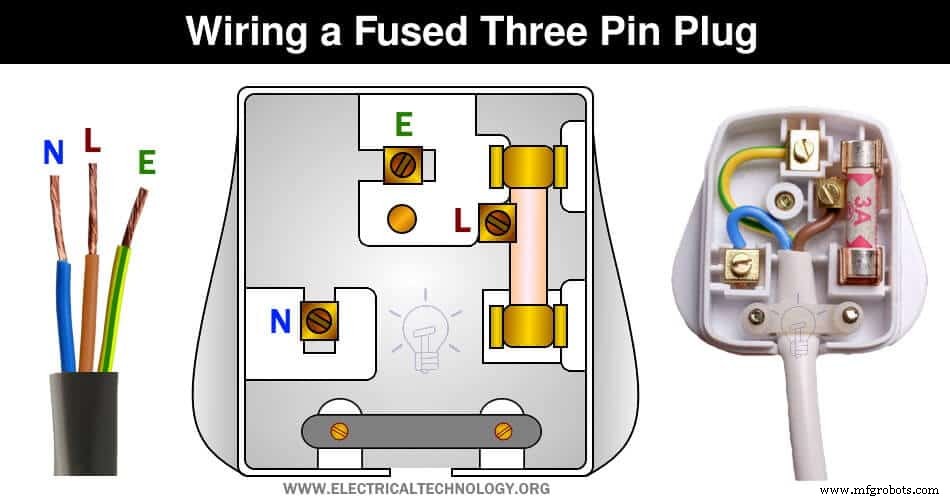
Follow the following simple steps to wire a BS-1363 UK plug.
- First of all, remove 2″ or 5cm of the outer sheath or insulation of the cable without damaging it by using a knife, snipe nose snips or wire stripper.
- Now, shorten the Live and Neutral (Brown & Blue) wires in appropriate length which suitably fit in the Live and Neutral screw terminals.
- Remove about half an inch (10mm) of the insulation from the inner cores for all three wires i.e. brown, blue and green/with yellow stripe by using snips, knife or wire stripper. All this process should be carefully done without damaging the wire strands or conductors.
- It is a good practice to tightly twist all the wire strands and double them over before inserting in the screw terminals. This because it will avoid spreading the wire strands to other terminals as well as the screws are perfectly tightened in case of light gauge flex.
- Now, loosen the screws on the cable grip (strain relief) to easily connect the phase, neutral and earth wire to the related screw terminals.
- Connect the Green with Yellow Stripe wire into the Earth “E” terminal as shown in the fig.
- Feed the Blue wire into the Neutral “N” terminal.
- Finally, connect the Brown wire into the Live (Phase) “L” terminal.
- As a final step, tighten the cable grip (strain relief) screws and replace the back cover of the three-pin plug. Make sure all the wires and screws are perfectly tightened as loose connection may lead to catching a hazardous fire due to arcing and overheating or even electric shock having serious injuries.
Remember:
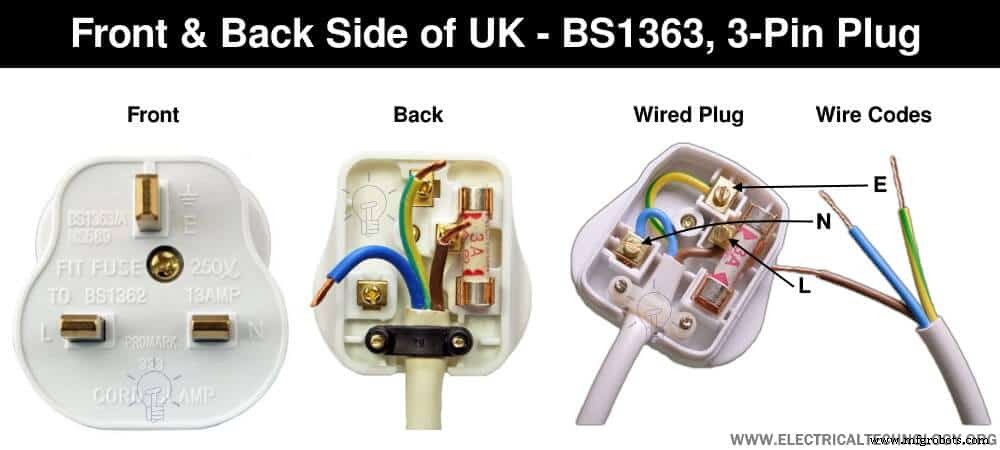
- Green with Yellow stripe wire to the Earth “E” terminal.
- Blue wire to the Neutral “N” terminal.
- Brown wire to the Live “L” Terminal.
IEC & UK Wiring Color Codes: Old & New
We have used the following IEC wiring color codes for 230V single supply voltage applicable in the UK & EU. The older wiring color codes in the United Kingdom (prior April 2004) is also mentioned below.
IEC Wiring Color Codes for 230V, 1-Phase, 3-Wire System
- Brown = Live or Phase Wire
- Blue = Neutral
- Green or Green with Yellow Stripe = Earth or Ground wire as protective earth (PE).
The Old UK wiring color codes for single phase wiring are as follow.
230V Single Phase
- Red = Phase
- Black = Neutral
- Green = Earth or Ground Wire.
Instruction & Safety Precautions
- Disconnect the power supply (and make sure it is really swathed OFF) before servicing, repairing or installing electrical equipment. To do so, switch off the main switch in the main consumer unit or distribution board.
- Never stand or touch wet and metal parts while repairing or installation.
- Read carefully all the cautions and instructions and follow them strictly while doing this tutorial or any other work in practical related to electrical works.
- Always, use the right size cable and wire, proper size outlets and switch and suitable size of circuit breakers. You may also use the Wire and Cable size calculator to find the right gauge size.
- Never ever try to play with electricity (as it is dangerous and can be fatal) without proper guidance and care. Do the installation and repairing work in presence of experienced persons having vast knowledge and good practice who knows how to deal with electricity.
- Doing your own electrical work is dangerous as well as illegal in some cases. Contact the licensed electrician or the electric power supply provider before practicing any change/modification in electrical wiring connections.
- The distribution board should not be installed 2.2 meter above the floor, must be protected from the corrosion and away from watery areas. All the wires should be covered in the panel board (i.e. it should not hang outside the panel). Finally, there must be a safety sign near the distribution board.
- The author will not be liable for any losses, injuries, or damages from the display or use of this information or if you try any circuit in wrong format. So please! Be careful because it’s all about electricity and electricity is too dangerous.
Related Wiring Installation Tutorials:
- How to Wire and Install an Electrical Outlet Receptacle?
- How to Wire a Garage Consumer Unit?
- How to Wire 240V, 208V & 120V, 1 & 3-Phase, High Leg Delta Main Panel?
- How to Wire 277V & 480V, 1-Phase & 3-Phase, Commercial Main Service Panel?
- How to wire a GFCI Outlet?
- How to Wire an AFCI Outlet?
- How to Wire Combo Switch and Outlet?
- How to Wire GFCI Combo Switch and Outlet
- How to Wire an AFCI Combo Switch
- How to Wire a GFCI Circuit Breaker?
- How to Wire an AFCI Breaker?
- Staircase Wiring Circuit Diagram – How to Control a Lamp from 2 Places?
- Corridor Wiring Circuit Diagram – Hallway Wiring using 2-Way Switches
- Tunnel Wiring Circuit Diagram for Light Control using Switches
- Hospital Wiring Circuit for Light Control using Switches
- Hotel Wiring Circuit – Bell Indicator Circuit for Hotelling
- Hostel Wiring Circuit Diagram and Working
- Godown Wiring Diagram – Tunnel Wiring Circuit and Working
- How to Wire 120V Water Heater Thermostat – Non-Simultaneous?
- Even More Electrical Wiring Installation & Tutorials
Industrial Technology
- Step-by-Step Guide: Wiring a 3‑Phase Non‑Simultaneous Water Heater Thermostat
- Step-by-Step Guide to Wiring a 240V Dual-Element Water Heater Thermostat
- Step-by-Step Guide to Wiring an AFCI Outlet for Enhanced Safety
- Step‑by‑Step Guide: Wiring GFCI Circuit Breakers for 1‑ to 4‑Pole Systems
- Installing a GFCI Outlet: Step‑by‑Step Wiring Guide & Circuit Diagrams
- Step‑by‑Step Guide: Wiring a Household Outlet Receptacle with Clear Diagrams
- Step‑by‑Step Guide: Wiring an AFCI Combo Switch with Diagrams
- Step-by-Step Guide to Wiring a UK 3‑Pin BS1363 Socket Outlet Safely
- Complete Guide to Wiring a Twin 3‑Pin UK Socket Outlet (2‑Gang)
- Mastering DPDT Switch Wiring: Step-by-Step Guide for 120V/240V Control