



Industry 4.0 Demands Extensive IoT Deployment and Uninterrupted Connectivity
To enable the benefits of Industry 4.0 applications and services, a massive deployment of sensors, gateways, and cloud computing systems is necessary, with seamless connectivity.
Some people think that the Internet of Things (IoT) always requires wireless connectivity. This misconception derives from the massive use of mobile devices, wearables, and other connected devices that are not physically plugged into a wired network.
The reality is that most of the industrial internet is achieved by wired networks, and Ethernet is still the backbone of connectivity at most factories worldwide.
When wireless connectivity is necessary, new technologies such as Low-Power Wide-Area Networks (LPWANs) such as Sigfox, LoRaWan, and NB-IoT help to manage millions of IoT devices in local and remote facilities.
Wired industrial connectivity and M2M had been around for decades
Many industries have benefited from some form of wired data connectivity since the 1980s, mostly using Programmable Logic Controllers (PLC) working at 24v, which is considered the global voltage standard and digital language for industrial applications.
In 1990, the second generation of cellular networks (2G) and the SIM cards introduced wireless for industrial connectivity services, the cellular machine-to-machine communication (M2M).
M2M allowed industries to access and control machines remotely, deploy hundreds of connected devices and collect information anywhere where a cellular network was available. In retrospect, M2M is the framework of what we today call IoT. Most of the remaining M2M connectivity works over the 2G GPRS standard, requiring 2G EDGE coverage and SIM cards.
Today’s smart factory uses a mix of wired and wireless technologies, working together by Time-Sensitive Networking (TSN).
TSN is a set of standards specified by IEEE 802.1 to enable Ethernet networks to give QoS guarantees for time-sensitive and mission-critical traffic and applications. TSN is a toolbox that includes four categories of tools: resource management, traffic shaping, reliability, and time synchronization.
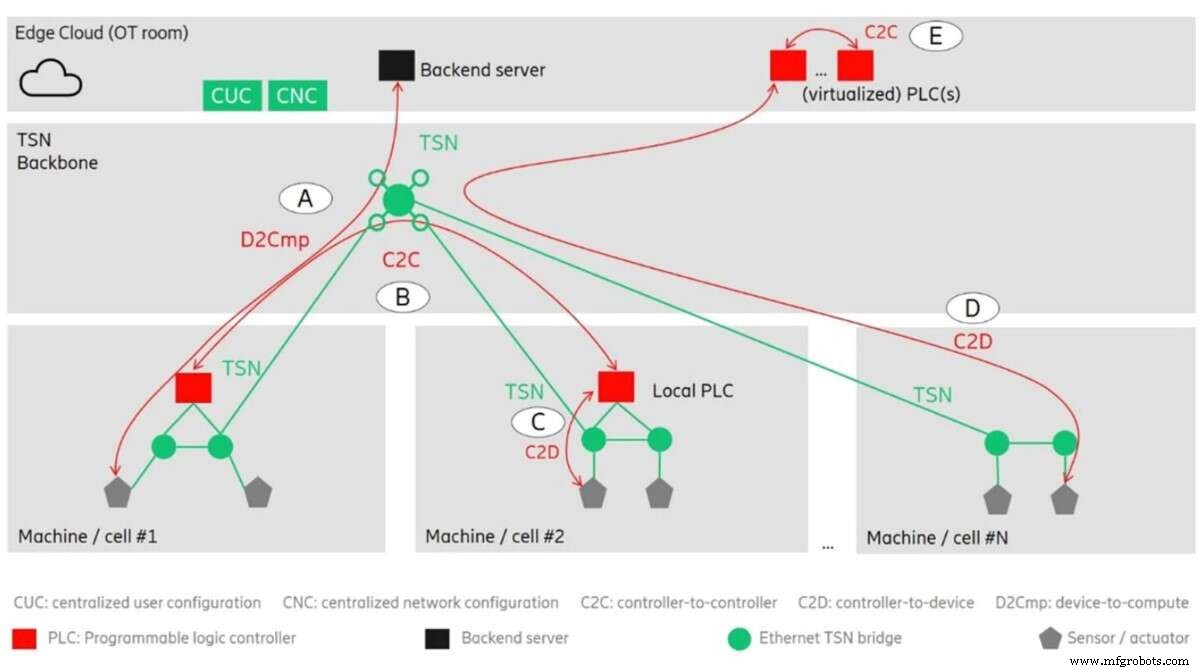
In essence, a TSN-based industrial communication network is a converged system that allows a mix of various traffic types. Service requirements range from best-effort traffic to critical real-time traffic. TSN provides for the convergence of many different services running on a shared network while still having tools to prioritize time-critical services.
For most connections, LPWAN networks are the best option
With the arrival of the Long-Term Evolution (LTE) or 4G networks, a new range of services and possibilities became available for industries and consumers. LTE allows for multiple connectivity types, including fast data transmission, low latency, Voice-over-IP (VoIP), and low-power wide-area networks (LPWAN).
The most common industrial versions of 4G networks are based on LTE-M, which has become the new M2M, and Narrowband-IoT (NB-IoT). Both services are designed for massive IoT, enabling the connectivity for millions of low-power connected devices.
Additionally, other LPWAN networks that do not rely on cellular connectivity are widely available, including LoRaWAN, Sigfox, and Wi-Fi HaLow (IEEE 802.11ah).
Most industrial connections do not need 5G, which is still in the early stages of roll-out
There has been a lot of buzz about 5G and its promises of blazing speeds and ultra-low latency for critical connectivity in the last two years.

Picture courtesy of Ericsson.
The reality is that over 99% of industrial and professional IoT connections do not need those unique features. If cellular service is desired, 4G, LTE-M, and NB-IoT can provide the bandwidth and massive IoT connectivity necessary for today’s and tomorrow’s applications.
Additionally, the full specifications of 5G to enable some of its most critical features are still being defined by the 3GPP and other regulatory bodies. It would take a few more years to have the 5G networks ready to provide the services that some critical IoT applications require.
“5G is really needed when you need some special features. We’re talking about bigger valued, lower latency, many more connections or connecting points, where you actually have problems with the LTE being congested. So the whole notion that 5G is needed for wide-area cellular IoT is not really true.” says Marie Hogan, head of IoT and Broadband at Ericsson.
Industrial Technology
- Industry 4.0 & IoT in Germany: Current Landscape & Strategic Insights
- Industry 4.0 & IoT: Key Market Trends Shaping the Next Two Years
- Industrial IoT: Key Building Blocks Driving Industry 4.0
- Machine Vision: Driving Industry 4.0 and the Industrial IoT
- Mastering PCB Design for the Internet of Things: A Comprehensive Guide
- Unlocking Industry 4.0: How 5G & LTE Transform IoT in Manufacturing
- Industry 4.0: Benefits, Risks, and Implementation Challenges
- SCADA Systems & Industry 4.0: Revolutionizing Remote Process Control
- Driving the Future: How Digital Transformation & IoT Revolutionize Automotive Manufacturing
- IoT, AI, and Edge Computing Revolutionize Oil Industry Operations