



Resolving the U.S. Military’s Missing Weapons Issue Through Advanced Tracking Solutions
In 2017, the U.S. Army Criminal Investigation Command discovered that 32 grenades were stolen from a container of explosives. But these grenades are far from the only weapons that have been diverted from the armed forces.
From 2010 to 2019, the U.S. Army reported the loss or theft of:
- 1,179 rifles
- 694 pistols
- 74 machine guns
- 36 grenade launchers
- 34 rocket launchers
- 25 mortars
- 11 shotguns
It’s difficult to know what’s missing because of the military’s legacy tracking systems, which are full of discrepancies. It’s likely that the U.S. military’s official reports underestimate the degree of theft and loss.
Military-grade weapons are incredibly dangerous in the hands of terrorists, criminals, and even unwitting civilians. Although the Pentagon can account for 99.9% of its weapons, the lost 0.01% is making the world a more dangerous place.
Without a significant overhaul, the U.S. military risks placing more weapons in the hands of its adversaries. This is why improved tracking systems are so critical: to solve a systematic problem, the U.S. military needs systematic solutions.
New Changes to U.S. Military Traceability
In light of this missing weapons problem, Congress passed the National Defense Authorization Act of 2021. This piece of legislation requires the military to be accountable to Congress for its lost and stolen weapons. Congress will now receive an annual report on the Pentagon’s missing weapons, adding a layer of accountability to an issue that has lacked oversight for decades.
The law also led to sweeping changes in how the U.S. military traces its weapons, including:
- Reporting lost weapons to the FBI National Crime Information Center.
- Updating the Defense Department’s Small Arms and Light Weapons Registry. This will allow the database to search every military branch’s database for lost weapons that are recovered during criminal investigations.
- Increasing notification rules, creating new internal inspection procedures, and digitizing tracking systems.
As the largest branch of the U.S. military, the Army has found itself in the midst of a weapons traceability overhaul. The Army no longer allows paper weapons tracking and has plans for digitizing the entire process. It even created an operations reporting center to collect incident reports in one centralized location.
Army Vantage is a new initiative that allows lost weapons reports to go up the chain of command without delays. Thanks to the power of AI and machine learning, the Army can now see its lost weapons reports in real-time, which was previously impossible.
The Benefits of Improved Weapons Tracking
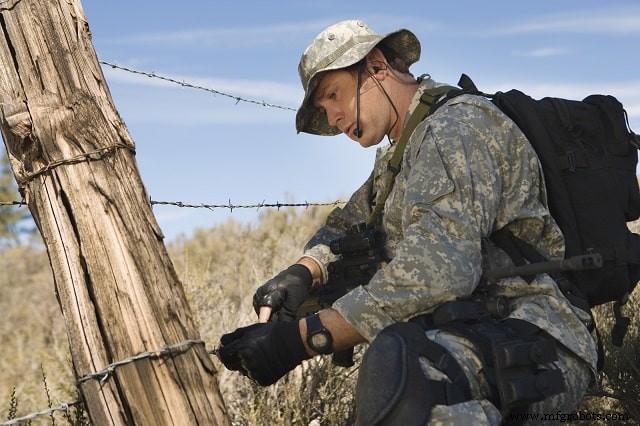
Military-grade weapons must be stored and disposed of properly. By overlooking lost and stolen weapons, the Department of Defense is unwittingly arming criminals and terrorists with the latest and greatest technology.
Improved weapons tracking is essential to keep the public safe and offers benefits such as:
- Crime reduction: Criminals want military-grade weapons to carry out devastating attacks against fellow civilians. By minimizing the number of diverted weapons, the DoD can aid in the reduction of violence against innocent bystanders.
- Counter-terrorism: Nefarious terrorists frequently steal U.S. weapons for their own purposes. With terrorist threats increasing, peace is only possible if the military can lock down its most dangerous assets.
- Financial impact: Theft of any kind leads to financial losses and greater expenditures. Since taxpayers fund the Department of Defense, it’s critical to track weapons so the military can stay accountable to the use of public funds.
- Increased recovery: In the event of theft, the military has little recourse to recover unlabeled weapons. But with sophisticated weapons tags, the military is able to recover lost weapons and return them to their rightful place.
How to Implement Better Tracking Solutions
Weapons traceability makes the world a safer place, which is why the U.S. military is digitizing its tracking programs. With barcodes compliant with the Item Unique Identification (IUID) program and UID label scanners, the U.S. military can track the movement of its weapons and supplies, automatically.
UID tags are considered the gold standard for tagging military weapons because they:
- Last the entire lifespan of the asset
- Store data in one centralized place
- Are mobile-friendly and low-cost
- Allow for recovery in the event of loss or theft
In fact, these tags are so effective that Camcode Global has marked over 3 million assets with UID tags across 15 countries. Our barcode tracking solutions and asset tags leverage UID to comply with Army Vantage and the Defense Logistics Agency’s Small Arms Serialization Program (SASP).
Today, Camcode is the most experienced UID provider in the defense industry for one simple reason: it works. Camcode’s sophisticated IUID barcodes allow the military to:
- Track the movement of weapons and supplies
- Improve accountability
- Quickly check-in and check out weapons with a clear chain of custody
UID marking is required by the U.S. Department of Defense for a variety of assets, but choosing the right labels is key for efficient tracking and streamlined compliance. Working with a trusted, experienced UID label supplier will help you keep your sensitive and valuable assets out of the wrong hands.
Industrial Technology
- Industry 4.0 Software Solutions: Insights Directly from Production Managers
- Scaling IoT Asset Tracking: Proven Strategies for Enterprise Growth
- How IoT is Revolutionizing Asset Management Solutions
- Real‑Time Pan/Tilt Face Tracking on a Raspberry Pi – Practical Guide
- Accelerate Innovation: Harnessing Engineering Design to Speed Up Product Development
- Ensuring Product Integrity: Molecular Tagging for End-to-End Supply Chain Traceability
- Barcodes vs. RFID: Choosing the Best Technology for Accurate Data Collection & Inventory Tracking
- Harnessing Digital Solutions to Attract Young Talent to Your Plant
- Mitigating the Global Aluminum Shortage with Remnant Resources
- Prevent Conveyor Failures: Identifying Misaligned Idlers Before Damage Occurs