



A Comprehensive Guide to Tube Bending Techniques
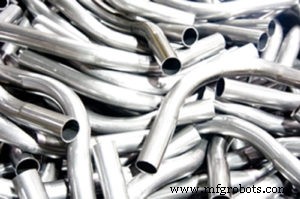
When you see a properly fabricated pipe, you probably don’t think much about how it got there. But, in fact, tube bending is a rich science — and there are several approaches to get the result you want. The method of tube bending you use will vary depending upon factors such as the quality of the metal you’re using, the planned function of the finished product and the resources you have at hand.
So what are the different types of tube bending?
Press Bending
The easiest and most common type of tube bending, this process involves pressing a “bend die” against the pipe to force it to conform to the shape of the bend. This is not a precision form of bending, because there can be some deformation of the pipe due to a lack of internal support.
Rotary Draw Bending
A more precise type of bending is rotary draw bending. This type of bending uses a rotary draw machine, which bends the metal through a series of die sets with a consistent center line radius. Rotary draw benders allow for more specific jobs and are used to bend tube and pipe for products like roll cages, hand rails and handles.
Roll Bending
Roll bending involves the use of a machine with three rollers, called a jig. It can be used to bend both sheet metal and metal bars. It works by putting the bar into the jig and manually lowering and pressing the middle roller against the bar. As the rollers are rotated, the bar moves along and force is applied to the bar as it goes back and forth along the rollers until it reaches the desired shape.
Roll bending can be good for circular fabrications, such as wheel rims.
Mandrel Functions
A Mandrel is less a method of tube bending and more an aid to tube bending. As a piece of tube is bent, the external wall of the tube necessarily thins. This comes with a tightening of the bend radius and an increased chance of a flattened bend. To counter this, a device called a mandrel is sometimes put inside the tube at the point of the bend. This offers support and increases the chance of getting the desired shape when bending.
Wiper Dies
Mandrels help when the external wall thinning becomes a problem, but in extreme situations, like when a thin tube needs a tight bend, a wiper die may be needed. The wiper is inserted into the grove between the tube and the bending die to prevent a wrinkle defect due to uneven internal wall compression.
If you have a metal fabrication job that requires tube bending, we have the ideal solution. Fairlawn is one of the few companies in the United States with a Crippa Tube Bending Machine — a state-of-the-art tube bender that features multiple, fully automatic bending cycles.
For tube bending and all your metal fabrication needs, contact Fairlawn Tool, Inc. today!
Industrial Technology
- The Ultimate Guide to Nail Types: Understanding Every Variety
- The Four Core Types of Steel Explained
- Types of Maintenance Workers: Roles, Responsibilities, and Collar Color Explained
- Tube Bending Mastery: Techniques, Applications, & Industry Standards
- Types of Sandblasting Media: Choosing the Right Material for Your Project
- Understanding the Various Roles of Factory Workers
- A Comprehensive Guide to Propane Fittings: Types, Uses, and Safety
- Cereal Crops Explained: Rice, Wheat, and Corn – The Backbone of Global Food Supply
- Exploring the Various Welding Techniques: Types and Applications
- Understanding the Various Types of Prototyping: A Guide for Founders