



Pelican Flashlights: A Trusted Solution to Prevent Industrial Fire Hazards
In industrial plants that produce flammable fumes and dust—from oil refineries to metalworking foundries and grain mills—everyday items as seemingly innocuous as flashlights can turn deadly.
Using the energy from a battery to power up a bulb in a standard light can generate enough heat to spark an explosion in such settings, U.S. regulators warn.
To reduce the risk, safety experts have crafted detailed guidelines on portable illumination that consider factors including the types of material in a workspace, whether there’s enough of it to pose an explosion risk and what temperature could set it off.
Building flashlights that meet those standards isn’t cheap, however, and obtaining the required certifications is time-consuming and arduous. That’s where Pelican Products, a leader in the specialized field of advanced portable lighting tools, comes in.
The Torrance, California-based firm traces its roots to 1976, when founder Dave Parker, a scuba-diving enthusiast, fashioned an underwater marker buoy for divers that he dubbed the “Pelican Float.”
Brighter Is Better
The business went on to produce protective cases for divers to store first-aid kits and other valuables, temperature-controlled packaging and lighting equipment for markets including industrial firms and emergency and military personnel.
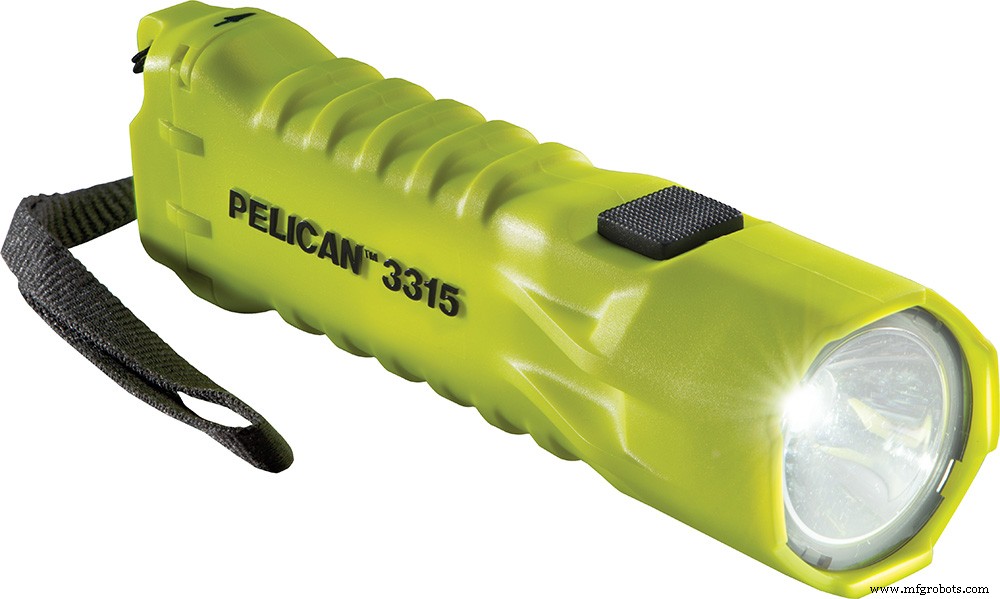 Pelican Products flashlight (Model No. 3315)
Often, when buyers think of safety lights, they imagine two or three products, but Pelican offers an array of them, says channel marketing specialist Jom Thaipejr.
There are small penlights that a firefighter or construction worker could fit in a vest, handheld devices, head lamps and even flashlights with articulating beams, he adds.
Choosing the right device and the correct safety classification under the National Electrical Code is similar to selecting the appropriate personal protective equipment, says Kim Fry, director of sales for national accounts at Pelican.
Users and safety directors must consider the location where the flashlight will be used and what hazards are present, then decide which model will provide sufficient illumination with the appropriate level of safety certification.
The company provides training to both distributors and end users on how to choose what they need, and its products come with a lifetime warranty.
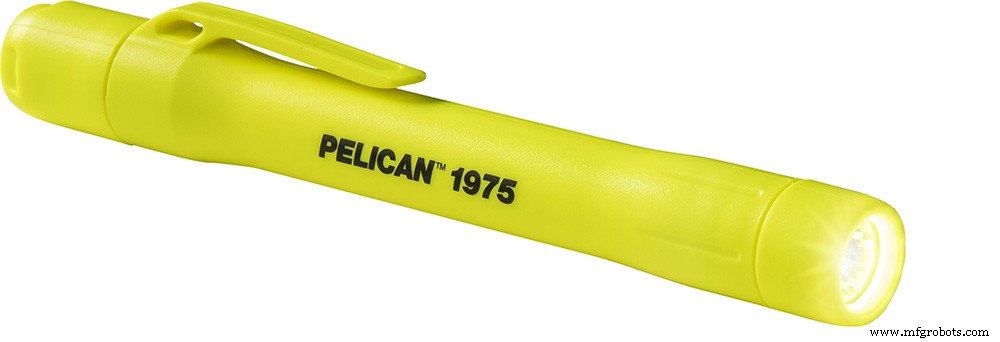 Pelican Products penlight (Model No. 1975)
A top priority for customers is typically brightness, Fry says—a trend she refers to as a “race to the lumens”—with buyers wanting the most illumination they can get from a device that’s still safe for the environment where it will be used.
“They’re going to want to make sure they have the right flashlight, because if they go into an area that’s flammable or combustible with the wrong one and turn it on, then it could cause an explosion,” she says.
Flashlight Safety Categories
Not only do explosions threaten employee life and health and destroy valuable company property, but they also may lead to large fines from the U.S. Occupational Safety and Health Administration.
As of this year, the agency may levy penalties of up to $14,502 per count for serious violations of its standards and up to $145,027 per count for willful or repeated violations.
In the early 2000s, OSHA issued a bulletin examining industrial explosions since the early 1970s that led to nearly 70 deaths at sites from a foundry to a pharmaceutical plant and grain elevators.
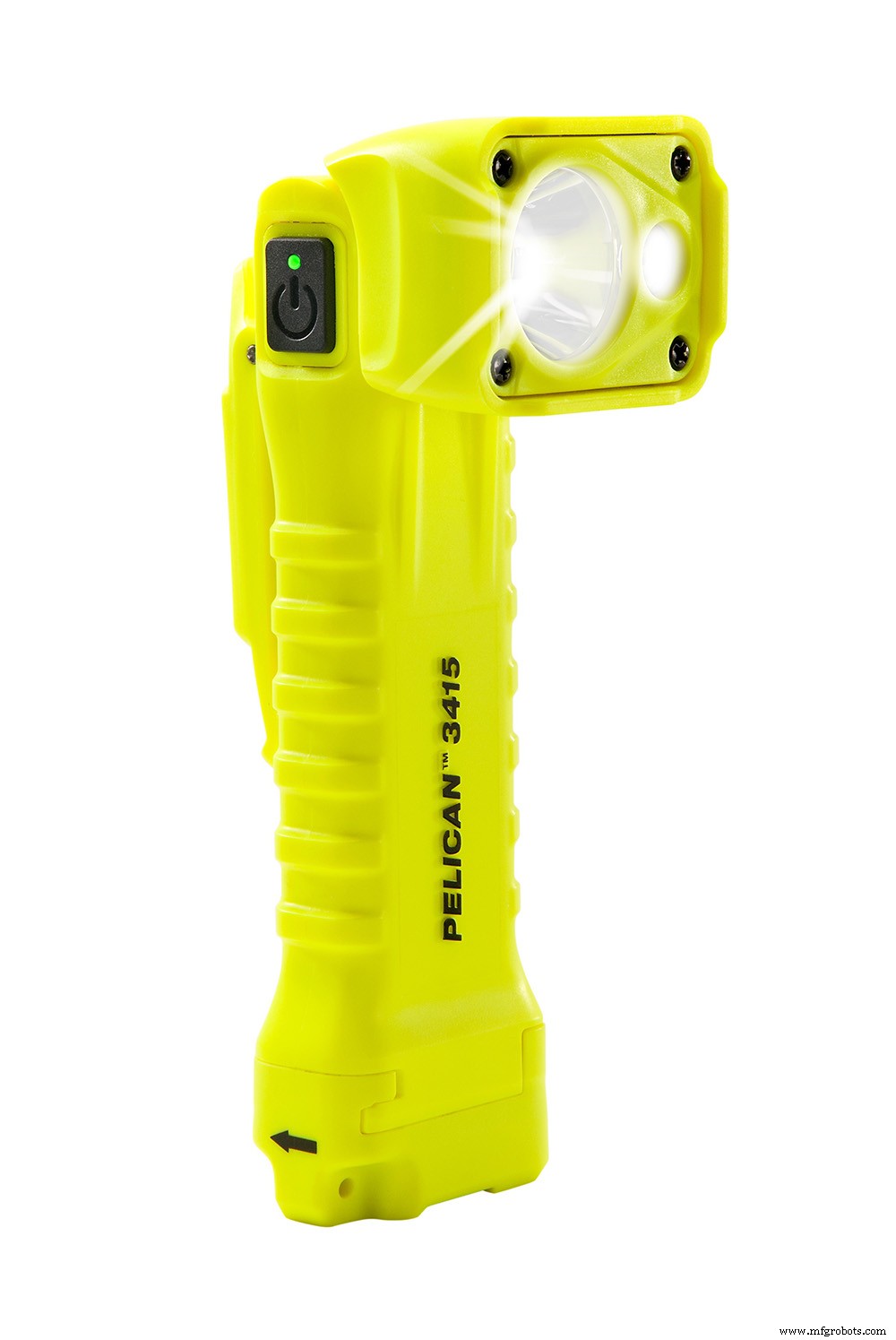 Pelican Products articulating flashlight (Model No. 3415)
All were attributed to clouds of combustible dust, though in several cases the cause of the dust igniting wasn’t known, underscoring the importance of keeping any potentially hazardous heat source away from such environments.
It’s a responsibility covered in both the General Duty clause of the Occupational Safety and Health Act, which requires employers to provide a workplace free of hazards that are known to cause, or likely to cause, death or serious harm, and OSHA standards on fire prevention.
The risk of serious harm is why all equipment used in hazardous locations must be tested and approved as safe to operate, Scott Jones, Pelican’s director of lighting product management, wrote in a white paper on the topic. “As a potential source of ignition, flashlights are held to strict guidelines for these conditions.”
Industrial combustion risks are categorized in Articles 500 through 506 of the National Electrical Code, published by the National Fire Protection Association, based on class, division, group and ignition temperature, he wrote.
- Class covers the physical properties of the potentially hazardous materials.
- Class I: Flammable gases, vapors or liquids (e.g., gasoline)
- Class II: Combustible dusts (e.g., metallic dusts, sugar, cornstarch)
- Class III: Ignitable fibers (e.g., rayon, cotton, sawdust)
- Division gauges the concentration of hazardous materials.
- Division 1, or Hazard Likely: A large enough concentration to ignite is present under normal operating conditions
- Division 2, or Hazard Not Likely: A large enough concentration to ignite is only present in abnormal conditions
- Group divides materials by their flammability or explosive characteristics. Class I has four groups, from A through D, and Class II has three, from E through G. Class III materials aren’t categorized by group.
- Ignition temperature, which rates the maximum surface temperature permissible on equipment carried into hazardous areas.
- T1: 450 degrees Celsius (842 degrees Fahrenheit)
- T2: 300 degrees Celsius (572 degrees Fahrenheit)
- T3: 200 degrees Celsius (392 degrees Fahrenheit)
- T4: 135 degrees Celsius (275 degrees Fahrenheit)
- T5: 100 degrees Celsius (212 degrees Fahrenheit)
- T6: 85 degrees Celsius (185 degrees Fahrenheit)
Pelican stands out from its competitors partly because the company makes flashlights deemed intrinsically safe for all three classes, Fry notes.
“Not every flashlight manufacturer has intrinsically safe lights because they’re expensive to make and they’re hard to get certified,” she says. While Pelican’s are among the more expensive options on the market, “we’re providing a premium product that’s going to have a lifetime warranty, and we’re always trying to add upward features that customers really want.”
Which work areas at your business require intrinsically safe flashlights? Tell us in the comments below.
Industrial Technology
- Designing an HACCP Plan: Safeguarding Food Safety and Avoiding Recalls
- Eliminate Condensation in Industrial Air Compressors with Air Dryers
- 8 Common Pitfalls of Service Technicians and Proven Strategies to Avoid Them
- How Tracking Software Enhances Worker Safety and Prevents Fines
- Expert Strategies for Eliminating Non-Wetting Defects in PCB Production
- Preventing Poor Solder Wetting: Proven Techniques for Reliable Joints
- Eliminate Void Defects in Solder Joints: Expert Prevention Guide
- Avoiding Machine Guarding Pitfalls: Safety Tips & Prevention Strategies
- Effective Strategies for Managing Warehouse Safety Hazards
- Industrial Safety Management: Ensuring a Secure and Efficient Workplace