



Li‑Fi Explained: History, Advantages Over Wi‑Fi, and Real‑World Applications
What is Li-Fi?
Li-Fi (also known as light fidelity) is a technology for the wireless transmission of data between devices Li-Fi uses light as a medium for transmission of data. LED lamps are the source used for encoding data by switching the light on and off during regular intervals to create a binary code. This is transmitted to the other end where the receiver decides it. Li-Fi has a huge potential in data transmission since it uses simple LED bulbs to transmit data.
Components of a Li-Fi System:
A Li-Fi system had two main components.
1: A transmitter (most likely a LED lamp)
2: A receiver (used to decode the received data)
History of Li-Fi Technology:
The term Li-Fi was first coined by the University of Edinburgh, however, this technology was first introduced by Herald Has, a German professor, and physicist. He introduced and demonstrated it at a TED talk in July 2011. He believed light bulbs could act as wireless routers for Data transmission. His demonstration showed how changes in the amplitude of a light bulb at high speeds can be used for energy transmission. He demonstrated the use of LED for the transmission of a high definition video and then showed the same video to the audience. He also formed a company later on by the name of pureLiFi. Since then the use of this wireless technology has increased, now being deployed in more than 20 countries.
Li-Fi VS. Wi-Fi:
Li-Fi and Wi-Fi are both used for wireless communication and transmission of data. However, they differ in the medium used. Wi-Fi, for example, uses radio waves transmitted over modems whereas on the other hand Li-Fi uses visible light from LED bulbs for transmission and receiving of data.
How it works:
Li-Fi is a VLC (visible light communication) system. It uses a photo Detector (photodiode) to detect incoming signals and decode the data received into digital form. The LED light bulb uses a fast alternating stream of dim and bright signals that are invisible to the human eye.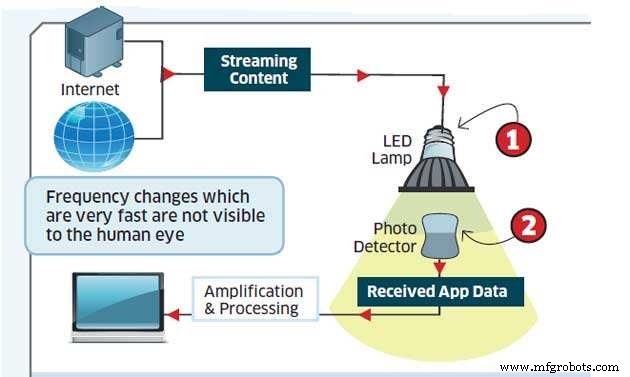
First, data is fed to the LED bulb. The bulb operates on signal processing technology so it is capable of sending the data in an embedded format high rapid speeds to the Detector which in this case is the photodiode. The photodiode then converts the incoming beam of light into electrical signals. The electrical signals are then converted into streamable data.
Advantages of Li-Fi Technology:
- High speed: Li-Fi technology is much faster as compared to Wi-Fi technology. It has the capability to transmit data up to 100 Mbps or 1 Gbps. This means you can download a high-definition video in seconds.
- Higher capacity: Li-Fi can help in keeping up with the demand if wireless data networking. After all the increase in radio frequency spectrum occupancy has limited the capacity of data transmission. This is why Li-Fi could lead to new opportunities and a higher capacity of data transmission as compared to Wi-Fi. The visible spectrum used in the transmission of data is much greater than the radio waves spectrum, therefore, it has a greater capacity.
- Better security: radio waves are penetrable and can be intercepted by unwanted people. On the other hand, Li-Fi is much more secure as the signals are confined to the same room and cannot be intercepted easily.
- More efficient: Since the Li-Fi systems use LED lights which are already installed in majors of our homes and commercial areas, therefore, is an efficient use of energy as compared to Wi-Fi.
- Free from Interference: Wi-Fi networking faces problems of neighboring network interference or radio interference whereas Li-Fi is free from all types of interferences that could affect Wi-Fi system and are therefore more efficient for use.
Disadvantages of Li-Fi Technology:
- Can only work on light source: Li-Fi C only function If the light source provided is continuous and uninterrupted. You can dim the light but never shut it off. It cannot, therefore, function without a continuous light source.
- A range is limited: as discussed before long, Li-Fi is more secure as it is limited to the area of transmission. This might be an advantage but it also limits the range for Li-Fi to work in.
Applications of Li-Fi Technology:
There are numerous applications of Li-Fi in use today and are increasing day by day. Here we will discuss a few of these applications.
1: Use in Military:
Li-Fi is perfect for use in military bases. This is because of the confinement of the data transmitted to a small area which cannot be penetrated by outside sources. Also, it does not require any complex infrastructure for its application and is simple to use.
2: Use in Traffic Lights:
Li-Fi can be used in traffic lights to update drivers on weather conditions and traffic information so they can have a smooth journey on the road. Especially useful for sending critical information.
3: Use in Underwater Communication:
Wi-Fi, as we know, uses radio waves which are not suitable for use underwater. Li-Fi can, however, be used for underwater communication as light cab penetrate water easily. This will help to make underwater communication much easier.
4: Use in AR:
AR is being used at a greater rate than before. They are used in institutions for better customer service. The Use of Wi-Fi in such cases is problematic as it can lag with more customers connected to it. On the other hand, Li-Fi is much faster and can lead to uninterrupted AR transmission. Another advantage is that the light used is already illuminating the institution. Once again, an efficient use of energy.
5: Use in Urban Areas:
Urban areas are already using large quantities of LED bulbs and light sources. The Use if Li-Fi here is therefore very useful. This will not only connect more users in urban areas but will provide fast data to its customers.
The Uses of Li-Fi are endless. As of now, more than 20 countries are using LI-FI technology. Worldwide use of this alternative to Wi-Fi could prove to be revolutionary in the future.
Industrial Technology
- Shift Registers: Fundamentals, Applications, and Design Variants
- Ultra‑Wideband (UWB) Technology: A Modern Wireless Standard for High‑Speed, Secure Short‑Range Connectivity
- Top 12 Data Science Applications Shaping 2021
- Revolutionizing Data Storage: Next‑Generation Magnetic Nanostructures with Invisibility Cloaks
- Navigating IT Challenges in Modern Manufacturing: Strategies for Digital Transformation
- Photochemical Machining: A Comprehensive Guide to History, Process, and Applications
- Artificial Intelligence: Evolution, History, and Real-World Applications
- The Evolution of Stereolithography: From Inception to Modern 3D Printing
- Harnessing Digital Twin Technology to Boost Manufacturing Efficiency and Cost Savings
- CNC Machining: A Comprehensive Overview of its Evolution and Precision Power