



C Programming Language: Fundamentals, History, and Applications
Welcome to a comprehensive guide on the C programming language—its origins, core concepts, and why it remains a cornerstone of modern software development.
What is C?
C is a versatile, general‑purpose programming language renowned for its simplicity, performance, and portability. Developed in the early 1970s, C introduced structured programming and remains the backbone for building operating systems, compilers, embedded systems, and high‑performance applications.
C’s design abstracts machine architecture while keeping low‑level control, making it ideal for systems programming, device drivers, and real‑time applications. Its influence is evident in languages like C++, Java, and Python, all of which borrow core concepts from C.
History of C
The lineage of C traces back to ALGOL (1960), a pioneer in structured programming. In 1967, BCPL (Basic Combined Programming Language) by Martin Richards introduced a compact syntax suitable for system software. Three years later, Ken Thompson’s B language emerged at AT&T Bell Labs, blending BCPL’s features with UNIX system needs.
In 1972, Dennis Ritchie formalized C at Bell Labs, integrating concepts from ALGOL, BCPL, and B. C quickly became the language of choice for UNIX—most of the operating system was written in C—and subsequently spread across platforms.
To standardize the language, ANSI defined ANSI C in 1989, followed by ISO 9899:1990. These standards ensured portability and consistency across compilers, earning C the moniker "ANSI C." The language has evolved through several revisions—C90, C99, C11, and C17—each adding safety, concurrency, and library enhancements.
C Basic Commands
The following table outlines essential syntax elements that form the foundation of any C program:
| C Statement | Description |
|---|---|
#include <stdio.h> | Includes the Standard Input/Output header before compilation. |
int main() | Entry point of a C program. |
{ ... } | Delimits the body of a function. |
/* comment */ | Multi‑line comment ignored by the compiler. |
printf("Hello, World!"); | Outputs text to the console. |
getch(); | Waits for a single character input (non‑standard; provided by conio.h). |
return 0; | Terminates main, signaling successful execution. |
Key Applications of C
- Embedded systems and microcontroller firmware.
- System and kernel development (e.g., Linux, Windows).
- Desktop applications and graphical tools.
- Adobe Creative Cloud applications and game engines.
- Web browsers—Chromium is written in C++ with extensive C code.
- Databases—MySQL, PostgreSQL, and SQLite rely heavily on C.
- Mobile OS kernels (Android’s Linux kernel).
- Compiler front‑ends and language runtimes.
- Internet of Things (IoT) firmware and sensors.
Why Learn C?
Mastering C provides a solid foundation for understanding how software interacts with hardware. Key benefits include:
- Transferable concepts—data types, pointers, control flow—found in modern languages.
- Performance—compiled code runs directly on the processor, enabling high‑speed applications.
- Modularity—functions and modules simplify testing, maintenance, and debugging.
- Extensibility—libraries can be expanded with custom functions.
- Portability—ANSI/ISO standards allow code to compile on diverse platforms.
- Career opportunities—developers skilled in C are in demand for embedded, systems, and performance‑critical roles.
How C Works: Compilation and Linking
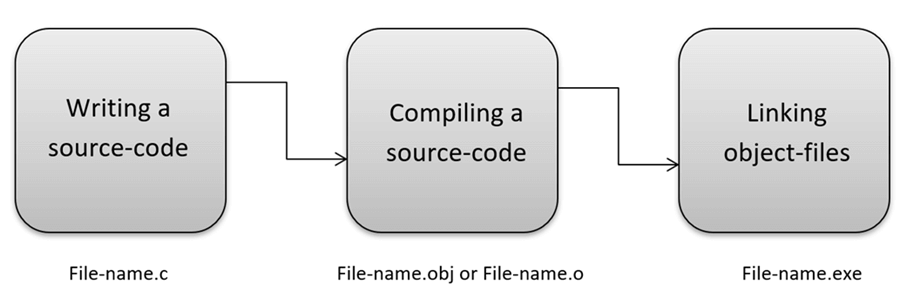
C is a compiled language. The build process consists of two main steps:
- Compilation—the source file (
.c) is translated into an object file (.o) that contains machine code but is not yet executable. - Linking—the linker combines one or more object files and libraries into a single executable (
.exeor binary).
The diagram below illustrates the typical flow from source code to running program.
Numerous compilers are available—both offline and online. Popular choices include:
- Clang (LLVM compiler)
- MinGW (Minimalist GNU for Windows)
- Portable C compiler (cross‑platform)
- Turbo C (classic DOS‑based compiler)
Summary
- C was introduced by Dennis Ritchie in 1972.
- It remains a robust, low‑level language close to hardware.
- ANSI C (1989) and ISO C (1990) established industry standards.
- Its procedural and structured nature supports modular design.
- Comprehensive OS and hardware support ensures portability.
- Compilers transform source into object files; linkers produce executables.
- C’s portability and performance make it ideal for diverse applications.
C Language
- Top 10 Cloud Programming Languages Every Developer Should Master
- Microprocessor Programming Fundamentals
- What Is VHDL? A Practical Guide to Hardware Description Language
- C++ Programming Basics: What Is C++ and Why It Matters
- Pointers in C: A Comprehensive Guide to Types, Usage, and Best Practices
- Master C Programming: Comprehensive PDF Tutorial for Beginners
- Python vs. Go: Which Language Wins for Your Project?
- Understanding Grinding Wheels: Key Components and Applications
- Raspberry Pi Programming: Which Languages Are Supported? A Complete Guide
- Osai GTL: Advanced High-Level Geometric Programming for CNC