



What Is VHDL? A Practical Guide to Hardware Description Language
VHDL (VHSIC Hardware Description Language) is a specialized computer language used to model, design, and verify digital integrated circuits. Unlike general‑purpose programming languages such as Java or C++, VHDL is not intended for building software applications; instead, it describes the structure and behavior of electronic hardware.
VHDL is event‑driven and supports parallel execution, making it ideal for capturing the simultaneous operations that occur inside a processor or other digital logic. Because of this, VHDL can be used to specify the logic that ultimately becomes a CPU, an FPGA, or an ASIC.
Access the Basic VHDL Tutorials series here!
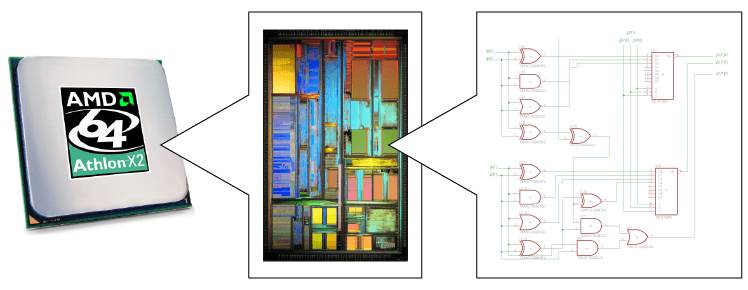
Consider the illustration above. Inside a CPU chip, numerous digital circuits (shown in the middle) perform arithmetic, control, and data‑movement tasks. These circuits are typically represented as a schematic diagram (right). However, the first step in creating an integrated circuit is to define the logical circuit diagram in a textual format—enter VHDL.
Synthesis
Rather than drawing every gate manually, engineers write VHDL to describe the desired behavior of a circuit. A synthesis tool then transforms that behavioral description into a concrete netlist—a gate‑level representation of the circuit. This process, called synthesis, bridges the gap between abstract design and physical implementation.
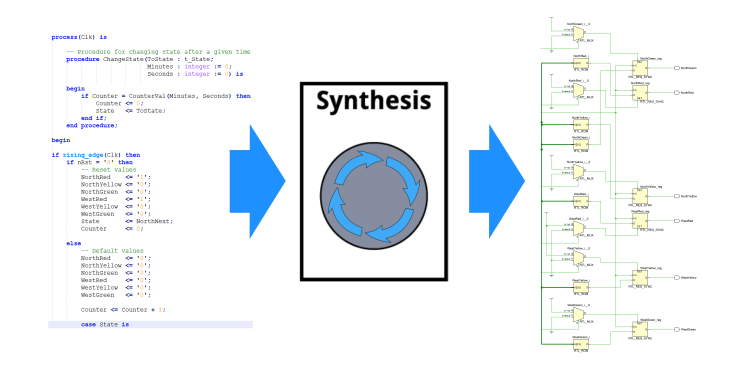
Successful synthesis yields a netlist that can be inspected in a schematic editor, providing a visual map of the gates and interconnections.
Place and Route
While the netlist defines the logical connectivity, it does not specify where components will reside on a silicon chip or an FPGA fabric. The place‑and‑route (PAR) stage addresses this by allocating netlist elements to physical resources on the target device and routing the connections between them. This is essentially a large optimization puzzle that the PAR tool solves automatically.
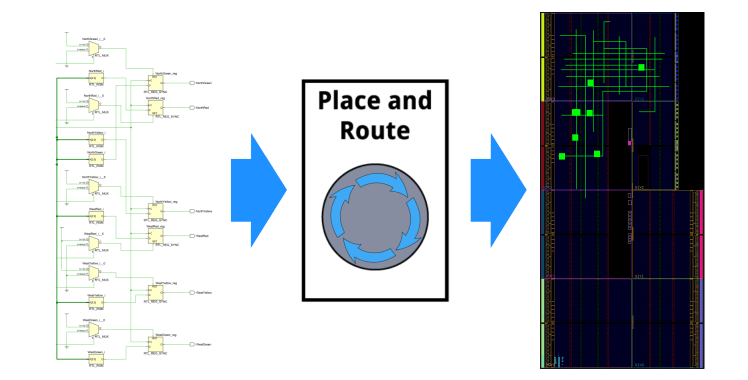
After successful PAR, the resulting netlist contains placement and routing data tailored to the specific device. For FPGAs, this netlist can be compiled into a configuration bitstream. For ASICs, the netlist feeds into further manufacturing steps.
In Summary
VHDL is a powerful, specialized programming language that allows engineers to describe, analyze, and generate digital logic for integrated circuits. By mastering VHDL, you can design everything from simple logic gates to complex CPUs and high‑performance FPGAs.
Take the basic VHDL tutorials here >>
VHDL
- Understanding the Oxygen (O2) Sensor: Role, Placement, and Failure Signs
- Understanding AS9100: The Aerospace Quality Management Standard
- What Is A2 Steel? A Versatile, Cost‑Effective Tool‑Steel Grade for Industrial and Woodworking Applications
- C Programming Language: Fundamentals, History, and Applications
- Java Explained: Definition, Features, Platform Overview & Versions
- Python vs. Go: Which Language Wins for Your Project?
- C Programming Language: A Comprehensive Overview
- C#: A Comprehensive Overview of Microsoft's Modern Programming Language
- Understanding Metal Casting: Process, Benefits, and Applications
- Demystifying 3D Printing: A Clear Guide for Innovators