



Understanding Carbon Film Resistors: Basics, Types, and Applications
Fixed or variable Resistors have been in existence since their invention. Often, they function to resist current flow in circuits. There are several resistor types made of different features.
Today’s text will focus on carbon film resistors and the essential information you need concerning them.
What is a Carbon-film Resistor?
A carbon-film resistor, also known as a thermal decomposition carbon film resistor, falls under fixed value resistor types. Further, the carbon film is of resistive material, enhancing the resistor’s durability by restricting electric current levels.
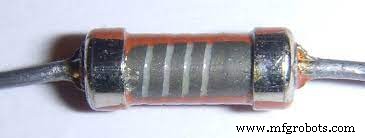
A carbon film resistor
Source: Wikimedia Commons
The Structure and Characteristics of Carbon Film Resistors
Structure and construction
Ceramic core/substrate
Lead
Nickel cap
Carbon film
Protective lacquer/coat
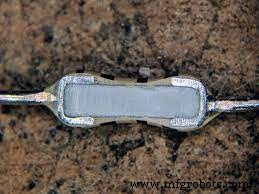
Structure of a carbon film resistor
A carbon film resistor goes through a deposition process in its construction. The process is as follows;
- A hydrocarbon gas holds in a ceramic carrier or ceramic rod at high pressure and high temperature. Often, when gases (like benzene or methane) get to 1000°C, manufacturing machines shatter them.
- Then, the now crystalline carbon settles on a ceramic substrate as deposits.
The final product is a structure of a carbon resistor with the following parts;
- Ceramic core/mold – provides insulation against electricity or high temperatures,
- Lead,
- Carbon film that restricts current flow,
- Nickel cap, and
- Epoxy layer/lacquer – for protection.
Other structures that promote its functionality include;
- First and foremost, the increased length and decreased width enhance the efficacy of the resistors.
- As for better conductivity, there’s copper material as connecting leads held between metallic ends.
- Then, a helical form of carbon sheets provides a precise resistance of the resistor. Decreasing or increasing the length of the helical path adjusts the resistance value.
- Lastly, the carbon coating ensures the resistor bears electricity without getting damaged.
How the carbon film layer restricts electron flow
The restriction is dependent on the width of your carbon film layer. A thin-layered film means a high resistance value as it provides less space for the movement of free electrons. And vice versa with a thick-layered film.
Characteristics
The following list denotes the characteristics of a carbon film resistor.
- The value resistance range is from ˂1Ω to 10MΩ.
- Maximum noise (µV/V) is 20, with a noise electromotive force below 10µV/V.
- Nominal resistance is E-48 and, resistance ranges from 1 ohm to 10 megaohm
- High accuracy from 2% to 5%. You can adjust the accuracy to construct a precision resistor by cutting the film’s thread.
- Voltage coefficient (%/V) of 0.0005
- Typical tolerance availability of ±2%, ±5%, ±10%, ±20%
- The maximum resistor temperature (°C) is 150
- Negative temperature coefficient of resistivity
- Rated power comprises 1/8W, 1/4W, 1/2W, 1W, 2W, 5W, and 10W at 70°C.
- Temperature coefficient (ppm/°C) ranges from ±200 to ˃±1500
- Carbon film resistors have high-frequency characteristics. For that reason, you can transform them into high-frequency resistors and ultra-high-frequency resistors.
- Their packaging method involves bulk bulking or bagging.
- Finally, it has a stable pulse load and can adapt faster to pulses. Thus, its application can suit pulse, DC, and AC circuits.
Pros and Cons of the Carbon Film Resistor
Some of its advantages are as listed below;
- A carbon film resistor produces less noise compared to a carbon composition resistor.
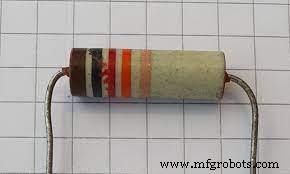
A carbon composition resistor
- Secondly, it has a low tolerance.
- It has excellent long-term stability.
- Also, it has a wide range of operations.
- Then, it can withstand high-energy pulses.
- Again, it is cost-effective in terms of manufacturing.
- Lastly, the entire carbon resistor body conducts energy when you run a current through it.
Disadvantages of carbon film are;
- First, when compared to metal oxide and metal films, it has a significantly lower resistance range.
- Then, it has a high negative temperature co-efficient of its resistance. Consequently, as there’s an increase in temperature, the resistance value reduces.
Carbon Film Vs Metal Film
Metal film and carbon film resistors differ in many ways. Hence, depending on your need, you’ll settle for the best option from the discussion below.
Construction
Technologists make carbon film resistors by first separating the carbon from a high-temperature vacuum. Next, they attach the carbon film tight on a porcelain rod surface. Finally, they use epoxy resin to coat the surface for extra protection.
Metal film resistors, on the other hand, have alloy vacuum plating technology. Here, there’s a deposition of films on the surface of porcelain rods (white). Afterward, carbon film resistor manufacturers cut the rod to adjust the resistance values.
Size
First of all, a carbon film resistor has a larger size compared to a metal film resistor.
Noise design
Then, carbon film resistors have a slightly higher noise design compared to metal film resistors. Nonetheless, you can use them in high-frequency and radio frequency applications.
Voltage and temperature coefficient
A voltage coefficient is the ratio of change in the circuit’s resistance to change in its voltage. Here, a metal film resistor has a better temperature and voltage coefficient than a carbon film resistor. Even though both can withstand a massive temperature, metal films have better chances in a wide resistance range.
Tolerance
A is 2% at a minimum. Conversely, a metal film resistor can go up to a 0.5% low intolerance level.
Appearance
Both resistors have color bands but differ in appearance.
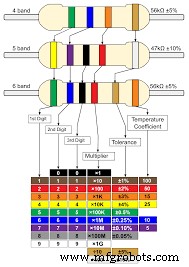
Color code guidance
A carbon film resistor consists of four-color rings (5%) that are khaki or other colors.
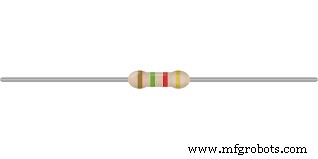
A carbon film resistor
On the other hand, metal film resistors have five color rings (1%) blue.

A metal film resistor
- Factors for the increase of carbon film resistor resistance
Many reasons can cause the resistance value of carbon film resistors to increase as follows;
- First, a bad quality carbon paste equates to increased resistance.
- A carbon film that is porous/reflowed
Several mobile ions such as Ca, Na, and K degrade the protective coating of the resistor, making them inefficient. Also, a defective film can increase resistance.
- Oxidation
An oxidation process often begins from the resistor surface moving inwards to cause an increase in resistance value. The long-term damage becomes accelerated with thinner resistance film, coatings with organic material (resins or plastics), and environmental conditions.
Gas desorption and adsorption
If you directly use your carbon film resistor under usual environmental conditions, it will adsorb some gas. It’s majorly because of an increase in air pressure from the constructing vacuum. In turn, that’ll increase the resistance value.
How you can manually increase the Resistance value
Increase the value by scraping off the paint film on the resistor’s surface until you expose the carbon film. In the process, keep track of the resistance by measuring till you reach the desired value.
At most, you have an added value within 20% of your original resistance value. Ensure it doesn’t surpass 20% since the higher value will affect the resistor’s resistance stability.
Applications of the Carbon Film Resistor
Carbon film resistor applications are in devices that can survive high voltage (15kV) and high temperature (up to 350°C). Examples;
- High voltage power supplies,
- Lasers,
- Medical defibrillators,
- Hospital equipment that needs shielding from high-energy pulses,
- Manual installations and maintenance,
- RADAR, and

(radar)
- X-rays.
Conclusion
To conclude, due to the effectiveness of carbon film resistors, they have gained many operations. For instance, you’ll find them in applications that involve information products, electric appliances, and electrons. Not only are they cheap, but they also have better stability and are highly reliable.
Despite having a drawback in high negative temperature coefficient, it still serves electric circuits a great deal.
As we round up today’s post, we hope you’ve gathered much about carbon film resistors. However, if you still have a burning issue with the resistors, don’t hesitate to contact us. We’re ready to guide you.
Industrial Technology
- Mastering Digital Circuit Design: Your Complete Guide
- Essential Guide to Choosing the Right 9V Battery Holder
- Digital Buffers Explained: A Comprehensive Guide to Signal Isolation & Strength
- How to Build a Touch‑Activated Lamp: A Complete Guide
- Master PCB Laminates: The Definitive Guide for Engineers
- SL100 Transistor Explained: Design, Specs & Applications
- Distance Sensors Explained: Types, Uses, and How to Choose the Right One
- Transistor Types Explained: Your Complete Reference
- A Complete Guide to Filter Types in Signal Processing
- Sark 110 Antenna Analyzer: Full Feature Guide