



Cold Electricity Explained: A Comprehensive Guide to LC Circuit Fundamentals
Cold electricity is electricity generated through an opposing line of the LC network. The unconventional principle governing its production first ensures positive charge flow in the bar. Then, the flow develops a negative charge crossway and inductor. Finally, the electric charge passes on to the capacitor as ‘cold’ electric power.

A standard LC circuit
The term ‘cold’ implies that the electricity works in an open circuit with zero heat dissipation.
Today, we’ll learn how to use a simple circuit to produce cold electricity as a power source.
Analysis of Cold Electricity phenomenon
Now that we know about cold electricity let’s analyze the concept behind its production. We’ll use a circuit consisting of a 24V DC supply, SPDT switches, an inductor, and a high voltage capacitor.
You can shock the capacitor to release a radiant and huge electrostatic burst.
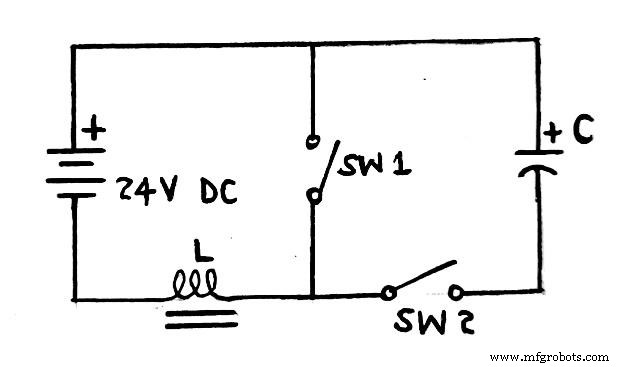
Circuit diagram on cold electricity
Circuit explanation
After immediately opening and closing the switches briskly together, the capacitor gets charged. Further, the capacitor voltage acquired becomes similar to the value of inductance back emf.
- L stands for 800 turns of the bifilar coil surrounding a ferrite core and is approximately 30 ohms.
- C holds a value of 30µF, 4000VDC.
Phase 1: Charging phase
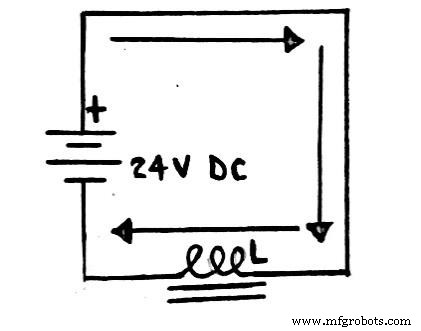
Charging phase circuit
The inductor stores energy in magnetic energy form if you have the switches closed as a standard rule. Consequently, the battery develops a high resistance then limits current consumption by the inductor.
Phase 2: Discharging phase
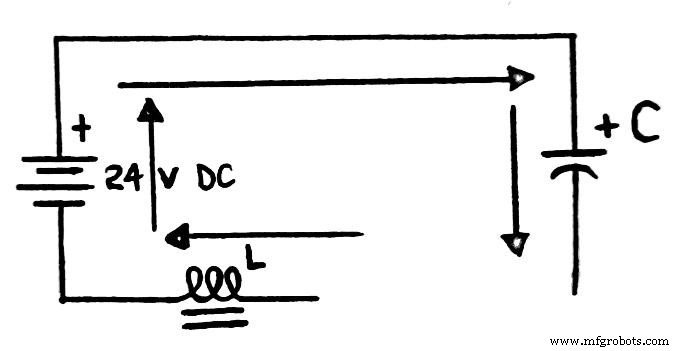
Discharging phase circuit,
However, the inductor releases a high voltage that charges the capacitor once you open the switches.
Cold Electricity Features
The idea of cold/radiant electricity, as Dr. Tesla founded it, adopts the following features;
- First, in terms of thermal conditions, it has a relation to negative dissipative energy.
- Then, it functions with over-unity/thermoelectric devices and often absorbs heat from the surrounding weather conditions (hence the name cold).
- Further, it does not have electron flow.
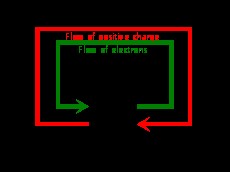
Electron flow in conventional electric current
- You can at times consider it as back-EMF since it flows backward and has a negative time.
- Also, if we have COP˃, it’ll relate to over-unity.
- Fourthly, we’re likely to have an occurrence of radiant energy in a ‘slow charge and instantaneous discharge’ process.
- Last but not least, radiant energy isn’t similar to conventional electric current.
How Does it Work?
From our discussion on the analysis, we have already seen the practical application of cold electricity and circuit functioning. But there are other concepts you need to know to understand how hard electricity works.
Saturation in Inductor Internal Energy
You might be wondering how the potential difference reaches the capacitor while having open switches. In addition, the capacitor isn’t charging up because the circuit makes no closed loop.
The above effect occurs because of the electrical current coming in contact with the open switch resistance. In the process, the inductance current keeps the resistance saturated.
Another explanation for the effect is the creation of a singularity situation.
A singularity situation occurs when you quickly open and close the switch. Its generation is due to non-interruption of the current as it moves across the inductor.
Further on, the inductor’s magnetic field crossway goes through a voltage magnification at the coil before shutting down afterward. Therefore, the capacitor receives charge from the magnified voltage while consuming no current from the battery.
Lastly, we have the Ferroresonance Effect.
Ferroresonance effect states that when the inductor core reaches saturation, the potential uses an unconventional negative path. As a result, it influences a positive charge which consequently prompts induction of a negative entropic field in an inductor. Subsequently, the process charges up the capacitor.
Differences Between Normal Electricity & Cold Electricity
The table below compares cold/ radiant energy and standard/ordinary electricity.
| Cold electricity | Normal electricity |
| It has heat absorption (in the generation of electricity). | It has heat dissipation. |
| It experiences implosion because of lower voltages and current. | Explosion. Due to the large voltage and current, it can kill. |
| It has a reverse/ negative entropy. | It has a positive entropy. |
| electro-radiant | electromagnetic. |
| endothermic | exothermic |
| It works with no current flow (0 Amps) | It operates through a flow of current. |
| It has a scalar/longitudinal electro-radiant Teslian wave. | It has a transversal electromagnetic Hertzian wave. |
| Lastly, most scientists see it as fringe science and impractical. | Often in textbooks and practical. |
Conclusion
To conclude, cold electricity is a form of electric energy with zero current flow (no electrons). Its electric inflow is evident at negative resistance. Its voltage can burn a filament bulb in a single wire even though it won’t show up in the meter.
Undoubtedly, there are several debates about whether we should adopt cold electricity to curb power outages. And so, if you’d like to share your views or make inquiries on the same, kindly contact us.
Industrial Technology
- AIaaS Demystified: The Definitive Guide to AI as a Service
- Master Maintenance Management: Boost Efficiency & Cut Costs
- Mastering Supply Chain Management: A Comprehensive Guide
- Your Comprehensive CMMS Buying Guide: Maximize Asset Performance
- Master CMMS: Comprehensive Guide Part 2 – Essential Features for Efficient Maintenance
- CMMS Fundamentals: The Ultimate Guide – Part 1
- The Ultimate CMMS Guide: Part 4 – Choosing the Right System for Your Organization
- Back to Basics: The Ultimate CMMS Guide – Part 3: Selecting Features for Successful Implementation
- Mastering LED Drivers: A Comprehensive Guide to Efficient Lighting
- Comprehensive Guide to CNC Machining: Techniques, Applications & Best Practices