



MQ-3 Gas Sensor: Comprehensive Guide to Alcohol Detection
Undeniably, no one can dispute the lifesaving changes gas sensors have contributed by detecting flammable, combustible, and hazardous gases. The gases detected are methane, CO, flammable gases, among others. An example is the MQ3 gas sensor alcohol sensor module. This article will discuss how MQ3 works, its alternatives, pinout, applications, and features.
What is MQ3?
MQ-3 module is a gas sensor that detects the presence of gases like carbon monoxide, hexane, LPG, methane, and alcohol. It is a Metal Oxide Semiconductor (MOS) sensor type that detects alcohol concentration when placed in a voltage divider network.
An Overview of the Hardware
- MQ-3 alcohol sensor is recommendable in a small breakout board since it isn’t compatible with a breadboard. Additionally, it has two different outputs and is easily usable. Its function is to provide a binary indication of alcohol presence and its analog concentration in clean air.
- The sensor (at analog pin) analog output voltage usually provides varying proportions of analog output voltage depending on alcohol concentration. Therefore, a high alcohol concentration in clear air equals a high output voltage and vice versa.
- Later, a comparator such as the LM393 high precision comparator receives the same analog signal. Then, it avails the signal at the digital output (DO) pin.
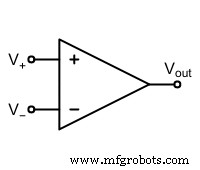
Comparator symbol
- The hardware module has an inbuilt potentiometer that adjusts the DO sensitivity. In addition, it helps in setting the threshold whereby alcohol concentration exceeding the threshold value has a low output.
- Last but not least, the hardware MQ-3 module has two LEDs, power and status LED. The status LED lights up when there’s a low digital output, while the power LED lights up when you power the module.
How Does the MQ-3 Sensor Work?
MQ3 works as explained below.
To begin with, when you heat the tin dioxide (SnO2) semiconductor layer at high temperatures, the surface will absorb oxygen.
Next, (in clear air) oxygen molecules will attract electrons from the conduction band in tin dioxide.
Consequently, an electron depletion layer will form beneath the surface of SnO2 molecules and create a potential barrier. As such, the SnO2 film prevents the flow of electric current because of being highly resistive.
However, when present alcohol reacts with adsorbed oxygen, the surface density of the oxygen reduces. As a result, the potential barrier also diminishes. The tin dioxide then receives electrons, thus allowing the free flow of current through the sensor.
In short, more alcohol consecration lowers the analog resistance, thereby increasing the voltage reading.
Pin Description
The two major categories of MQ-3 pinout is as follows;
For MQ-3 Sensor Module
GND – The ground pin connects the module to the system’s ground.
Analog out (AO)/ Aout pin outputs an analog voltage ranging from 0-5V depending on gas intensity.
VCC – The Vcc pin is the power supply to the module and provides an operating voltage of +5V.
Digital out (DO) – After using a potentiometer to set a threshold value, you can use the DO pin to get the output voltage.
For MQ-3 Sensor
H-pins – There are two H pins whereby you’ll connect one to the ground and the other to supply.
A-pins – You ought to tie the A pins to supply voltage.
B-pins – Note that B-pins and A-pins are interchangeable. Hence, one of the pins can connect to the ground while the other acts as output.
- Feature
We will now give an insight into the features and specifications of the MQ-3 sensor.
Features of MQ-3 Alcohol Sensor
- First, its sensor type is a semiconductor.
- Then, it requires a simple drive circuit to operate.
- Thirdly, it is often in a low-power standby mode.
- Besides its longevity, MQ-3 is also cheap.
- Also, it has high/good sensitivity to alcohol gas and fast response.
- It has an easy SIP header interface that assists in its compatibility with most microcontrollers.
- Finally, it requires heater voltage.
Specifications of MQ-3 Gas Sensor
- Its operating temperature ranges from -10°C to 50°C (14°F to 122°F).
- Secondly, its power requirement is 5 VDC at 60mA (heater off) and 165mA (heater on).
- Further, it has a load resistance of 200kΩ.
- It has a sensitivity (S) as Rs (in air) / Rs (0.4mg/L Alcohol) ≥5. Thus, it can detect a concentration of 0.05 – 10mg/L alcohol.
- It has a preheat time of over 24 hours and a concentration scope ranging from 25 to 500 ppm of alcohol.
- Also, its interfaces include one TTL-compatible output (ALR) and one TTL-compatible input (HSW).
- Its Digital output pin outputs a TTL digital of 0 and 1 (0.1 and 5V). Contrarily, the value of its AO output is 0.1-0.3V, with a maximum voltage concentration approximating 4V (relative to pollution).
- Moreover, its sensing resistance (Rs) ranges between 2kΩ-20kΩ (in 0.4mg/L alcohol).
- Its current consumption is 150mA, whereas its heater consumption is less than 750mW.
- Lastly, it has a 32 × 22 × 16 mm.
MQ-3 Equivalent Sensors
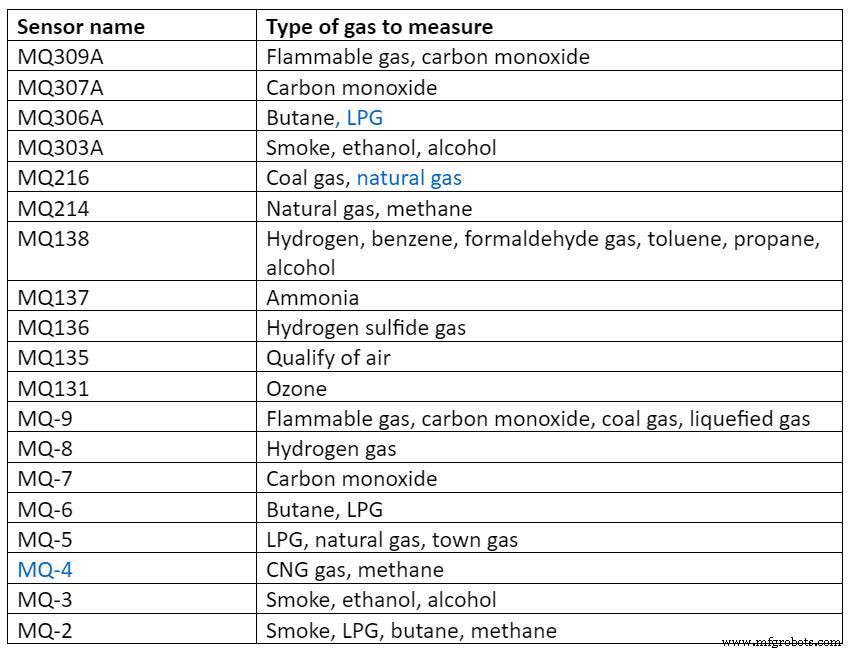
Some MQ-3 equivalent sensors in the market are MQ303A, MQ214, and MQ-2.
Alternatively, you can use the table below to determine which sensor you’ll settle for depending on the gas type.
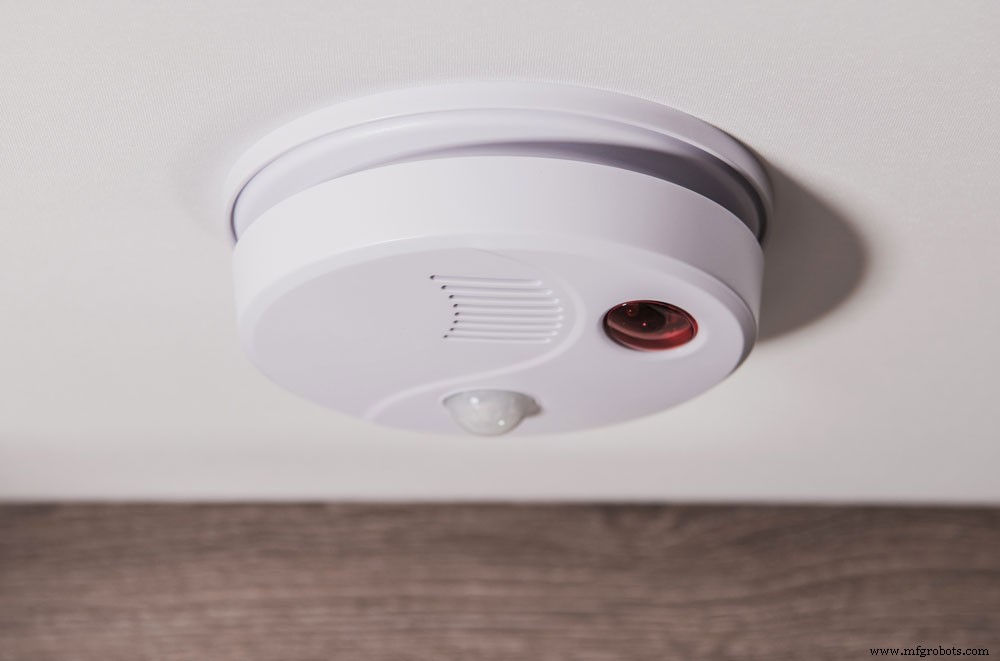
(carbon monoxide detector)
Applications of MQ-3 Gas Sensor
include;
- Environmental monitoring equipment,
- A common breathalyzer,
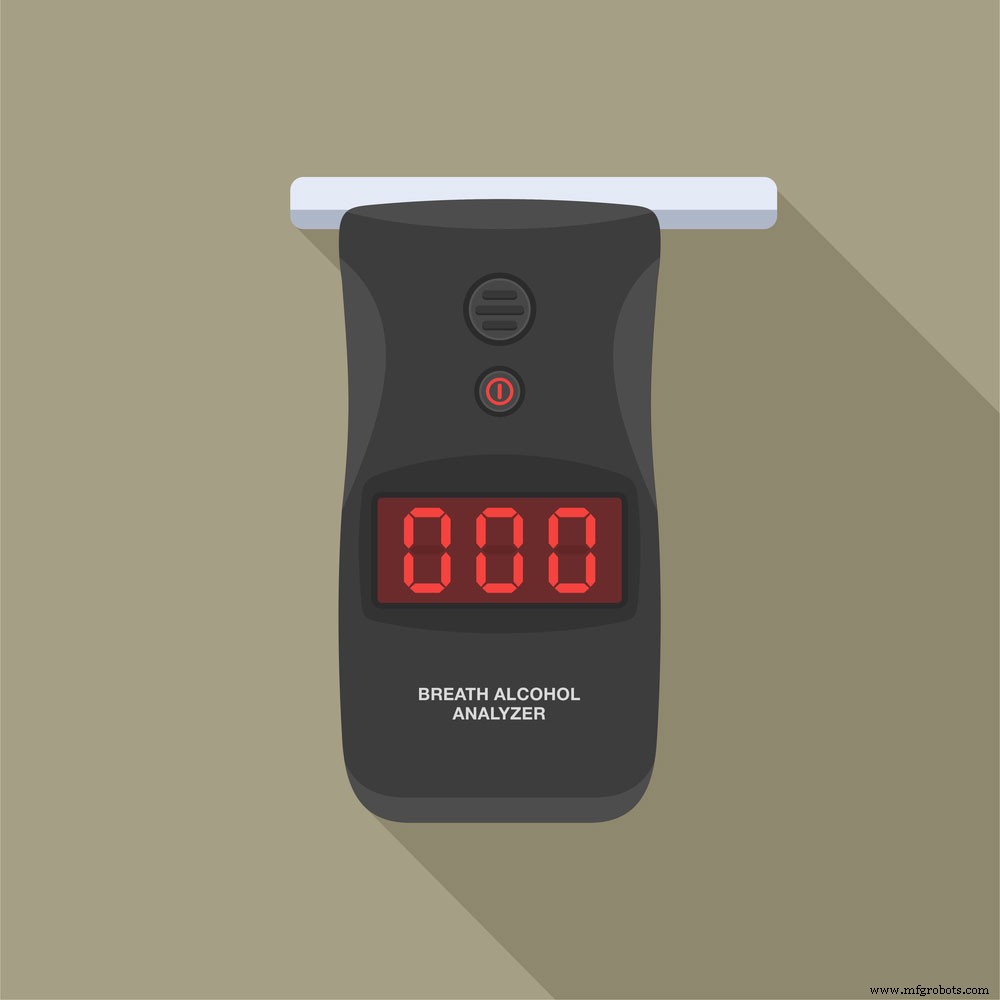
- Gas level over-limit alarm,
- Toys, and
- Background/ Stand-alone sensing device.
Conclusion
To conclude, the MQ-3 alcohol sensor is an electronic component that has significantly contributed to safety, especially on the road. What’s more, apart from being cheap, anyone can operate it.
As we wind up, we hope that the article has been helpful. However, kindly contact us if you need further details concerning the sensor kindly contact us.
Industrial Technology
- AIaaS Demystified: The Definitive Guide to AI as a Service
- Master Maintenance Management: Boost Efficiency & Cut Costs
- Mastering Supply Chain Management: A Comprehensive Guide
- Your Comprehensive CMMS Buying Guide: Maximize Asset Performance
- Mastering LED Drivers: A Comprehensive Guide to Efficient Lighting
- Complete Guide to HID Lighting Ballasts: Types, Functions & Maintenance
- Mastering Opamp Hysteresis: A Comprehensive Professional Guide
- LM35 Temperature Sensor: Complete Guide to Pinouts, Features & Applications
- Fingerprint Sensors Explained: A Complete Beginner's Guide to Secure Authentication
- Comprehensive Guide to CNC Machining: Techniques, Applications & Best Practices