



LM35 Temperature Sensor: Complete Guide to Pinouts, Features & Applications
LM35 Temperature sensors are electric devices that detect and measure coolness or hotness before converting them to electrical signals. The types of sensors range from mechanical (thermometers), electrical (thermistor or thermocouple), or Integrated Circuits (MCPXXXX, LMXX, or ADTXXX series).
In today’s article, we’ll discuss LM35, a temperature sensor IC in the LM-series. In it, we will share knowledge on the IC’s pin configuration, pinout, applications, features, etc.
What are the lm35 Temperature Sensors?
An LM35 temperature sensor is an integrated circuit that generates an analog output signal equivalent to the instantaneous temperature.
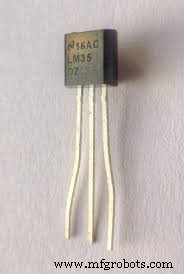
LM35 temperature sensor
One advantage of LM35 is that it doesn’t need external calibration to work. Moreover, its outer coating prevents it from self-heating, and can anyone can afford it since it’s cost-effective.
lm35 Temperature Sensors Pin Configuration

TLM35 pinout
LM35 is a three-terminal sensor, and it has the pins below;
Pin1/ Vcc pin / Input pin – It supplies the input voltage ranging from 4V to 30V (average of 5V) to typical applications.
Pin2/ Out/ Analog pin – It provides the analog output voltage directly proportional to the rise in temperature (in centigrade).
Pin3/ GND or ground pin – The last pin connects to the circuit’s ground.
LM35 Specifications and Features
The features and specifications of LM35 are as follows;
- First, it can measure a temperature range from -55C° to 150°C.
- Then, it is a small sensor, therefore, recommendable in remote applications. Besides that, because of wafer-level trimming, it’s cheap.
- It has a current drain that’s less than 60µA. In addition, it should have a low self-heating of 0.08°C in still air.
- Its minimum input voltage is -2V whereas, its maximum input voltage is 35V.
- The temperature is directly proportional (linear) to its output voltage. In other words, for each 1°C temperature rise, there’s a voltage rise of 0.01V (10mV) – 10-mV/°C scale factor.
- It also has an ensured accuracy of ±0.5°C and a low output impedance of 0.1Ω for 1mA load.
- Lastly, you can find it in SO8, TO-CAN, TO-220, and TO-92 packages.
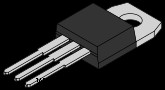
TO-220 packaging
- lm35 temperature sensor circuit configuration
You can use LM35 in two circuit configurations that yield different results, as we will discuss below.
Note;
Often, the average accuracy for the two configurations is +-1°C even though there’s a temperature reduction between 2°C to 25°C levels.
The table shows the accuracy level of LM35
| Parameter | Value |
| 25°C accuracy level | ±0.5°C |
| -55°C to 150°C accuracy range | ±1°C |
| Temperature slope | 10-mV/°C |
Basic Centigrade Temperature Sensor
A basic sensor only allows the measure of +ve temperature ranging from 2°C to 150°C.
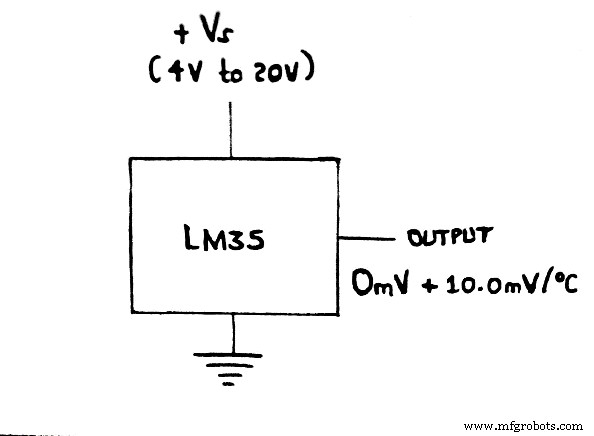
Circuit of a basic centigrade temperature sensor
In its circuit, you only need to power LM35 IC and connect its output to an ADC. The circuit can also have an 80k to 100k resistor connected between GND and Vout pin. The connection tightens the Vout pin, therefore, preventing it from floating.
Full-Range Centigrade Temperature Sensor
A full-range sensor permits using all sensor resources that further measures temperature ranging from -55°C to 150°C. Despite being complex, its results are higher than in basic sensors.
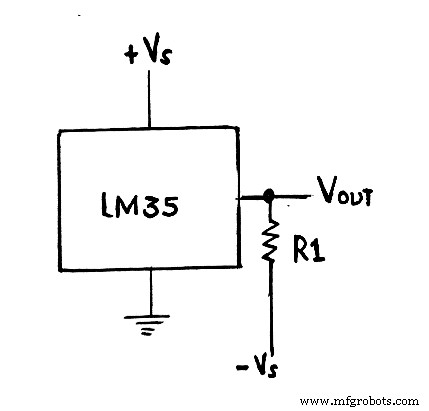
Circuit of a full-range centigrade temperature sensor
As for its circuit, we attach an external resistor that’ll ultimately switch the negative voltage level upwards. We can further use the formula R1 = -Vs/50µA to calculate the value of the external resistor.
lm35 Temperature Sensors Alternatives
The alternatives of LM35 include DS1620, DS18B20, LM34, and LM94022.
Furthermore, you can use sensors from the LM35 family such as LM335, LM235, LM135, or LM135A. Their difference from LM35 is the package types and varying temperature measuring capacities.
- Applications
LM35 sensor has a wide range of applications. Such as;
- Monitoring battery temperature,
- Thermal shutdown for components or circuits.
- It measures temperatures in any environment and all HVAC applications.
Using LM35 Temperature to Calculate the Temperature
The following steps will help you use an LM35 sensor to calculate the temperature.
- Start by building the circuit.
- In the circuit, ensure you connect GND to the ground, then power LM35 VCC with +5 operating voltage (Vs).
- Thirdly, connect the VOUT to an ADC input (Analog-to-Digital Converter). After which you proceed by sampling the reading from ADC of the output voltage (VOUT).
- Finally, finish by converting the output voltage to temperature.
Use the formula below to convert voltage to temperature.
Centigrade temperature = Voltage read by ADC / 10 mV (mills volt).
Alternatively, you can use;
VOUT = -10 mV/°C × T
Whereby;
VOUT = LM35 output voltage
T = Temperature in centigrade
10mV represents the linear scale factor of LM35.
Conclusion
Briefly, LM35 is an analog device operating as a temperature sensor and comes in a form factor of a 3-pin TO-92 package. Some of its applications include measuring temperature in HVAC applications. Moreover, it is cheap and reliable.
For clarifications or queries, kindly reach out to us.
Industrial Technology
- AIaaS Demystified: The Definitive Guide to AI as a Service
- Master Maintenance Management: Boost Efficiency & Cut Costs
- Mastering Supply Chain Management: A Comprehensive Guide
- Your Comprehensive CMMS Buying Guide: Maximize Asset Performance
- Mastering LED Drivers: A Comprehensive Guide to Efficient Lighting
- Complete Guide to HID Lighting Ballasts: Types, Functions & Maintenance
- Mastering Opamp Hysteresis: A Comprehensive Professional Guide
- Fingerprint Sensors Explained: A Complete Beginner's Guide to Secure Authentication
- MQ-3 Gas Sensor: Comprehensive Guide to Alcohol Detection
- Comprehensive Guide to CNC Machining: Techniques, Applications & Best Practices