



Prevent Galvanic Corrosion: Choosing Compatible Materials for Marine Equipment
Imagine a newly constructed marine ship in which several pieces of equipment are installed over the roof using bolts; for example, a soundboard has been installed on a steel structure using hot aluminum rivets. Now, fast forward a couple of months when the board suddenly falls onto the ground. A thorough analysis of the incident concludes that the reason for the breakdown is dissimilar metal corrosion.
Dissimilar metal corrosion, also known as galvanic corrosion, is a common phenomenon in many newly constructed sites operating in damp environments, such as in the oil and marine industries. As per a survey by the NACE international, the global cost of corrosion stands at US$2.5 trillion.
Below, we delve into dissimilar metal corrosion, how and why it occurs, and tips for avoiding it to prevent accidents and damaging project delays.
What is Dissimilar Metal Corrosion?
A galvanic reaction occurs when two metals of different nobilities or electrochemical potential are placed in contact with each other under an electrolytic solution or dampened environment. The active metal (less noble) behaves as an anode, and the passive metal (high noble) acts as a cathode.
At the cathode, water reacts with oxygen to form hydroxides. However, for this reaction to take place, an inflow of electrons is required. The active metal starts to lose electrons, and the ions travel through the electrolytic media and get deposited in the passive metal. As a result, different chemical reactions start to take place at the sample surface, and the less noble metal corrodes. The rate of corrosion is directly proportional to the area of cathode available for reaction and the level of nobility difference between the two metals.
A chart that compares different metals and their electrochemical voltage ranges in seawater has been included below.
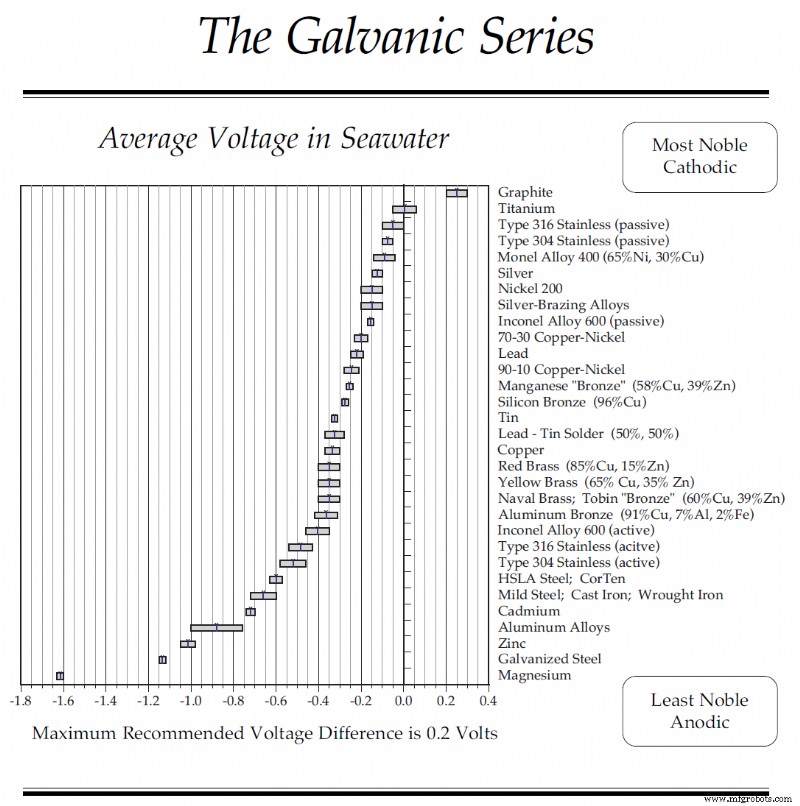 Metals with wide voltage differences react the most. For instance, a galvanized steel screw on a stainless steel clamp will corrode faster than a titanium screw.
Dissimilar metal corrosion may also occur between parts of the same metal when they are placed in areas with different pH values and are electrically in contact with each other.
Factors Affecting Dissimilar Metal Corrosion
The following factors affect the rate of dissimilar metal corrosion between two metals:
- Electrode potential: Metals with wide electrode potential confirm faster corrosion of the less noble metal.
- Contact resistance: Low contact resistance at the boundary of two metals allows a higher rate of electron flow, causing more corrosion.
- Electric resistance: Highly concentrated electrochemical solutions (pH < 7) stimulates hydrogen formation at the cathode and increase galvanic corrosion.
- Metal areas: The rate of reaction is directly proportional to the area of the cathode and inversely proportional to the area of the anode.
- Changes in the atmosphere: Changes in atmospheric conditions can influence dissimilar metal corrosion. For instance, the size of the cathode area exposed to the damp area determines how quickly the reaction will occur. More exposure leads to more acceleration.
In this regard, let’s learn more about the impact of the environment on dissimilar metal corrosion.
Environmental Factors Affecting Dissimilar Metal Corrosion
Depending on the environment, the electrochemical properties of an anode may change. The environmental condition influences three major anode properties: potential, current capacity, and anode consumption rate.
Anode potential can become more negative under chemical or seawater operating environments. Even different variations to the same environment can impact the anode’s practical current capacity, such as hot seawater vs. cold seawater vs. seabed mud.
Long-term performance data related to an anode’s current carrying capacity for a particular environment is necessary. In the absence of sufficient data, additional electrochemical tests, such as a galvanostatic test and a potentiostatic test, should be carried out to note the current carrying capacity of the anode under different environmental conditions.
How to Prevent Dissimilar Metal Corrosion
Below are a few best practices to follow to prevent dissimilar metal corrosion:
- Run an overview: Obtain an overview of the material of application, the load involved, and the possible effect of the atmosphere on the galvanic reaction.
- Follow the basic rule: Select metals of the same or almost the same nobility in the galvanic chart.
- Insulate dissimilar metals: Use insulation between contacts of different metals; e.g., sleeve bolts in flange joints, and use insulating washers.
- Use isolation spools: Non-conducting isolation spools (such as Glass Reinforced Plastic [GRP]) can be used to achieve piping connections of two different metals carrying non-hydrocarbon fluids.
- Use sacrificial anode: Sacrificial anodes are used to protect metals in seawater.
- Paint the cathode: Use paint as an alternative to prevent the contact; paint the noblest part, the cathode.
Note: If you paint the anode and a crack forms in the paint, galvanic current will flow into that cross-section and will accelerate the corrosion. The same is true for any crack in the galvanic material as well.
In this regard, frequent inspections can also aid in minimizing any accidental hazards due to dissimilar metal corrosion.
The choice of material is extremely important. The dimension and shape of the anode material must be able to withstand the mechanical force exerted by the surrounding environment in the form of waves, currents, and vibrations. Moreover, you must also consider a lot of other factors, such as chemical composition, homogeneity, and current carrying capacity. Partnering with an experienced metal supplier to get high-quality corrosion-resistant alloys can help you avoid dissimilar metal corrosion in the first place.
Your Local Supplier for High-Grade Alloys
Industrial Metal Service has been one of the leading metal suppliers in the San Francisco Bay Area for more than two decades. We also provide state-of-the-art metal sawing services for precision cutting metals into machine-ready pieces, allowing fabricators, hobbyists, and machinists to focus on what’s important.
Our Amada PCSAW 530 X band saw with pulse cutting technology is excellent for cutting high-strength metals such as titanium without any work distortion, while our MetlSaw NF12-T12 quickly cuts aluminum alloys with the highest precision.
Industrial Technology
- Key Criteria for Selecting High-Performance Thermal Interface Materials
- Choosing the Right Materials: Essential Steel Facts
- Expert Sheet Metal Fabrication Services Tailored to Your Project
- 6 Essential Factors for Selecting Hard vs Soft Metals in CNC Machining
- Understanding the Differences: Pitting vs. Crevice Corrosion
- Preventing Metal Corrosion: Proven Strategies for Long-Lasting Durability
- Preventing Aluminum Corrosion: Proven Strategies for Long-Lasting Durability
- Prototyping Materials 101: A Small-Scale Fabricator's Guide
- Metal Bending: When to Apply It for Precision Fabrication
- 10 Key Considerations for Choosing a Metal Fabrication Partner