



How Industry 4.0 Empowers Tightening Specialists in Manufacturing
Tightening specialists are indispensable in production environments, especially when dealing with safety‑critical fasteners. Their expertise is essential in the automotive and aerospace sectors, where the slightest mis‑torque can jeopardise safety and reliability. Only a select group of professionals possess the depth of knowledge required to identify the root causes of tightening defects and implement effective countermeasures, making a tightening expert a rare commodity that must be deployed strategically.
Consider a modern vehicle‑assembly plant. More than 2,000 tightening systems operate on the floor, generating over 250 million safety‑or function‑critical screw fittings each year. The Association of German Engineers (VDI) publishes specific guidelines for automotive tightening, underscoring the sector’s stringent quality demands.
Did you know?
In a car manufacturing plant, for example, there are more than 2,000 tightening systems in use and over 250 million safety‑or function‑critical screw fittings per year.
Safety‑critical tightening processes must be closely monitored and analyzed. Anomalies need to be detected and addressed promptly, with alerts for production staff triggered in near real‑time. This transparency allows tightening experts to take preventive action, continuously improve the process, and fully leverage their expertise. Early quality controls—applied during the manufacturing of an engine or transmission, for instance—reduce failure and rework costs while boosting output.
In detail: What measures take tightening experts in their day‑to‑day work?
How can Industry 4.0 bring the expertise of tightening specialists to production sites worldwide without tying them down with routine manual tasks or fragmented data from disparate systems?
1. Quick overview of tightening processes
Tightening experts need a fast, intuitive overview—often presented as a tree structure—covering plants, areas, lines, stations, tightening applications, and even individual channels. This view instantly reveals which tightening systems are active in a given factory and how many production lines operate within a plant.
Access to the tightening systems’ master data provides the tool fleet manager with a detailed snapshot of system status and utilisation. Familiar office‑style features such as favourites enable specialists to reach specific tightening processes, rundowns, or units in seconds.
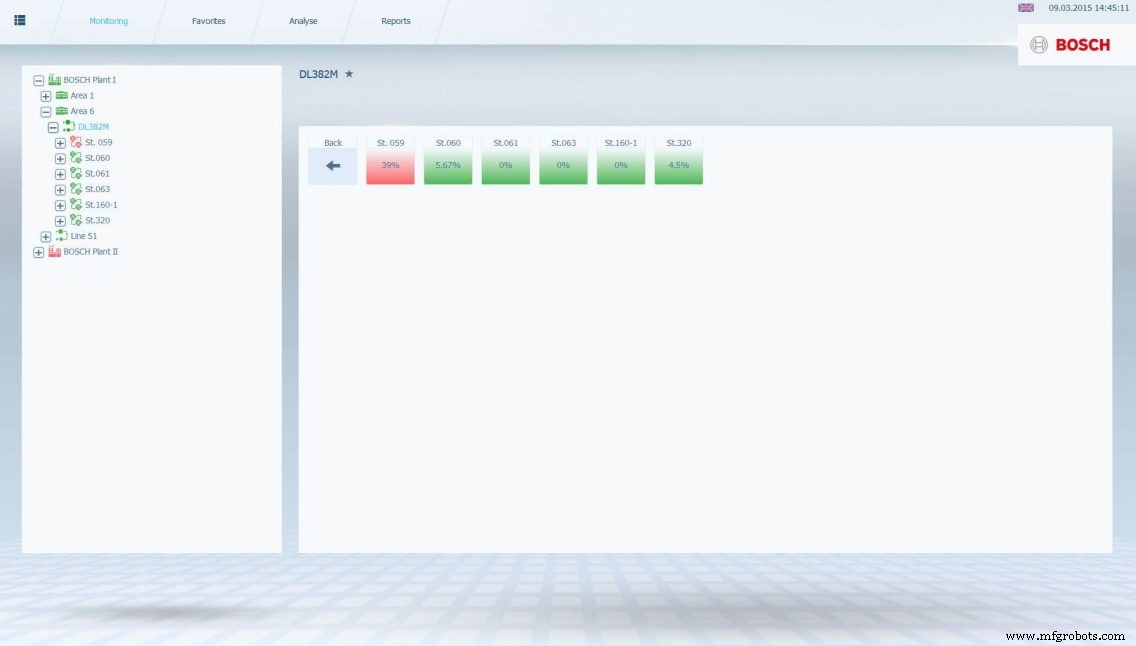
Source: Bosch.IO – Plant overview provided in form of a tree structure for greater transparency.
2. Optimizing processes by carefully analysing tightening data
Visual tools such as graphs and statistical functions enable tightening experts to analyse processes quickly and spot early signs of change. Features like a night‑mode view with a darkened layout ease visual strain during night shifts.
At a glance, traffic‑signal colours indicate whether a tightening process is proceeding correctly. Alarm functions notify experts when defined thresholds are exceeded or not met, offering insight into why a process deviates.
Reacting quickly to errors thanks to real‑time data acquisition
To spot trends early, data from the tool controller must be streamed in real time to a database. Tightening experts can then view this data in a web‑browser‑friendly interface, granting immediate access to the process and enabling prompt intervention.
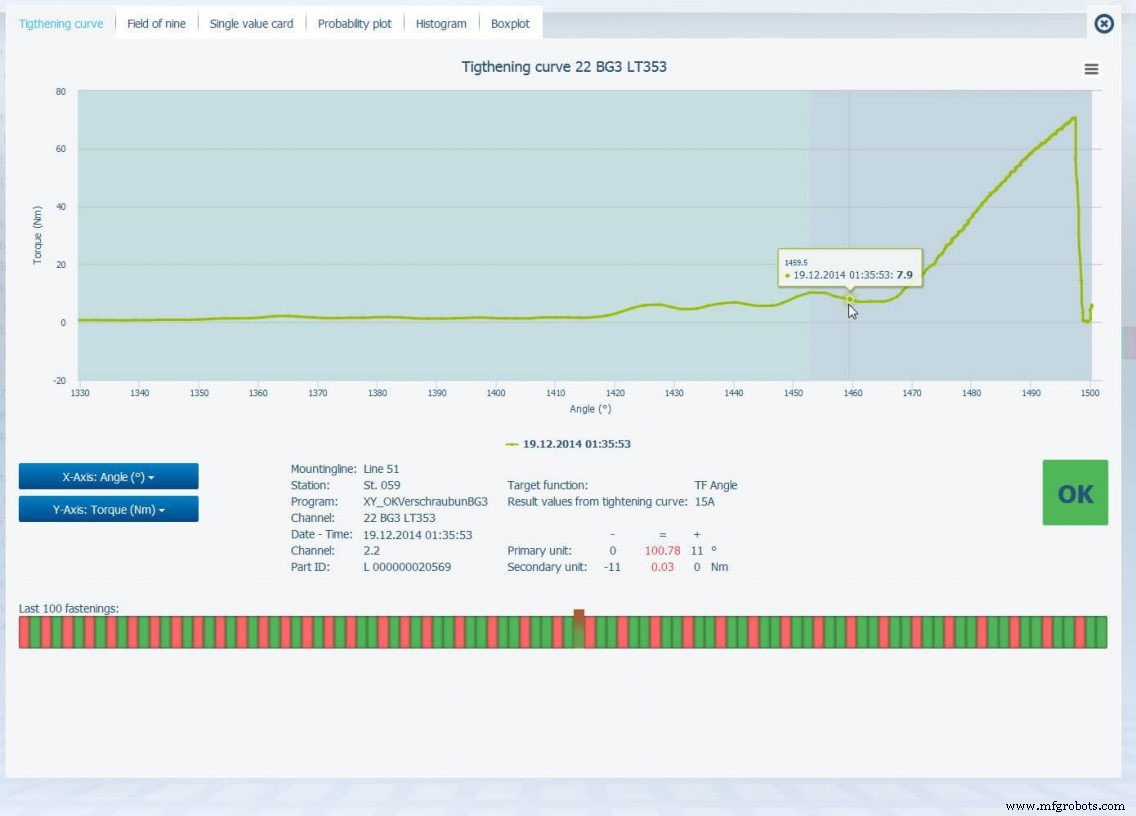
Source: Bosch.IO – The tightening curve shows the torque‑angle progression of a selected screw fitting. Selecting a curve segment zooms in for detailed inspection.
3. Documentation and quality assurance
Documenting tightening events is critical for quality management, especially for safety‑critical applications. A database can link each completed tightening event to its product ID, the tool ID that performed it, and the outcome status (OK/NOK). In case of production errors, this information is essential to trace which tightening system was used on which component and when, and to verify the event’s outcome.
I might ask how I can speak on this topic without being a tightening expert. My experience comes from developing software solutions for the manufacturing industry alongside colleagues who regularly collaborate with leading German automotive suppliers. Together with Bosch Rexroth, we distilled their key requirements into a software‑based solution called Process Quality Manager.
Did I miss anything? What else can Industry 4.0 do to better support professionals in manufacturing?
Industrial Technology
- Industry 4.0 for SMEs: Leveraging Cloud‑Based Data Monitoring to Boost Production Efficiency
- Emerging Trends in IoT Platforms for 2018: Edge Computing, Blockchain, and More
- Industry 4.0 Explained: What It Means for Smart Manufacturing
- Key Factors to Consider When Buying Used Industrial Equipment
- The Modern Manufacturing Process: Key Techniques and Innovations
- What to Expect from Additive Manufacturing: A Comprehensive Guide
- Understanding Gray Cast Iron: Properties, Production, and Automotive Applications
- Everything You Need to Know About Soft Drink Vending Machines
- Vegetable Vending Machines Explained: Key Features & Benefits
- Choosing the Right 3D Printer: Expert Tips & Recommendations