



Industry 4.0 for SMEs: Leveraging Cloud‑Based Data Monitoring to Boost Production Efficiency
Every factory aims to identify and classify latent issues in the manufacturing process before they impact production flow. While large corporations often have the resources to deploy sophisticated monitoring solutions, small and medium‑sized enterprises (SMEs) frequently struggle to do the same. Why? Because traditional on‑premise software demands capital investment and dedicated IT staff—luxuries many SMEs cannot afford.
Enter the cloud. In Industry 4.0, cloud platforms are becoming the backbone of data integration across disparate plants. Although manufacturers are still exploring this frontier, the long‑term vision of a fully connected value stream is achievable only through cloud‑enabled solutions.
Extensive monitoring of process data – even for SMEs
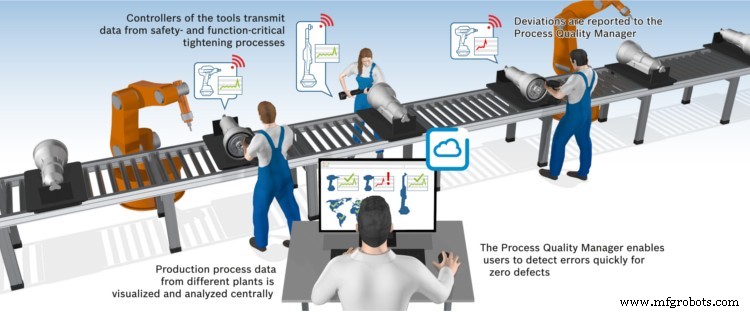
So how can SMEs reap the benefits of real‑time process data monitoring? Consider the Process Quality Manager, an early Industry 4.0 offering on the Bosch IoT Cloud that captures tightening data as well as other key metrics.
Manufacturing specialists use the Process Quality Manager to visualise torque, rotation angle, and other tightening parameters in real time. Its cockpit automatically flags deviations and emerging trends, enabling experts to fine‑tune operations, pursue zero defects, and maximise throughput.
Source: Bosch.IO
Until now, such monitoring was the preserve of large firms operating their own IT infrastructure and managing more than 150 tightening systems. The cloud model eliminates upfront costs and eliminates the need for a long‑term commitment. It also supports phased global integration, allowing companies to centrally monitor tightening processes while decentralising expert knowledge.
How does it work? The Process Quality Manager is delivered as a web service within the Bosch IoT Cloud. It is accessed directly from any browser—no local installation required—so engineers can view data from anywhere, provided they have an internet connection. For small numbers of devices, a standard DSL line is sufficient.
Practical example: how the technology benefits a sports‑car seat manufacturer
A sports‑car seat manufacturer employs 150 people and runs 20 tightening systems on its assembly line. Each system completes a tightening operation every two seconds, generating approximately 200 KB every two seconds (≈100 KB/s). Accessing the cloud cockpit requires only a normal DSL connection.
The service provider handles all patches, upgrades, and maintenance, freeing the customer from ongoing operational overhead. Moreover, cloud offerings increasingly adopt pay‑per‑use models, converting capital expenditure into operating costs. For this manufacturer, paying per tightening operation aligns the cost of monitoring with actual production volume.
SMEs retain flexibility: they can add or remove tightening systems from the monitoring service at any time without contractual lock‑in.
Data security remains paramount. Bosch safeguards customer data through advanced protection mechanisms and hosts the Bosch IoT Cloud in its own secure data centres, ensuring strict confidentiality and compliance.
By embracing cloud‑based Industry 4.0 solutions, SMEs can confidently step into the digital age, monitor processes in real time, cut rework, and reduce costs.
Industrial Technology
- The Cloud Revolution: How Cloud Computing Transforms IT, Security, and Careers
- Expert Guide to Enhancing Cloud Management: Strategies, Best Practices, and Key Benefits
- Industry 4.0 in 2017: Seven Key Trends Driving the Future
- Industry 4.0: Harnessing Cloud and Edge for Smart Manufacturing
- How Industry 4.0 Empowers Tightening Specialists in Manufacturing
- Enhancing Industry 4.0: Rule‑Based Analysis of Production Data for Real‑Time Quality Control
- How Leading IT Trends Transform Modern Manufacturing
- Streamline Procurement: From Vendor Selection to Seamless Payment
- Leveraging IoT to Transform Automotive Manufacturing: Boost Efficiency & Innovation
- Industry 4.0 in Process Industries: Proven Steps to Boost Efficiency and Innovation