



Choosing the Right 3D Printer: Expert Tips & Recommendations
3D printing FDM (Modeling by Fade Deposition) is an additive manufacturing method in which a plastic filament passes through a head that is at the material's melting temperature and moves at the X-Y-Z coordinates to make the piece by layers of the required thickness. This technology is already widespread in both the professional and domestic environments, where anyone can carry out their projects, models or parts by themselves. Therefore, today users who want to buy a 3D printer for your home or your business, are faced with a complex decision given the wide variety of 3d printers that are in the market.
Factors to consider when choosing a 3D printer FDM
Before deciding on a specific device, it's necessary to take into account certain factors, which we explain below:
Type of user
The first step is to know if large pieces will be made with industrial materials or, on the contrary, only conventional materials (PLA, special PLA and ABS) will be used for medium and small size pieces.
For the first case, it is advisable to use industrial 3D printers that can work with all types of materials and make large-volume pieces while maintaining high precision.
For the second case, we recommend Desktop 3D printers, which tend to be simpler and cheaper. Some 3D Desktop printers can be purchased both assembled and ready to use (ain the absence of leveling the base), as in kit. The advantages of buying a 3D printer in kit is that it can be modified to suit the user and is cheaper. The problem is that the user must take into account the time it takes to assemble, program and calibrate the 3D printer and if he has the necessary knowledge and means. Our advice is that, if you aren't a user with abundant knowledge in the field and you only want to print 3D models, buy a 3D printer already assembled.
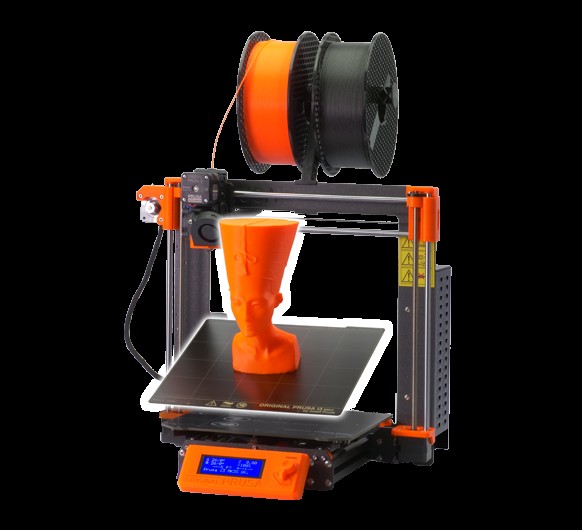
Prusa i3 Mk3S 3D printer (kit or assembly)
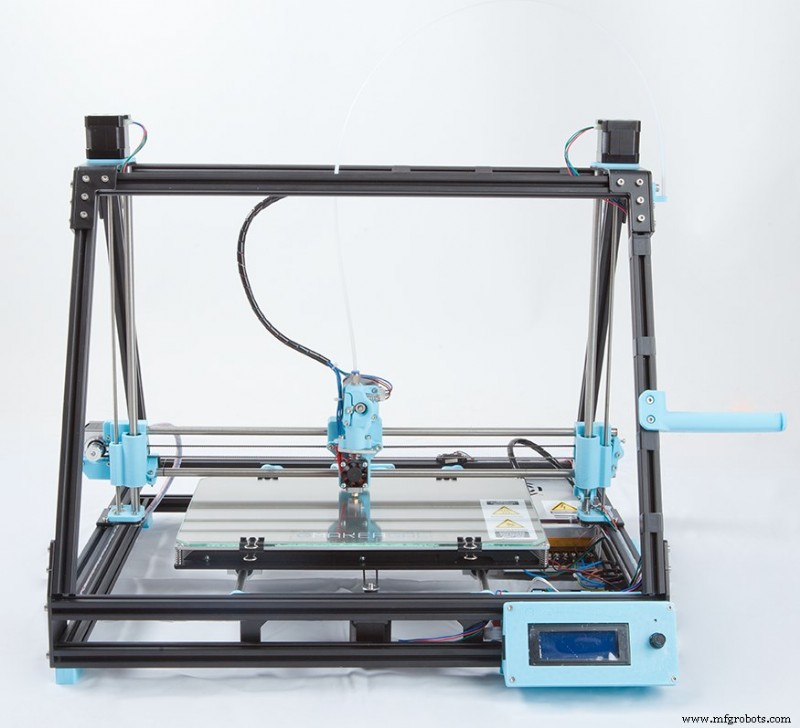
Mendek Max 3D printer kit
In the event that the user is a public organization or a company, it is very important to check before buying a 3D printer that it has the CE marking. All 3D printers sold in Kit and most of the low quality do not have the CE mark, which don't comply with relevant European legislation.
Material of the parts to print
Depending on the material you want to use in the manufacture of the parts, some printers can offer better results than others, so it is very important to know the main specifications of printing of the materials to be used: extrusion temperature, temperature the necessary base, sensitivity to air currents and printing speed.
- Temperatures: Knowing both the extrusion temperature and the base temperature is key to ensuring that we can use the material we need without any problem. For example, there are low cost printers that the temperature of the base only reaches 70-80 ºC, being an insufficient temperature to avoid warping when printing parts in ABS.
- Sensitivity to drafts: Materials such as ABS or ASA are sensitive to air currents, as they cause the cracking effect (separation of the layers between them). Having a closed 3D printer always brings benefits and avoids many problems.
- Print speed: This parameter affects the speed with which parts can be made, this being a point that the user should consider depending on their needs. Quality 3D printers allow high-performance materials to be brought to the limit of printing, for example, the PC-Max that can be used up to a printing speed of 90 mm/s. For conventional materials speeds between 40 and 60 mm/s are used, which can be achieved with virtually any 3D printer on the market.
Finally, if you want to use flexible materials, especially TPE, you must take into account that only the direct extruder system is recommended for this type of filaments. This type of extruder is valid for all types of material, both flexible and rigid, but has the disadvantage that all the weight is located in the axis of movement of the HotEnd, generating inertias that reduce the precision of the 3D printer. In contrast, the Bowde extruder minimizes the inertias mentioned above but its use with flexible materials isn't recommended, especially with the more elastic ones (Filaflex and Filaflex UltraSoft 70A), because the filament doesn't run continuously through the extruder when tending to flex inside the PTFE tube. To use these very elastic materials, it's advisable to use a special extruder for flexible materials, such as the Recreus Extruder V3.
Size of the pieces to be printed
The size of the pieces you want to make also influences when choosing a 3D printer. Most basic 3D printers have a print volume of 200x200x200 mm but exist in different sizes, for example the BCN Sigmax thas a print volume of 420x297x210 mm, or the 3NTR A2 that has a print volume of 620x355x500 mm. You should look for a 3D printer that fits the particular needs of each user to avoid having to make cuts in the design, print in parts and then join them.
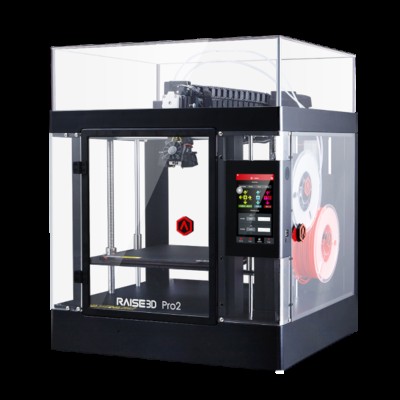 BCN Sigmax
Raise Pro2
BCN Sigmax
Raise Pro2
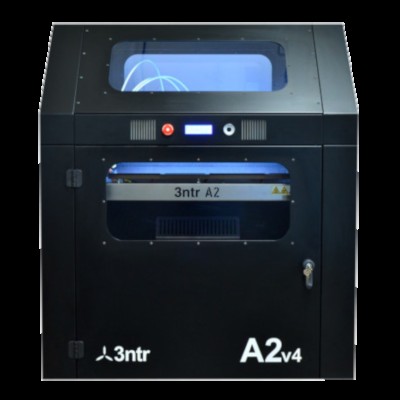 3NTR-A2
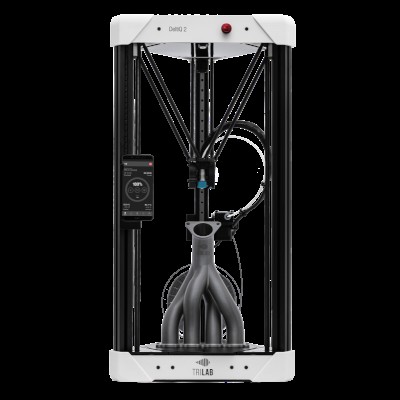 Trilab DeltiQ 2
Structure and precision
A very important part of a 3D printer is its structure. This aspect directly affects the performance, performance and manufacturing precision, therefore, when deciding which printer to buy, you must emphasize this part and make sure that the 3D printer you choose, especially if it's in kit, present a robust, stable and durable structure.
Apart from the above, we must be very clear that, to get more precision, you have to invest more money because accuracy is only achieved with better components, such as using precision spindles instead of threaded rods; a sophisticated system of pulleys and belts instead of a simple belt system; an extrusion system composed of calibrated and resistant elements for a correct operation and to avoid jams; and a well-designed quality electronics with the correct heat dissipation and protection instead of a low quality electronics that is surely a source of problems.
The most important precision value is that of the z axis, which will give more or less detail to the piece that you want to manufacture. For this axis a more than acceptable value is 50 microns, with which really spectacular pieces are achieved, as long as the base is well leveled.
Our recommendation is that, whenever the budget allows it, you should buy a 3D printer with the CE marking, assembled to avoid firmware and software problems, that is closed so that 3D impressions are not affected by the air currents that can exist by simply opening or closing a door, that fits the usual size of the projects, that the extruder is of the right type for the materials you want to use (we recommend direct extruder for flexible materials) and that the printing base reaches the enough temperature (80-100 ºC) to be able to use a material as common as ABS.
3D printing
- Multi‑Nozzle 3D Printers Explained: How They Work and Why They Matter
- What Is a Desktop 3D Printer? A Practical Guide for Businesses
- How Industry 4.0 Empowers Tightening Specialists in Manufacturing
- Beyond Prototypes: Real‑World Innovations Made with 3D Printing
- UV 3D Printing: How SLA Resins Deliver Faster, Higher‑Quality Prints
- Choosing Between Resin and Filament 3D Printers: A Practical Guide
- 3D Printer Thermistors: Their Role and How They Ensure Accurate Printing
- Role of a 3D Printer Operator: Skills, Responsibilities, and Career Opportunities
- Resin 3D Printers Explained: UV Light‑Cured Technology for High‑Precision, Smooth Prints
- How 3D Printers Transform Classroom Learning