



Understanding Retraction in 3D Printing: Definition, Settings, and Best Practices
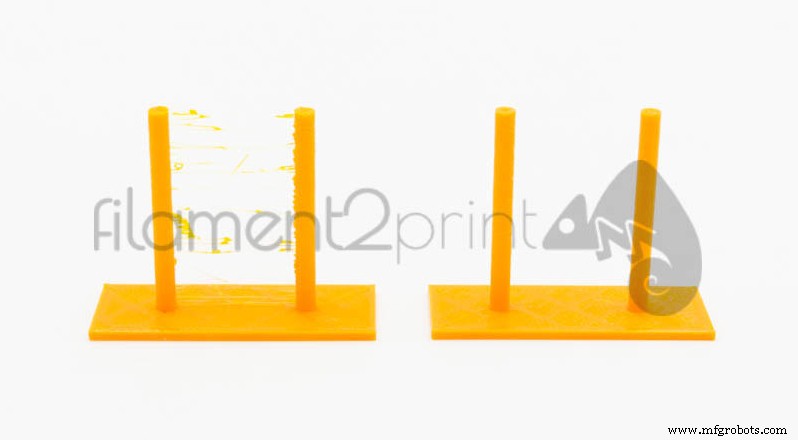
This article tries to clarify the concept of retraction in 3D printing as it's a very important parameter to achieve quality prints, without material depositions on the exterior face of the model, or threads between pieces that are printed at the same time.
Retraction is the recoil movement of the filament necessary to prevent dripping of material during movements and displacements that the vacuum extruder performs during 3D printing.
The parameters that configure the retraction are:
- Retraction distance: Length of material that recedes in the retraction process. It varies depending on the type of material, the type of extrusion system (Direct or Bowden) and the type of HotEnd. For flexible materials, especially for the TPE type (Filaflex), retraction must be deactivated to prevent the filament from coiling on the extruder pinion.
- Retraction speed: Speed at which the extruder motor drives back the filament. With this parameter it's necessary to be very careful if high speeds are used (greater than 70mm/s) because it can mark the filament in such a way that it's unusable to continue the 3D printing.
- Minimum displacement: Minimum length from which you want the retraction to take place.
- Enable combining: By activating this parameter, which is in the section of advanced options of retraction of the program of lamination that is used (Cura, Simplify3D, Slicer, etc), apart from performing the retraction, the HotEnd is prevented from moving over holes. With this material remains are avoided in the faces seen from internal parts of the pieces.
- Z-axis elevation when retracted (Lift z): At the same time that the retraction occurs, the HotEnd moves on the z axis the indicated distance. This elevation is only necessary in the case of making pieces with many details and with small areas of great detail to avoid leaving traces of material right in that area. If you need to use this parameter, we recommend using the same distance as the layer height.
With the appropriate adjustment of the above parameters you get the ideal retraction for your 3D printer.
Unfortunately there is no formula to find the exact value, but each 3D printer and each extruder needs a particular value. The following table contains recommended values of length and retraction speed for the 3D printer depending on the type of extruder used, which are a good starting point to adjust them to your particular case:

Image 1: Retraction parameters
The values of the table are entered in the retraction section of the lamination software that is used, in our case, Cura 3D, is within the category of material.
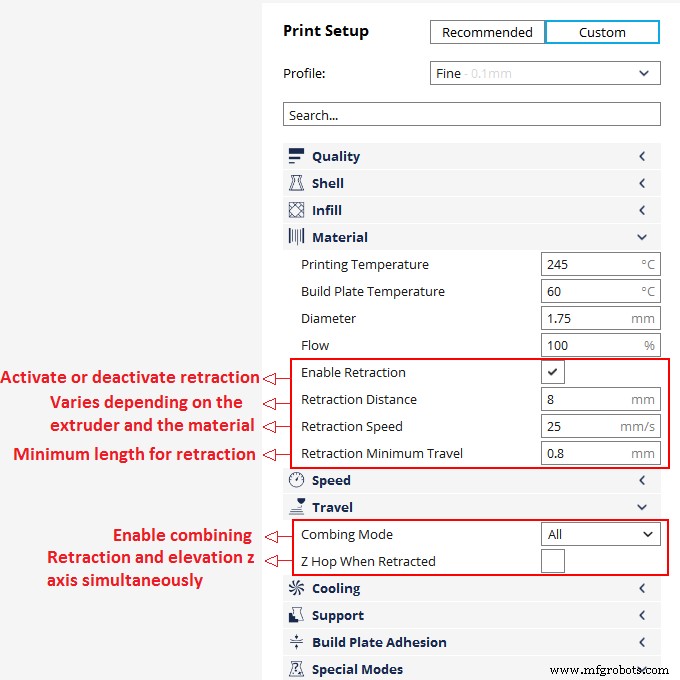
Image 2: Retraction configuration in Cura 3
Care must be taken when varying the length parameter, because if it is increased too much (20 mm in a direct extruder), it will cause a discontinuous flow and thus gaps in the piece being printed.
Once all the parameters that configure the retraction are understood and based on the values that we have provided, each user will obtain their ideal configuration by simply making small adjustments.
3D printing
- Bioprinting Explained: How 3D Printing Creates Living Tissues & Future Organs
- 4D Printing Explained: The Future of Adaptive, Time‑Responsive Manufacturing
- Pigment Printing: Benefits, Drawbacks, and Applications in Textile Manufacturing
- Understanding Proxy Servers: Definition, Functionality, and Key Benefits
- Powder Metallurgy Explained: Definition, Processes, and Benefits
- Corrosion Explained: Causes, Effects, and Prevention Techniques
- Understanding SLA 3D Printing: Process, Benefits, and Applications
- Understanding SLS 3D Printing: How Selective Laser Sintering Creates Durable Parts
- Demystifying 3D Printing: A Clear Guide for Innovators
- Mastering 3D Printer Flow: Definition, Significance, and Calibration Tips