



Mastering Overmold Material Compatibility & Mechanical Bonding: Proven Tips for Durable Parts
Overmolding is not a new manufacturing technology, but there is still some confusion about how to design for the two-part process. One of the largest areas to consider? Bonding. A number of materials can be used to overmold components together, but without a chemical bond or mechanical interlock, some overmolded parts won’t stand the test of time.
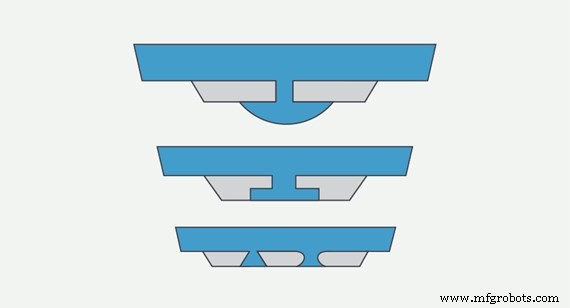 Three types of mechanical bonding techniques.
Chemical Bonding
This bonding process involves two chemically compatible materials that are molded together to form a strong bond with each other. It’s important to note that not all materials play well with one another. The compatibility chart below indicate whether a chemical or mechanical bond is recommended for key thermoplastic and thermoset materials.
Mechanical Interlocking
What happens when your materials are not compatible, the desired bonding strength cannot be achieved, or you want to ensure your materials don’t peel apart from repeated use? This is where designing a mechanical interlock, which physically holds the overmolded material to the substrate, makes sense. There are many ways to design these into parts (see example), so discuss the options with your manufacturer.
Overmold Material Compatibility Chart
| Substrate Material | ||||||
|---|---|---|---|---|---|---|
| Overmold Material | ABS Lustran | ABS/PC Cycolo C2950-111 | PC Lexan 940-701 |
PBT Valox 357-1001 |
PP Profax 6323 | Nylon 66 Zytel 103 HSL NC010 |
| TPU - Texin 983-000000 |
C | C | C | C | M | M |
| TPV - Santoprene 101-87 |
M | M | M | M | C | M |
| TPE - Santoprene 101-64 |
M | M | M | M | C | M |
| LSR - Elastosil 3003/30 A/B |
- | - | M | M | - | M |
| TPC - Hytrel 3078 | C | C | C | C | M | M |
| TPE-Versaflex OM 1060X-1 |
C | C | C | M | M | M |
| TPE-Versaflex OM 6240-1/td> |
M | M | M | M | M | C |
| TPE-Versaflex OM 6258-1 |
M | M | M | M | M | C |
| TPE-Versaflex OM 1040X-1 |
C | C | C | M | M | M |
M = mechanical bond recommended
C = chemical bond
If you have further questions regarding rapid overmolding at Protolabs, contact one of our applications engineers at 877-479-3680 or ADMIN@MFGROBOTS.COM.
Industrial Technology
- Master Sheet Metal Design: Proven Tips & Tricks for Faster, Cost‑Effective Production
- Machining vs. Grinding: Key Differences Explained
- Drilling Explained: Definition, Process, and Expert Tips
- Extrusion Explained: Process, Types, and Practical Applications
- Machining Explained: Definition, Process, and Key Tools
- Grounding, Earthing, and Bonding: Key Differences Explained
- Mastering Sheet Metal Bending: Fundamentals, Allowance, and Expert Tips
- Comprehensive Metal Strength Chart: Tensile, Yield, Hardness, and Density for CNC Machining & Design
- Solder Mask Design: Proven Tips for PCB Reliability & Performance
- Efficient Vertical Bulk Material Handling with Bucket Conveyors & Elevators