



AI Transforms Amateur Dancers into Professionals with Deep Learning Motion Transfer
- A breakthrough deep‑learning system can replicate the choreography of top dance stars on any video footage.
- It requires only ordinary video input—no expensive 3D rigs or motion‑capture suits are needed—to produce studio‑quality results.
Artificial Intelligence is reshaping industries from consumer electronics to space exploration, and this latest innovation showcases its transformative power in the arts. Researchers at the University of California have developed a motion‑transfer algorithm that maps the movements of a source dancer onto a target performer, making even a casual participant look like a seasoned ballerina or pop icon.
The core idea is straightforward: “Do as I do.” Within a matter of minutes, the system can overlay professional dance motions onto a target subject, opening new creative possibilities for performers, educators, and content creators.
How the Technology Works
The process begins by extracting keypoint‑based pose skeletons from both the source and target videos. These pose stick figures provide a lightweight, appearance‑agnostic representation of body position, enabling the model to focus solely on motion.
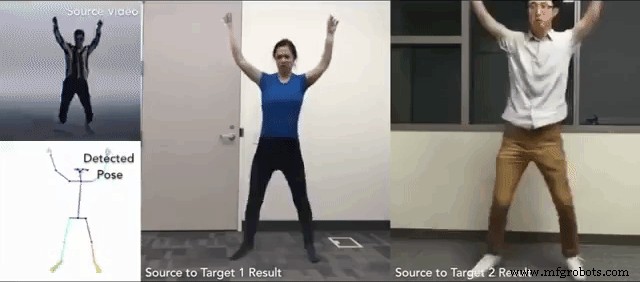
Each frame’s pose is generated by a supervised pose‑estimation algorithm, producing accurate stick figures. The motion‑transfer model then ingests these skeletons, generating target images that mimic the source’s pose while preserving the target’s appearance. The final output is refined by fusing the pose‑transfer module with a generative refinement network, delivering sharper, more realistic frames.
The workflow is divided into three stages:
- Pose detection – extract 2D keypoints from both source and target footage.
- Global pose normalization – align the skeletons across subjects.
- Pose mapping – synthesize target frames that match the source pose.
To ensure temporal smoothness, the algorithm blends the current frame’s pose with the previously generated frame, dramatically reducing jitter. For low‑frame‑rate inputs, a median filter is applied; for high‑frame‑rate videos (up to 120 fps), Gaussian smoothing of keypoints is used.
High‑fidelity results are achieved by integrating Conditional Generative Adversarial Networks (cGANs) trained on over 20 minutes of high‑framerate amateur dance footage per subject. The pix2pixHD architecture, developed by NVIDIA, serves as the backbone for the image translation pipeline.
Reference: arXiv:1808.07371
Training and inference were performed on NVIDIA GeForce GTX 1080 Ti and TITAN Xp GPUs using PyTorch with CUDA acceleration.
Future Directions
The algorithm currently supports motion transfer across a wide variety of subjects without the need for specialized hardware. However, occasional jitter remains, especially when the source’s motion speed exceeds the range seen during training. Ongoing research focuses on optimizing pose‑estimation methods and expanding the motion repertoire to mitigate these artifacts.
For related breakthroughs, see: NVIDIA AI Can Convert 30fps Videos To 240fps
Industrial Technology
- Revolutionizing Production: Injection Molding Meets 3D Printing for Complex Parts
- Machining Fundamentals: Mastering the Work Coordinate System
- 18650 Battery Specs: Key Features for Reliable Design and Performance
- Remanufacturing Leads Machine Investment Strategies for Peak Performance
- Create Power BI Dashboards from PLCnext Cloud Data
- 9 Key Reasons Facilities Managers Are Moving From Spreadsheets to CMMS
- Quantum Circuit Breaks Barriers: Detecting the Weakest Radio Signals Possible
- How Industrial IoT Cuts Costs: 5 Proven Strategies for Manufacturers
- Five Supply‑Chain Finance Trends for 2021: How to Prepare Now
- Choosing the Right Plastics for Automotive Manufacturing: A Comprehensive Guide