



Acoustic Printing: Sound Waves Create Precise Droplets From Any Liquid
- Acoustophoretic printing harnesses sound waves to generate droplets from any liquid.
- The technique is unaffected by the liquid’s viscosity or composition.
- Droplet size is inversely proportional to the sound‑wave amplitude: lower amplitude yields larger droplets.
- Applications span biopharmaceuticals, cosmetics, food, and advanced materials.
The evolution of home printing traces back to the 1930s. Today, liquid inkjet and laser printers offer rapid, energy‑efficient, high‑quality color output at low cost.
Inkjet technology, the most prevalent droplet‑forming method, is limited to liquids with viscosities at least ten times that of water. Laser‑induced forward transfer and valve‑based printing further constrain throughput by nozzle size, source‑substrate distance, and viscosity. Adjusting these parameters for each ink becomes challenging when properties vary with temperature and time.
Many fluids essential for bioprinting—biopolymers, sugar‑rich gels—exhibit viscosities exceeding 100× water, with some as thick as honey (≈25,000× water). These high viscosities hinder conventional printing.
Harvard researchers have developed an acoustic‑based method that overcomes these constraints. By generating a highly confined acoustic field at the nozzle tip, they can produce droplets on demand regardless of fluid properties.
How It Works
Gravity alone cannot regulate droplet size. While water drips from a faucet in seconds, pitch—200 billion times more viscous than water—forms a single drop in ten years. The Harvard team employed sound waves to steer droplet formation. Acoustic levitation has long demonstrated the ability to counteract gravity; here it is used to assist it, a process termed acoustophoretic printing.
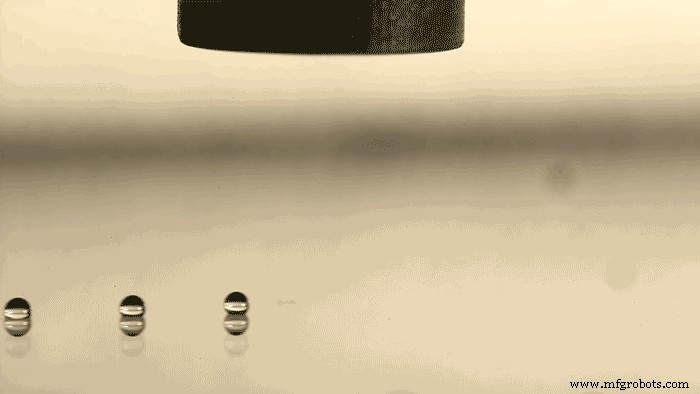 Credit: Daniele Foresti/Jennifer A. Lewis/Harvard University
The sub‑wavelength acoustic resonator delivers an acoustic field 100× stronger than gravity (1 g) at the nozzle tip—four times the Sun’s gravitational pull. When a droplet reaches its critical size, the acoustic force extracts it from the nozzle and propels it to the target location. Importantly, the droplet’s size is set by the wave amplitude, independent of the liquid’s viscosity.
Reference: Science Advances | doi:10.1126/sciadv.aat1659 | Harvard University
Testing and Applications
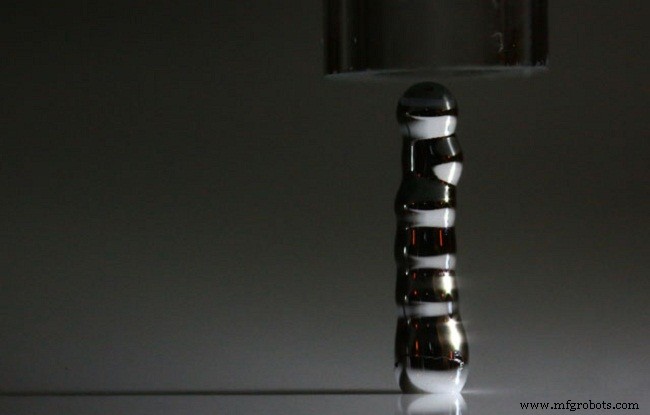 Credit: Daniele Foresti/Jennifer A. Lewis/Harvard University
The method was validated on a diverse set of materials—biopolymers, honey, optical resins, stem‑cell inks, and liquid metals. Because sound waves cannot penetrate droplets, the technique preserves the integrity of delicate biomolecules such as proteins and living cells.
Read: Scientists 3D Print An Artificial Human Cornea Using ‘Bio‑ink’
Researchers anticipate that acoustophoretic printing could revolutionize the production of cosmetics, biopharmaceuticals, and food, and expand the use of conductive and optical materials.
Industrial Technology
- Precision Flat Lapping Services: Advanced Applications for Industrial Surface Finishing
- 4 Key Steps to Safeguard Contract Employees During COVID-19
- 3‑Axis vs 5‑Axis Machining: What You Need to Know
- Optimizing Grab Sampling in Large-Scale Industrial Construction Projects
- Interconnect Defects: Debris-Driven and Copper Bond Failures Explained
- Explore 6 Cutting‑Edge Mold Manufacturing Technologies
- Why Electrical Safety Matters: Protecting Your Life and Work
- How Globalization and Industry 4.0 Are Transforming International Business
- Why Smart Factories are Essential for Modern Manufacturing
- Fiber Laser Cutting: The Optimal Choice for Modern Metal Fabrication Projects