



Electric Propulsion Breakthrough Accelerates Nanorobots 100,000× Faster
- Scientists have pioneered a low‑cost, contact‑free electric field technique to control nanorobotic arms.
- Electrical steering offers a dramatic speed increase, making nanorobots fast enough for real‑time molecular manufacturing.
- Potential applications span diagnostics, pharmaceutical synthesis, and precision molecular manipulation.
Researchers at the Technical University of Munich have engineered an electric propulsion system that propels DNA‑based nanorobots up to 100,000 times faster than traditional biochemical methods, unlocking the possibility of fully autonomous molecular factories.
This milestone marks the first demonstration of planar rotation and control of nanorobotic arms via external electric fields.
DNA Origami Nanorobots
Advances in DNA origami allow the fabrication of functional nanomachines at scale and low cost. Yet, their practical deployment has been limited by sluggish motion, typically powered by DNA strands, enzymes, or light.
Compared with optical tweezers, magnetic manipulation, or scanning probe techniques, electric control delivers orders‑of‑magnitude faster movement while requiring inexpensive, non‑contact instrumentation.
In this study, researchers achieved five orders of magnitude speed improvement over the fastest previously reported DNA motors.
Electric Field‑Driven Biomolecule Actuation
DNA’s intrinsic negative charge makes it responsive to electric fields, enabling precise steering of nanobots. The team fabricated millions of 400 nm long arms mounted on 55 × 55 nm base plates, with a flexible joint that permits random rotation about the horizontal axis.
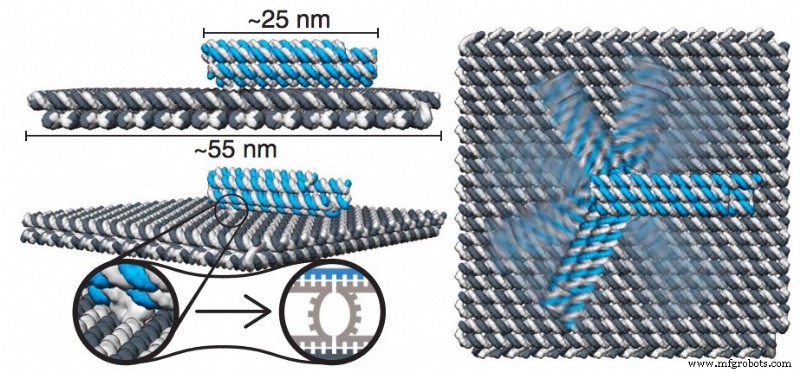
Reference: Sciencemag, 2026 – Technical University of Munich
By marking the arm tips with fluorescent dyes, the team visualized motion under a microscope. Adjusting the electric field direction produced millisecond‑scale, reversible arm reorientation, effectively initiating locomotion on a practical timescale.
Applications and Future Directions
Beyond mere transport, the electric propulsion platform can exert forces on biomolecules, opening avenues for targeted drug delivery, high‑throughput diagnostics, and on‑chip chemical synthesis.
Millions of these nanobots can operate in parallel, enabling rapid screening of specific analytes or the assembly of complex molecular structures.
Scalable integration with lithographic patterning and self‑assembly methods allows the creation of extended lattices or filamentous networks of nanorobotic arms, facilitating large‑scale hybrid systems.
Algorithmic self‑assembly can generate diverse robot platforms tailored to distinct tasks, while lithographic substrate patterning provides precise orientation control.
Individual arm manipulation becomes feasible through nanostructured control electrodes, paving the way for DNA‑templated synthesis and highly selective nanomanipulation.
Industrial Technology
- Build Complex Components with Protolabs' Insert Molding Technology
- AI Drives Real-Time 3D Hair Rendering with 30,000 Strands
- Industry 4.0: Benefits, Risks, and Implementation Challenges
- Seco & Fusion Coolant Systems Launch Safer, Eco‑Friendly Machining Solutions
- 7 Proven Ways to Maximize Your CMMS Value
- Avoid Common Mistakes in Stainless Steel Fabrication for Superior Quality
- Expert Guide to Welding Cast Iron: Proven Techniques for Strong, Durable Joints
- Precision Machining Explained: Key Tips & Best Practices for CNC Operations
- Understanding Look‑Up Tables: From ROMs to Advanced ALUs
- Electrochemical Grinding Explained: How It Works & Key Benefits