



IO‑Link: Overcoming Industrial Automation Bottlenecks
Industry 4.0 relies on high‑level automation and real‑time, bi‑directional data flows between controllers and field devices. Smart sensors and actuators—now ubiquitous—have given rise to the IO‑Link protocol, a standardized way for these devices to communicate within industrial automation systems.
Historically, field devices were wired in parallel, a setup that was inflexible, costly, and hard to scale. Fieldbus technologies improved the situation but still required shielding and offered low signal levels. IO‑Link eliminates these pain points by providing a simple, shield‑less, point‑to‑point interface that integrates seamlessly with existing fieldbus networks.
According to Future Market Insights, the global IO‑Link market is projected to grow from $48.3 billion in 2022 to $73.1 billion by 2032, registering a compound annual growth rate of 26 %.
What Is IO‑Link?
IO‑Link, launched in 2006 by the IO‑Link Consortium, is an IEC‑61131‑9 international standard for I/O communication in industrial settings. Key features include:
- Bi‑directional, digital, point‑to‑point communication—often called a single‑drop communication interface (SDCI).
- Fieldbus neutrality: an IO‑Link master can sit on top of Profibus, Profinet, Devicenet, Ethernet/IP, EtherCAT, CC‑Link, or CC‑Link IE, giving architects the freedom to choose the best backbone for their plant.
- Standard unshielded cables (three‑, four‑, or five‑wire) up to 20 m in length, powered at 24 V, carrying switching or coded signals.
- Each device is identified by a unique IO‑Device Description (IODD), which stores its communication profile and configurable parameters.
- Supported baud rates of 4.8, 38.4, and 230.4 kbaud.
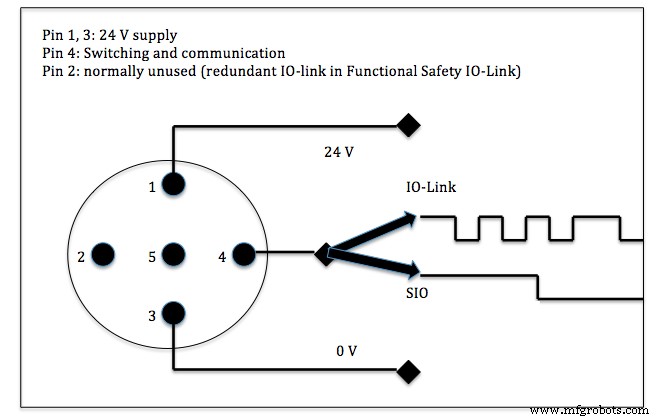
Figure 1: Typical 3‑pin IO‑Link pin configuration (Source: Sonu Daryanani).
- Periodic or event‑driven data, including process values and status flags, can be queried by the master at any time.
Advantages of IO‑Link
To illustrate its benefits, consider two real‑world applications: a hydraulic cylinder system and a packaging line.
1. Hydraulic Cylinder Control
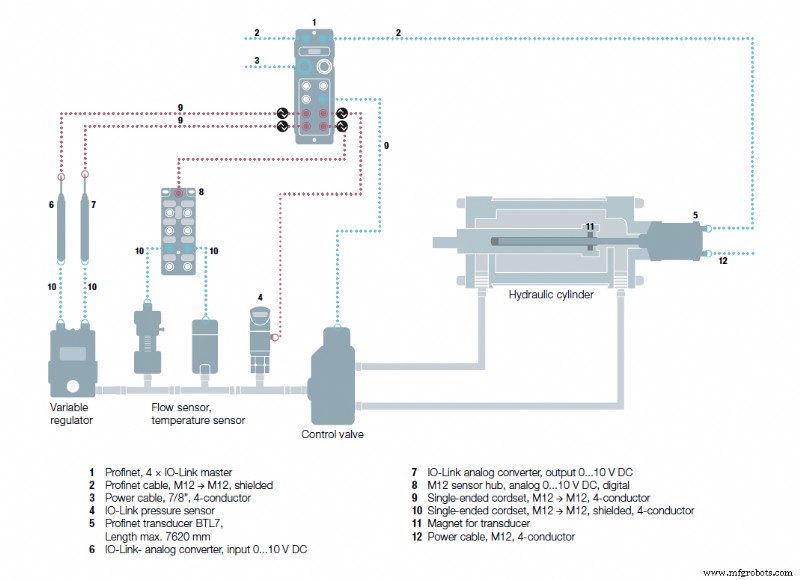
Figure 2: Hydraulic cylinder control using IO‑Link (Source: Balluff Inc.). IO‑Link enables accurate measurement and regulation of temperature, flow, and other analog signals via Balluff’s configurable analog converters. These devices translate RTDs, thermocouples, and other analog inputs into digital values while providing diagnostics for short circuits, temperature excursions, and wire breaks.
Analog data normally accounts for about 10 % of total traffic and traditionally required shielded cables and costly multi‑channel modules. With IO‑Link’s noise‑immune, point‑to‑point wiring, simple unshielded cables suffice, reducing both wiring and commissioning costs.
“IO‑Link delivers cost savings through simplified wiring, rapid parameter downloads, and a unified interface that works across vendors,” says Shishir Rege, automation specialist at Balluff.
Safety devices, such as interlocks and switches, can also be integrated, as shown in Figure 3.
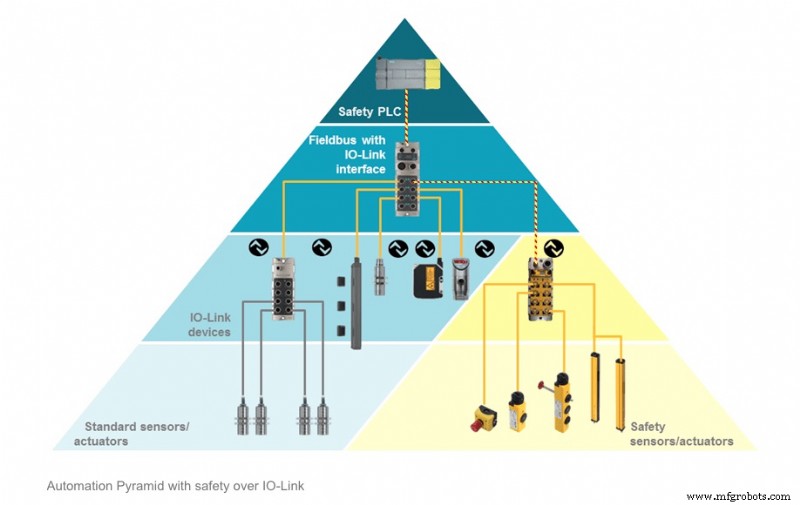
Figure 3: Integration of safety sensors via IO‑Link (Source: Balluff Inc.).
2. Packaging Automation
Packaging lines demand rapid changeovers, high resolution positioning, and robust diagnostics. Sensata Technologies’ IO‑Link sensors—including absolute encoders (AHx5, THx5), incremental encoders (DHx5), and Hall‑effect position sensors (ACW4, TCW4)—offer plug‑and‑play configuration and real‑time monitoring.
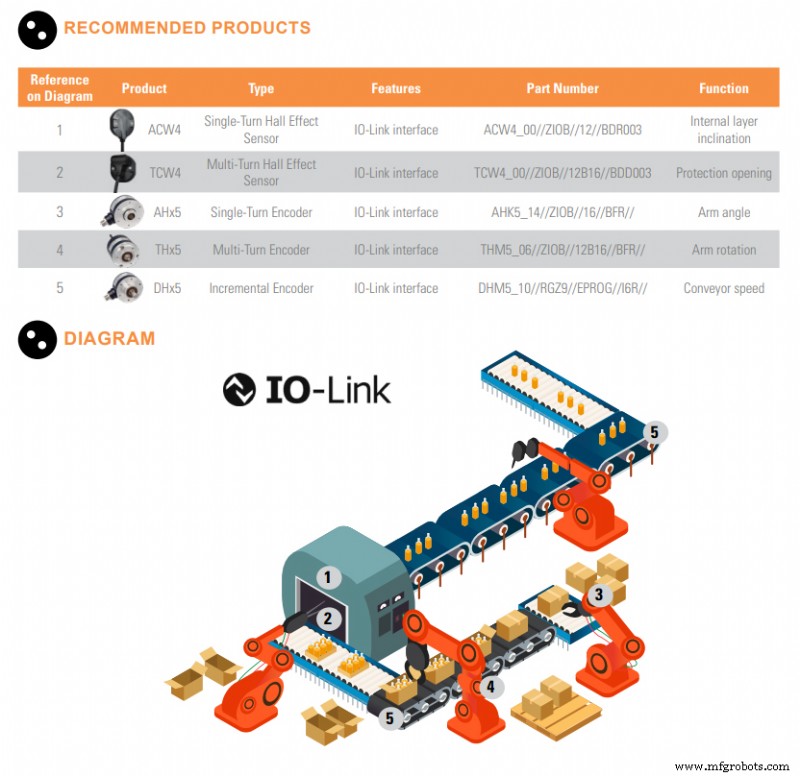
Figure 4: Packaging automation schematic with IO‑Link (Source: Sensata Technologies Inc.).
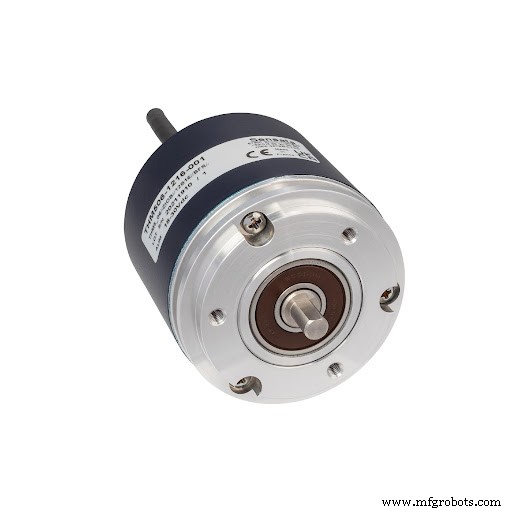
Figure 5: THM5 multi‑turn encoder (Source: Sensata Technologies Inc.).
“IO‑Link’s plug‑and‑play capability, combined with fast diagnostics and a 1 ms cycle time at 230.4 kbaud, dramatically cuts downtime and improves flexibility,” says Jean‑Marc Hubsch, engineering manager for encoders at Sensata.
IO‑Link System Extensions
IO‑Link Wireless
IO‑Link Wireless mirrors the wired protocol but operates in the 2.4‑GHz band, ideal for mobile or non‑stationary field devices. A master can host up to five channels, each supporting eight devices, enabling 40 devices per master and 120 devices per cell in a high‑EMI environment.
IO‑Link Safety
IO‑Link Safety extends the protocol with functional safety (FS) communication. Safety‑enabled devices (output switching sensing devices, OSSD) can be connected via redundant signals—leveraging pin 2 in the standard 3‑pin configuration—providing certified safety functionality.
Conclusion
IO‑Link delivers a single, standardized interface that unifies smart sensors from multiple manufacturers, enabling remote, real‑time configuration and diagnostics. By eliminating shielding requirements, reducing wiring complexity, and supporting future extensions such as wireless and safety, IO‑Link accelerates the adoption of Industry 4.0 across diverse sectors.
Keywords: 5G antenna design, 5G vs fiber, ADC resolution, analog computing, analog modulation, analog‑to‑digital converters, audio vs digital interfaces, automation, design for manufacturing, GAN on SiC, Halo Wi‑Fi, industrial, Industry 4.0, SiC doping, SiC vs GAN, silicon carbide sponges.
Industrial Technology
- Harness Industry 4.0: Proven Strategies for Building a Winning Digital Roadmap
- Nail Guns Explained: Function, Types, and Key Benefits
- Key Elements of Modern Steel Building Construction
- How a Petrochemical Giant Slashed Utility Gas Costs
- Custom Barge Stabilizer Supports 1500‑Ton Crane for Gulf of Mexico Bridge Project
- Effortless Remote RS232/RS485 Connectivity for PLCnext PLCs Using Pseudo TTY
- Understanding Ship Bulwarks: Definition, Height, and Construction
- 2N3055 Transistor: Comprehensive Guide, Features, and Applications
- Elevating Quality Standards in Automotive Manufacturing: Best Practices & Compliance
- Rake vs. Flank: Understanding Cutting Tool Surface Differences for Optimal Machining