



ISO 2768 Demystified: Tolerance Class, Chart, and Practical Drawing Examples
In most engineering drawings you’ll see a brief note such as:
GENERAL TOLERANCES: ISO 2768‑m
This shorthand tells the manufacturer which default tolerances apply to every dimension that isn’t individually specified.
ISO 2768 is the go‑to standard for simplifying drawings across mechanical engineering, CNC machining, sheet metal fabrication, and general manufacturing. By applying a single tolerance class, engineers can reduce clutter, speed up reviews, and keep costs predictable.
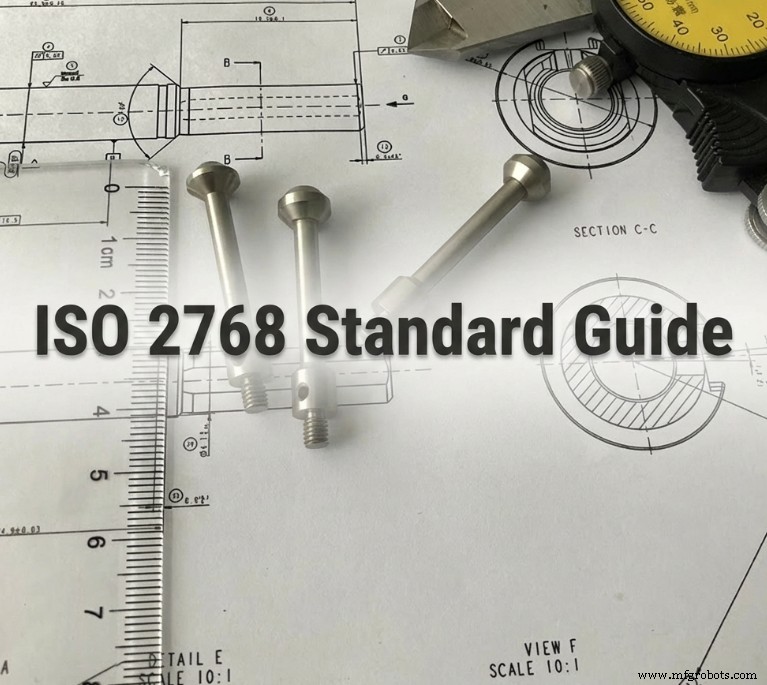
What You’ll Learn
- What ISO 2768 means and why it matters
- Details of the ISO 2768‑m medium tolerance class
- The official tolerance chart for linear dimensions
- How to read a real drawing that uses ISO 2768
- Common pitfalls and manufacturing best practices
ISO 2768 Explained
ISO 2768 is an international standard that defines general tolerances for linear, angular, and geometric dimensions when no explicit tolerance is listed on a drawing. The standard is split into two parts:
- ISO 2768‑1 – General tolerances for linear and angular dimensions
- ISO 2768‑2 – General geometric tolerances
Both parts are published by the International Organization for Standardization (ISO 2768‑1:1989, ISO 2768‑2:1989).
What Does ISO 2768‑m Mean?
The letter m denotes the *medium* tolerance class, the most frequently used class in mechanical design and CNC machining. It strikes a balance between manufacturability and cost while still offering acceptable precision for many functional features.
ISO 2768 defines four tolerance classes:
| Class | Meaning |
|---|---|
| f | Fine |
| m | Medium |
| c | Coarse |
| v | Very Coarse |
Note: ISO 2768 only applies to dimensions that lack an explicit tolerance. Any dimension with a listed tolerance overrides the standard.
ISO 2768 Linear Tolerance Chart (ISO 2768‑m)
| Nominal Length (mm) | Tolerance (ISO 2768‑m) |
|---|---|
| 0.5 – 3 | ±0.1 |
| 3 – 6 | ±0.1 |
| 6 – 30 | ±0.2 |
| 30 – 120 | ±0.3 |
| 120 – 400 | ±0.5 |
| 400 – 1000 | ±0.8 |
Example: A 25 mm feature marked as ISO 2768‑m is allowed to vary from 24.8 mm to 25.2 mm.
Reading an ISO 2768 Drawing
Typical notation on a drawing:
m– General dimensional tolerance (ISO 2768‑1)K– Geometric tolerance class (ISO 2768‑2)
Example:
| Dimension | Tolerance Source |
|---|---|
| 25 mm | ISO 2768‑m |
| Ø12 ±0.02 mm | Explicit tolerance (overrides ISO 2768) |
| 100 mm | ISO 2768‑m |
When to Use ISO 2768
- Most dimensions do not demand tight tolerances
- The design tolerates standard manufacturing deviations
- Engineers want to keep drawings concise
Typical applications include CNC machining, sheet metal fabrication, laser cutting, welded structures, and general mechanical parts. Always specify explicit tolerances for critical functional dimensions.
When ISO 2768 Should Not Be Used
- Fit tolerances (e.g., H7/g6)
- Thread tolerances
- Surface roughness specifications
- Geometric Dimensioning & Tolerancing (GD&T) features that require precision
- Any dimension that already has an explicit tolerance
ISO 2768 in CNC Machining
ISO 2768‑m is the most common tolerance class for machined parts because it aligns with typical machine capabilities while keeping costs down.
Typical CNC capabilities versus ISO 2768‑m:
| Process | Typical Capability |
|---|---|
| CNC milling | ±0.01–0.02 mm |
| CNC turning | ±0.01–0.03 mm |
| ISO 2768‑m | ±0.1–0.8 mm |
Most CNC setups can comfortably meet ISO 2768‑m tolerances, but functional features such as bearing seats or sealing surfaces still require explicit tolerances.
Common Misunderstandings
- ✅ Misconception: ISO 2768 applies to every dimension
Fact: Only to dimensions without specified tolerances - ✅ Misconception: ISO 2768 guarantees manufacturability
Fact: Actual process capability still determines achievable tolerances - ✅ Misconception: ISO 2768 replaces GD&T
Fact: GD&T and ISO 2768 serve different purposes; critical features must still be explicitly defined
Precision CNC Machining Services
When tighter tolerances than ISO 2768‑m are required, precision CNC machining can achieve ±0.01–0.03 mm depending on material and process. These services are ideal for parts where functional geometry dictates stricter limits.
FAQ
- Q1: What does ISO 2768‑m mean?
A: It denotes the medium tolerance class for unspecified dimensions. - Q2: How does ISO 2768‑m differ from ISO 2768‑f?
A: ISO 2768‑f is finer, while ISO 2768‑m is medium. - Q3: Does ISO 2768 replace GD&T?
A: No; ISO 2768 only defines general tolerances and does not replace GD&T specifications. - Q4: Can ISO 2768‑m be used for CNC parts?
A: Yes; it is commonly applied to CNC machined parts for a balance of precision and cost.
References
- International Organization for Standardization (ISO 2768‑1:1989, ISO 2768‑2:1989)
- CNCLATHING: ISO 2768 Tolerance Chart PDF
Industrial Technology
- Essential 16 Tools Every Electrician Needs (2019‑2020)
- Bare PCB Design & Manufacturing: Expert Steps for Engineers
- Norton’s Theorem Simplified: Step‑by‑Step Tutorial with Practical Example
- Utility Asset Tags: Boosting Accuracy & Efficiency in the Energy Sector
- Optimal Timing for Calls, Emails, and Social Posts: A B2B Manufacturer’s Guide
- Lean Manufacturing: Fueling Business Health and Growth
- How to Design and Acquire Premium Medical-Grade PCBs: 7 Expert Tips
- Three Leading Examples of Advanced Manufacturing Technology
- Sparse Fill vs. Solid FDM Parts: How to Choose the Best Build Strategy
- Camcode Achieves ISO 9001 Certification, Elevating Quality Standards