



Unlock Production‑Grade Additive Manufacturing with Smart DFAM Design
Published on September 27, 2023

Replicating existing parts with additive manufacturing is feasible, but it rarely leverages the full potential of the technology. To unlock maximum performance, cost savings, and material efficiency, you should design from scratch with additive‑specific opportunities and constraints in mind—essentially applying Design for Additive Manufacturing (DFAM) principles.
DFAM extends the well‑established concept of Design for Manufacturability (DFM) by integrating process planning directly into product development. While DFM focuses on conventional methods such as urethane casting or injection molding, DFAM tailors the design for industrial‑grade additive processes, balancing competing factors to produce the most efficient, cost‑effective part.
Creating a production‑grade component is more than simply pressing “print.” DFAM guides designers to achieve the same performance as traditionally manufactured parts while slashing lead times, eliminating tooling expenses, and maximizing design freedom. By embedding DFAM guidelines early, teams can fully capture additive manufacturing’s strategic advantages.
Below are key DFAM principles that differentiate prototype‑level additive builds from true production‑grade parts:
Minimize Overhangs and Reduce Reliance on Supports
Each layer of an additive build depends on the one beneath it for support. Features such as large overhangs or open sections often require additional support structures to prevent warping and maintain tolerance. Designs that follow DFAM best practices are self‑supporting, reducing material waste and post‑processing. If supports are unavoidable, orient the part so that support remnants lie in non‑visible areas, thereby lowering sanding and finishing time.
Part Orientation
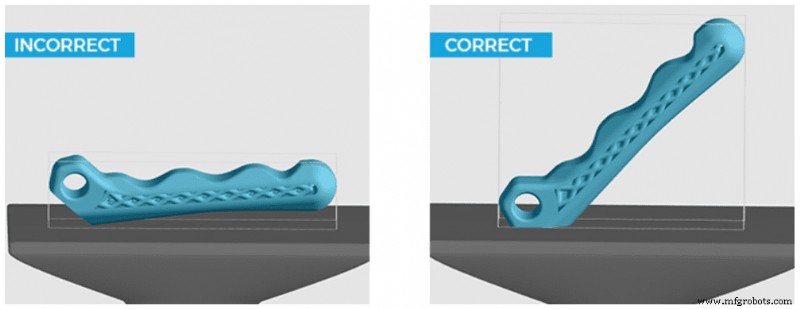
While additive printers can build parts from numerous angles, the build orientation influences surface finish and dimensional accuracy. Because tolerances can be breached by even slight deviations, evaluating multiple orientations during the early design phase helps identify the optimal build direction that meets specifications and streamlines production.
Consolidate Multi‑Part Assemblies
Complex geometries that require multi‑part assemblies in conventional manufacturing can often be unified into a single part with additive methods, cutting assembly labor and cost. For example, when Steelcase redesigned an arm cap, we transformed a three‑part assembly into one seamless component featuring multiple functional zones.
Leveraging Generative Design to Optimize Your Part
Additive manufacturing unlocks unique geometries that allow designers to employ generative tools—topology optimization, lattice structures, and more—to tailor a part’s internal architecture based on hundreds of variables. Lattice designs enable precise control over strength and material density across different regions, enabling a single part to satisfy varying performance requirements.
The Most Important Additive Manufacturing Design Consideration
These guidelines are valuable, but the greatest barrier to adopting production‑grade additive manufacturing remains the skills gap in product design. The most critical step is to engage additive‑manufacturing experts from the outset. They can recommend design modifications that optimize cost and performance, and they know how to harness supply‑chain efficiencies like on‑demand production and virtual warehousing. The sooner you partner with seasoned AM design engineers, the greater the upside of your transition.
Interested in learning more? Explore our article on advancing beyond prototyping and building a compelling case for additive manufacturing. At SyBridge, we partner with companies across industries to discover, design, and develop production‑grade parts using additive technologies. Our experienced design team delivers precisely tuned solutions that meet your performance and design needs. We’ve helped multi‑million‑dollar companies realize substantial value with additive manufacturing—and we can do the same for you. Get in touch today.
Industrial Technology
- Selecting the Optimal Motor Cable for Variable Speed Drives (VSDs)
- Arduino Unveiled: Mastering DIY Microcontroller Projects
- Boosting Production: How Automation Enhances Injection Molding Efficiency
- Unlocking Global Supply Chain Visibility with Advanced TMS Solutions
- Discover Why These Aluminum Alloys Are Ideal for CNC Machining
- Mastering Manufacturing Recruitment: Strategies & Insights
- Alternator Rewinding: Why It Matters & When to Schedule Repairs
- How Global Manufacturing Networks Boost Efficiency, Quality, and Market Reach
- Practical Roadmap for Deploying Generative AI in Legal Operations
- Trigonometric Derivatives: Mastering the Fundamentals