



Mastering Quality Control: Strategies for Consistent Excellence
Quality Control
There are two terms which are frequently used for ensuring the quality of a product or service. These terms are ‘quality control’ and ‘quality assurance’. These two terms are often used interchangeably. However these two terms differ in meaning. Quality control is an evaluation to determine needed corrective action. It is an act of guiding a process where variables are kept under constant observation and control within a range of limits. It is based on measurement and control of the parameters which can affect the quality of product or services. On the other hand quality assurance is an activity which gives confidence and make doubly sure that the things will not go wrong. Quality assurance takes place through a planned and systematic activity normally through procedures designed for meeting the quality requirements for a product or service.
The ISO definition states that quality control is the operational techniques and activities that are used to fulfill requirements for quality. This definition could imply that any activity whether serving the improvement, control, management or assurance of quality could be a quality control activity.
Quality control is a process for maintaining standards. Standards are maintained through a process of selection, measurement and correction of work, so that only those products or services emerge from the process which meets the standards. In simple terms, quality control prevents undesirable changes being present in the quality of the product or service being supplied. Quality control can be applied to particular products, to processes which produce the products, or to the output of the whole organization by measuring the overall quality performance of the organization.
Quality control is often considered to be an activity which takes place after the event is over. This means that the quality is determined after the completion of the activity and the action to correct the deficiencies takes place post event for future activities. However, one can control results by measuring parameters before, during or after the results of the activity is achieved. It all depends on where and when the measurement takes place in order to avoid the consequences of failure. Some failures cannot be allowed to occur and so must be prevented from happening through rigorous planning and design. Other failures are not so critical but must be corrected immediately.
Production system and quality control
The goal of any production system during its operation is to generate a product which is aimed at and which is useful. The product of the production system can be a physical object, service, or information. Every production cycle begins with inputs that are transformed by a process into a more desired state or into the product. Besides raw materials every process needs resource (consumables, energy, utilities, and operating parts etc.). The production inputs to a process can be classified as (i) man (persons executing or controlling the process), (ii) machine (equipment, furnace or machinery used in the execution of the process), (iii) material (raw materials, resources or spare and operating parts required in the process), (iv) methods (procedures and sequence used to execute the process), and (v) information (work instructions, control parameters, data, and instrument’s readings that guide process execution).
In every process, large amount of variations and discrepancies in the process parameters can cause nonconformities, with five undesirable consequences namely (i) scrapped or wasted raw materials and resources, (ii) degraded process throughput, (iii) contamination from undetected nonconformities causing degradation of the product to seconds or causing its total rejection, (iv) damage to the process equipment, and (v) unsafe working conditions for man and equipment.
The goal of quality control in any production system is to (i) provide inputs for taking timely corrective actions, (ii) eliminate nonconformities and their consequences, (iii) eliminate rework, wasted raw materials and resources, and (iv) achieve the goals at the lowest possible cost. Different components involved in quality control are shown in Fig 1
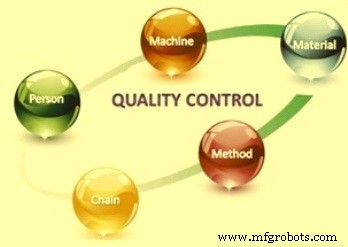
Fig 1 Components of quality control
Evolution of quality control
Many of the quality control methods were initially developed to aid manufacturing since high volume production needs several repetitive steps involving a controlled sequence of operations. Since during operation of a process, the activities are frequently repeated, it is easier to recognize processing errors and identify appropriate control measures. Historically, the first quality control methods were based on inspections.
Inspections are usually done on the products of a process and are made after the process has transformed inputs into a product. Inspections can be visual or are carried out with the help of gauges, instruments and testing machines. During the inspection, the product can pass, segregated for reworking, downgraded or rejected. Inspections are carried out based on applicable product standards. In order to ensure that the inspection results are consistent from one location to another, the gauges, instruments and the testing machines used in inspection are to be traceable to national standards.
Steps in quality control
The activity of quality control is carried out in the following steps.
- Study of the process so as to have complete knowledge of raw materials including their complete parameters, the process including the equipments, instrumentation and automation, the resources and their specifications and the products and byproducts of the and their specifications.
- Determination of the process parameters which are required to be monitored and controlled. Also decision regarding the range of values within which these parameters are to be controlled.
- Establishment of the sampling and testing methods for the raw materials, resources, emissions and the products.
- Establishment of the frequency of testing for the raw materials, resources, emissions and the products. Also decision regarding the limits of acceptability and the units of measurement.
- Determination of the criticality of the monitoring and testing so that corrective actions can be taken in time to avoid process and product going out of control or becoming unsafe for operation.
- Preparation of plans for control which specifies the means by which the process and product characteristics will be achieved as well as variations detected and removed. These plans are to be in the form of approved written document in form of procedures.
- Organization of resources to implement the plans for quality control.
- To ensure that gauges, instruments and testing equipment are available in working order at appropriate points in the process to know the variance from specification.
- To collect and record and transmit the data to a place for analysis.
- To verify the results and diagnose the cause of variance.
- To take remedial action and to decide on the action needed for restoring the process to a healthy state.
Practical considerations of quality control
Implementation of quality control needs resources, expertise and time. The following are the practical aspects of quality control.
- Quality control personnel are to work in complete harmony with all the connected departmental personnel especially with the personnel connected with operation of the process.
- Technological discipline is very important for quality control. Even small violation can have disastrous effect on the process.
- Speedy communication is an important aspect for quality control. It is necessary that monitoring and testing data as well as inspection results are shared with the concerned personnel without any delays.
- Quality control procedures are to follow the require standards and are to be comprehensive taking into considerations the process and product needs, facilities available and the operating personnel’s requirements.
- All the quality control personnel are to be well trained both in process and quality control activities.
- Frequency of quality control checks must meet the process as well as standard’s requirements.
- Quality control data is to be properly and systematically recorded and controlled for analysis and for future use.
- Quality control functions are to be carried only by those personnel who have the required expertise.
Manufacturing process
- Control Circuits: Fundamentals, Applications, and Best Practices
- Establishing Robust Quality Control for 3D Printing Success
- Leveraging IoT for Superior Quality Control in Manufacturing
- Enhancing Quality Control in CNC Machining: Strategies for Precision and Customer Satisfaction
- Understanding Quality Control: Ensuring Consistent Excellence
- Ensuring Precision: Comprehensive Quality Inspection & Control in CNC Machining
- Ensuring Precision: Quality Control in CNC Machining
- Streamline Packaging Quality Assurance with Advanced Automated Control Systems
- Enhancing Quality Control: The Power of Sampling Plans for Small Metal Parts
- Quality Control: Ensuring Steel Integrity for Reliable Fabrication