



Essential Phases of Designing & Constructing a Steel Plant
Phases in the Design and Construction of a Steel Plant
Steel plant is a project which is highly capital intensive and need a very long time for its construction and commissioning. Further steel plant is to operate for a very large number of years after commissioning and during this period steel plant has to cope with the changes in the operating environment. Hence proper decision making is of utmost importance during the different phases of the plant till commissioning. Any faulty decision during the implementation phase can create a lot of problems for the operating personnel and they have to live with the problem throughout the life of the plant. Various phases of the design of a steel plant and the decisions needed during these phases are described here.
Selection of product mix
Steel plant is set up to produce certain primary steel products which are required by the customers. During the production of primary steel products, some secondary products and by products are also produced which are to be sold. Selection of the product mix is a very important decision making process since the technology and production process selection in the plant depends on the product mix. Criteria for selection of the product mix include market survey, future demand projections by dependable agencies, and government policies and projections etc. Another important criterion for the selection of the product mix is the type of market the plant is to serve after commissioning. The market can be (i) captive use, (ii) local market, (iii) national market, (iv) export market, or (v) all of them.
Site selection and land acquisition
After the product mix is frozen the next step is the selection of site for the steel plant. The selection of a suitable site is a very critical activity since the investment is very large and it influences the economies of the area very much. It is a strategic decision that cannot be changed once taken. The changes in selected site can be done only with a considerable loss of time and money. Normally the final site selection is done after evaluating several sites. The details of the activities for site selection are described in the article http://www.ispatguru.com/site-selection-activity-for-a-greenfield-steel-plant/.
The land for the plant is to be acquired at the selected site. In addition to the land needed for the plant and the facilities, the land to be acquired should include (i) land needed for green belt as per norm which is presently 33 % of the land needed for the plant and the facilities, (ii) land needed for the road and rail approaches for the plant, (iii) land needed for the incoming HT line, (iv) Land needed for the facilities for the receipt of water in the plant, and (v) land needed for providing living facilities to a certain percentage of employees.
Feasibility report
The preparation of feasibility report (FR) is next step. The feasibility report can be a brief feasibility report sometimes called technical note, detailed feasibility report (DFR), or a techno economic feasibility report (TEFR). Earlier after feasibility report it was a practice to prepare a detailed project report (DPR). However DPR is not being made now-a-days.
TEFR is the most important document since it is the basis for all the future work. It is important that the TEFR is prepared with a lot of attention and with great accuracy. TEFR is needed by the financial institution for the purpose of funding the project. The TEFR contains the following aspects of the project.
- General scenario
- Product mix for the plant containing both the primary, secondary and the byproducts
- Technology and process selection for the plant
- Material balance for the plant and development of process flow sheet for the entire plant
- Determination of raw materials requirements, their specification along with description of their receipt and handling in the plant.
- Finalization of plant general layout. This is described in more details in the article http://www.ispatguru.com/considerations-in-general-layout-of-a-steel-plant/
- Preliminary detailing of plant processes and equipment and development of preliminary shop layouts.
- Preliminary detailing of plant auxiliary processes and equipment and development of preliminary shop layouts. A typical shop layout for an air separation plant is shown in Fig 1.
- Determination of power, water, fuel and utilities requirements and facilities of their receipts, handling and storages.
- Gas, power and water balance for the plant
- Description of plant internal logistics
- Determination of plant manpower requirement both for construction stage as well as operation stage and recommendations for their placement plans.
- Projection of requirement of construction materials for the plant
- Plant construction scheduled in sufficient details.
- Working out the project costs and operating costs
- Working out the plant profitability and IRR (internal rate of return) over a period of time.
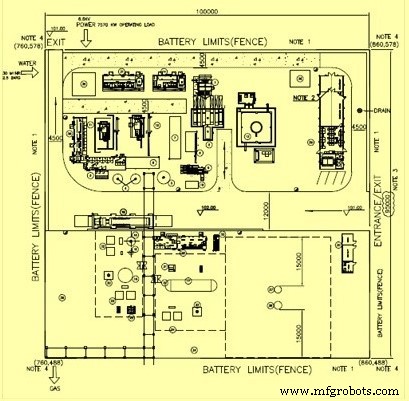
Fig 1 Typical shop lay out for an air separation plant
Post feasibility report activities
Post preparation of TEFR, several activities are required to be completed before the plant detailed engineering and construction activities start. These are given below.
- The TEFR once accepted by the plant owners is submitted to the financial institutions for the purpose of tying up the required finances for the construction and commissioning of the steel plant.
- The job of the environmental clearance (EC) for the plant is given to an authorized agency. The environmental clearance is a time consuming and the work on it should start as early as possible. Work on EC can start during midway of preparation of TEFR. The important steps for EC include scoping, public hearing, NOC (no objection certificate) from local pollution control authorities, preparation of environmental impact assessment (EIA) and environmental management plan (EMP) report as per the norms and its submission to the authorities, and the defence of the report in front of the authorities. Preparation of EIA and EMP report take time since the report is to be based on the actual field data collected at the plant site by the agency preparing the report. Construction activities at site can start only after receipt of EC from the authorities.
- Allocation of power and water from the state agencies both for construction as well as operation is to be tied up.
- Government is to be approached for the allocation of mines and till it is done MOU is to be entered with the leading raw material suppliers to ensure security of raw material supplies.
- Approvals from various other regulatory authorities such as factory inspectorate, railways for the movement of raw materials and finished products, labour inspectorate, and electricity inspector etc. are to be obtained.
- Survey of the land at the site and site leveling
- Recruitment of construction manpower
- Construction of boundary wall and security posts at the land site
- Carrying out the enabling works which include construction of approach road and approach rail line, facilities for construction power and construction water, facilities for communication during construction, construction stores, construction offices and canteens, construction of first aid centre, provision of fire fighting facilities, temporary colonies for construction employees, construction of concrete preparation plant, and procurement of mobile and transport equipment needed for construction etc.
- Organization has to develop a drawing archives department so that all the drawings and documents being received in the plant are systematically kept and issued to the consultants and contractors at the time of need. For record purpose one ‘not to be issued’ copy and one copy for the reference purpose should always be maintained in the archives.
Ordering of plant and equipment
The activity of ordering of the plant and equipment can start immediately after starting the activity for environment clearance. However actual orders are to be placed when there is sufficient progress with regards to the EC. For ordering, the complete plant is to be divided into a number of packages. The number of packages should not be too many since the large number of packages need bigger set up at the plant whose utility will not be there once the plant gets commissioned. The plant and equipment can be ordered either on complete turnkey basis or partly turnkey basis where civil work, building structures and equipment erection activities are excluded. An executive of the organization is to be overall incharge of each package. This executive is to coordinate all the activities regarding the package within the organization and with the supplier. The following activities are involved in the process of ordering of plant and equipment.
- Preparation of general standard specifications (GSS) which are common for entire plant and are part of all the tender enquiries.
- Preparation of package wise tender specification. Each tender specification is to have four parts namely (i) technical specification, (ii) commercial specification, (iii) enlisting of applicable standards, and (iv) GSS.
- Invitation to the tender along with the four specifications is to be sent to the selected short listed parties. In order to get only the useful offers, normally limited tender enquiry process is adopted.
- Receipt of the offers
- Evaluation of the offers. The offers should be evaluated by a team of executives covering all the disciplines included in the tender specification.
- Negotiation with the selected party
- Approval of the negotiation and placement of order
Post order engineering activities
The following are the post order engineering activities.
- After the receiving the order, the supplier updates the shop layout, the relevant part of the general layout, delivery and construction schedule and freeze them in the kick off meeting with the organization and its consultant. During this meeting take over points conditions for power, water, utilities and fuels are to be frozen.
- Supplier provides the feedback data for the civil and structural construction drawings to be prepared by a consultant or provide the civil and structural construction drawings as per the conditions of the contract.
- The quantities for civil and structural works are estimated and contractor for civil and structural work is fixed for carrying out the job.
- Since the civil construction work is large, one or two concrete preparation plants are to be constructed and commissioned at the plant site.
- Procurement action for cement, reinforcement steel bars, steel sections, sheets for roofing and side walls, sand, and stone chips is to start and a safe stock of these materials are to be maintained in the stores to ensure continuity of construction work.
- Work on civil work to start. Disruption of civil work during monsoon is to be kept in mind while planning for the civil work.
- Fabrication of building structures is to start so that the building structures are ready by the time their foundations are ready.
- Lists for equipment, commissioning spares, consumables, and operating parts, general arrangement (GA) drawings, specifications of major equipment, piping and instrumentation (P&I) diagrams, flow diagrams for water, utilities, and steam, control philosophy and scheme, and single line diagrams for power are to be submitted by the supplier for approval by the organization or by the consultant of the organization.
- Erection manual for the equipment is to be supplied well before the start of the erection.
- Manufacturing drawings along with detailed specifications for procurement for the fast moving spares and operating parts as well as the lists of two years spares and insurance spares are to be submitted by the supplier so that organization can take action for the procurement action of these items well in time.
- Cranes and handling equipments are to be erected well in time so that the shop equipment can be erected by permanent facilities as far as possible.
- The supplies of the equipment are to be regulated in such a manner that they can be placed immediately on foundation once they are received in the plant. Further handling instructions are to reach the plant in advance for the equipment which are sensitive to damage during handling.
- Equipment erection is to be carried out by the erection contractor under the supervision of the supplier representatives.
- To avoid accidents during construction and erection activities construction safety norms and fire safety norms are to be strictly followed.
- The activities of the supplier and various contractors are to be monitored on a regular basis. There are to be regular review meetings with all concerns so as to closely co ordinate all the activities of all the working agencies and to take corrective actions as needed to ensure uniform progress of work as per schedule on all the fronts.
- As per the progress of the engineering activities, revisions of general layout and shop layouts take place on a continuous basis, for which it is necessary that a master layout is maintained to avoid confusion regarding the valid revision for the lay out.
Commissioning activities
The following are the important aspects during the commissioning activities.
- Commissioning activities are to start after the erection is complete and a protocol is signed to this effect by all the concerned.
- Commissioning and operating manuals are to be received well in advance of starting of the commissioning activities.
- All the operating personnel should be available in their positions after undergoing proper training for the job.
- All the commissioning spares, operating parts and consumables are available at the site.
- It is desirable that permanent supplies of water and power are available.
- Raw materials needed for the running of the facilities have been procured and are available at the raw materials storage area.
- Commissioning activities are to be carried out in sequence. Auxiliary facilities needed for the running of the main units are to be commissioned and stabilized before the commissioning of the main units.
- Charging of the lines is to be done before the start of the commissioning activities.
- Commissioning activities are to be carried out under the supervision of the supplier’s commissioning representatives.
- Commissioning activities starts with the no load test for the recommended period of time for individual units. After removal of the faults noticed during the no load testing of the individual units, integrated no load testing is to be done for the recommended period of time. The faults noticed during the integrated no load testing, are to be rectified.
- After completion of the commissioning activities a protocol need to be signed.
- Receiving of the materials in the storage bins is to be carried out.
- During the commissioning activities all the safety norms are to be followed to prevent any untoward incident.
Post commissioning activities
The following are the post commissioning activities.
Plant equipments are taken on load and the production activities starts with precaution to avoid the teething problems.
- After the plant production is stabilized and reaches a respectable level, the supplier is to be asked to demonstrate performance guarantee of the plant as per the terms of the contract.
- After the performance guarantee test is successful regular production of the plant can continue.
Manufacturing process
- Generative Design & 3D Printing: Building Tomorrow’s Manufacturing
- Choosing the Ideal Site for a Green‑Field Steel Plant: A Comprehensive Guide
- Efficient Water Management & Pollution Control for Modern Steel Plants
- Low‑Carbon vs. High‑Carbon Steel: Key Differences Explained
- 304 vs 202 Stainless Steel: Key Differences Explained
- High-Speed Steel vs Tungsten Steel: Key Differences Explained
- How Material Choice Shapes Die Design: Key Factors and Benefits
- Expert Plant Automation: Design, Implementation, and Turnkey Solutions
- Sustainable Construction: Harnessing Structural Steel for Eco-Friendly Fabrication
- Harness Structural Steel: Boost Efficiency, Cut Costs, and Build a Better Future