



Essential Hammer Types Every DIYer Should Know
Today we will discuss about types of hammers. Hammer is widely used in mechanical industries to drive any thin metal part like nails etc. by an impact force. It is a tool which is used to create a sudden pointed force, which is further used to drive nails, remove unwanted metal parts form work piece and also in forging to create flat surfaces. Hammers are also used in our daily routine to drive nail in a wall or in wooden work piece etc.
A hammer consist two main parts. The first one is handle and the other one is head which is a heavy metal piece mounted at perpendicular to the axis of the handle. There are many different types of hammers used in mechanical industries for different uses. Now we will discuss about it.
Types of Hammers:
A hammer is a hand tool which is used to create sudden impact force. The impact of hammer depends on the size and shape of hammers and the power given to drive it. The hammer can be classified into many types according to its shapes and size but mainly there are only two hammers types.A. Hand Powered Hammers:
As the name implies hand hammer are powered by manually human hands. According to shape and size of heads and its different uses it has following types.1. Ball peen hammer:
As shown in figure, one side of head is shaped as ball and other is flat. It is mostly used to shaping rivets and metal work pieces. It may available in different sizes.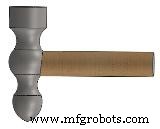
2. Claw hammer:
It is a tradition hammer which one side is a flat other side of head has a nails removing shape from wooden and other work piece. It is also known as carpenter’s hammer.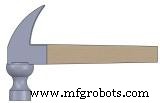
3. Cross peen hammer:
This hammer have one face is like ball and other face of head is like wedge. It is mostly used in domestic work where the peen is used to straight the nails.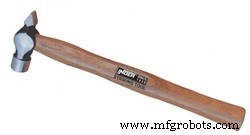
4. Dead blow hammer:
As a name implies it deliver very large impact force.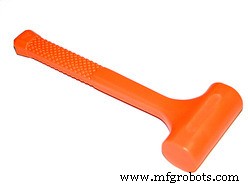
5. Engineer hammer:
this type of hammer is upgrade version of drilling hammer with bigger handle. The handle size is about 14 inch and mostly used in locomotive and steam engine work.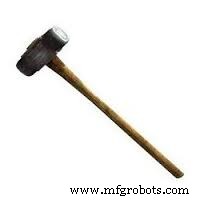
6. Geologist hammer or rock pick hammer:
It is specially used to break or split rocks and mostly used by a geologist.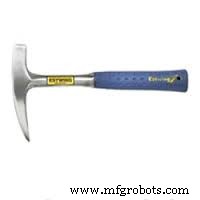
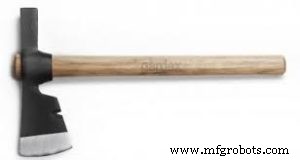
7. Knife edged hammer:
One end of this hammer is knife edge and other one is flat surface. It is mostly used to cut or split wood.
8. Sledge hammer:
It has a large flat metal head joint with a large handle. It is used to drive wedges.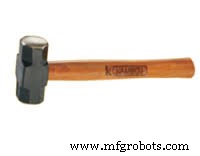
9. Rock climbing hammer:
It is a special type of hammer used to climb the rocks.
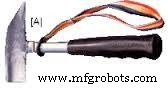
10. Rounding hammer:
It is also known as blacksmith hammer. It has round face which is used to design or shapes a forged bar or sheet in blacksmith.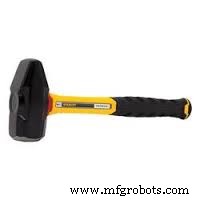
11. Soft faced hammer:
It has a soft face of rubber, plastic or copper. It is used where steel face may damage workpiece.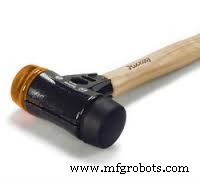
12. Stonemason’s hammer:
This hammer is also known as brick hammer. One end of the head is flat and other end has a chisel like shape. It is used to split bricks or concrete wall.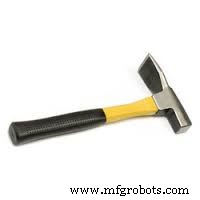
13. Welder chipping hammer:
This hammer is used to remove unwanted welded area form the work piece. It is also dissipates heat.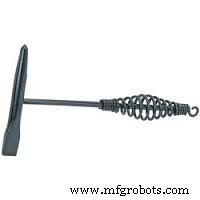
14. Lump hammer:
It is a double face hammer and used to driving steel chisel in work piece. It is one of the types of sledge hammer which has smaller handle with light weight. It is mostly used in domestic work.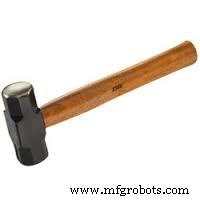
15. Mechanic’s hammer:
It is used to remove dents form the sheets. It has a small curve anvil at one side of head and a sharp chisel type face at other side.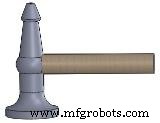
16. Drilling hammer:
It is mostly used in drilling in rocks with a chisel. It has a head weight almost 2 kg attached with a handle of 10 inch which is mostly drive by one hand. Other hand is used to hold the chisel.17. Lathe hammer:
One end of this hammer head has a hatchback blade and other end a round head at other side. It is using at lathe machine is workshop.
18. Brass hammer:
It is made by brass. It is used in flammable area to like oil or fuel fields. It prevents to spark generation during hamming.
B. Mechanically Powered Hammers:
This types of hammers are driven by some of mechanical power like hydraulic power or by Gear drives.1. Hammer drill:
It is a rotary hammer which has a drill at one side which provides hammering action. It is used to drill in brittle material.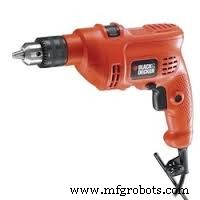
2. Steam hammer:
It is steam driven hammer and used to shaping the forged material. In this hammer the hammer head is attached to a piston which driven by the steam pressure. At the piston moves down it provide impact force which used to shape the material.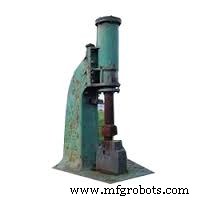
3. Jack hammer:
It is driven by the pneumatic pressure of electro mechanical. It is used to dig out roads.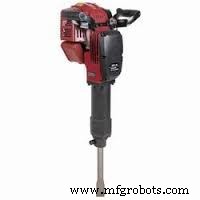 Image Source : www.indiamart.com
Today we have discussed about types of hammers. If you have any query regarding this article, ask by commenting. Subscribe our website for more informative articles. Thanks for reading it.
Manufacturing process
- Hammers: From Ancient Tool to Modern Workhorse
- Understanding Textile Dyes: Reactive, Direct, and Acid Types Explained
- Comprehensive Guide to Casting Methods in Manufacturing
- Top Sand Materials for Precision Moulding
- Understanding Casting Patterns: Types, Materials, and Their Impact on Quality
- Types of Welding Flames: How They Affect Weld Quality
- Understanding Industrial Materials: Types, Uses, and Benefits
- Polypropylene: Key Features, Uses, and Production
- Exploring the Varieties of CNC Milling Operations
- Choosing the Right Hammer: Types for Woodworking, Metalworking, and Beyond