



Understanding Metal Forming: Types, Advantages, and Classification
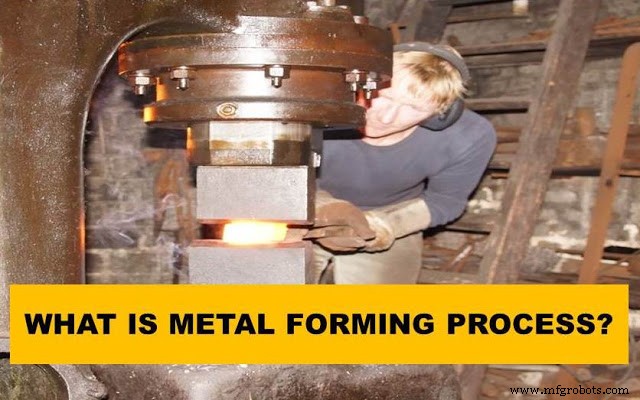
Today we will learn about metal forming process, its types, advantages and disadvantages. To convert a work piece into various shapes many manufacturing process are used like casting, machining, forming etc. Metal forming is one of the most useful processes of converting work piece into desire shape. Metal forming depends on yield strength of material. In this processes, the work piece is subjected under a force such that the stresses induced in work piece material is higher compare to yield strength of material and lower the ultimate strength. The metal forming takes place due toplastic deformation of material. In these process, the metal is either heated or not and the applied forces are either compressive or tensile according to the product requirement. All rolling, extrusion, drawing etc. processes are include in it.
Types of Metal Forming Process:
Mainly these processes can be classified into two types.Hot Working Process:
When the metal forming process done above the recrystallization temperature of material, it is known as hot working process. The recrystallization temperature is about one third of the melting temperature of most of the metals. In hot working process, the temperature at which deformation takes place is important because further increase in temperature increase grain growth thus decrease mechanical properties.Advantages:
- Any metal can be shaped above recrystallization temperature.
- Any amount of working can be imparted.
- It requires less force compare to cold working.
- Any grain size can be achieved by proper controlling the working temperature and cooling rate.
Disadvantages:
- The metals which get brittle at high temperature cannot be worked by hot working process.
- It gives poor surface finish due to scale formation at surface at higher temperature.
- It is difficult to control dimension accuracy at higher temperature.
- Difficult to handle hot work piece.
Also Read : Hot Working vs Cold Working
Cold Working Process:
When the metal forming process done below its recrystallization temperature, it is known as cold working process. This is done with or without actual heating but the achieved temperature should below its recrystallization temperature. This process accomplish with strain hardening due to working process done below recrystalization temperature.Advantages:
- It increase strength and hardness of the material due to strain hardening.
- This process gives higher fatigue strength and increases corrosion resistance.
- It gives better dimensional accuracy compare to hot working.
- No energy source required for heating.
- Cold worked work piece can be handle easily.
- It provide good surface finish because no oxide form at surfaces.
Disadvantages:
- The amount of deformation is limited according to the press size.
- These metal forming processes require higher force to deform the work piece.
- Brittle work pieces cannot worked by cold working.
- Higher risk of cracks in cold working.
- It accomplish by internal and residual stresses.
These is all about metal forming process types, advantages and disadvantages. If you have any query regarding this article, ask by commenting. If you like this article, don’t forget to share it on social networks. Subscribe our website for more interesting articles. Thanks for reading it.
Manufacturing process
- Understanding Sheet Metal Fabrication: Techniques & Applications
- Understanding Forming Processes: Types, Applications & Benefits
- Deep Drawing Process Explained: How Sheet Metal is Formed into Complex Shapes
- Sheet Metal Forming: Techniques & Applications for Modern Manufacturing
- Galvanization Explained: How Zinc Coatings Extend the Life of Metal Parts
- Ultrasonic Machining Explained: High‑Frequency Vibration Precision Removal
- Broaching Explained: Process, Applications, and Types
- Brazing Explained: How to Join Metals with Precision and Strength
- Chemical Machining Explained: Process, Applications, and Benefits
- Understanding Forging: Definition, Process, and Types