



The Comprehensive Guide to Bed Sheets: History, Materials, and Modern Manufacturing
Background
A bed sheet is a flat‑woven textile that serves as the protective layer between a sleeper and the blanket above. Typically a broadloomed rectangle without a center seam, it features top and bottom hems while the finished edges—selvages—serve as side seams, eliminating the need for side hemming. Modern bed sheets are sold as part of a coordinated linen set that includes a fitted sheet, a flat sheet, and at least one pillowcase, all matching in color, fabric, and detailing.
Bed sheets are produced from a range of fibers, including linen, cotton, synthetic blends, and occasionally silk. Percale, a closely‑woven plain weave of 100% cotton or a cotton‑polyester blend, is prized for its smooth, cool feel. Muslin, a coarser plain weave, and flannel, woven with nappy cotton fibers, provide warmth during winter months. Satiny, silky sheets—typically synthetic—offer a luxurious novelty, while linen, though imported from Europe, remains a niche option in the U.S.
History
While beds have existed for millennia, the first true bed sheets were likely linen, cultivated by ancient Egyptians who mastered flax cultivation, spinning, and weaving. Linen’s superior softness and increasing luster with use made it the preferred choice for bedding. However, linen production was labor‑intensive, requiring 30–40‑inch looms that produced sheets that needed center seams to reach usable widths.
By the early 19th century, cotton cultivation and processing in the United States had matured. Eli Whitney’s cotton gin revolutionized seed removal, enabling large‑scale production of short‑staple cotton. Simultaneously, New England textile mills adopted British cotton technologies, allowing for efficient spinning, dyeing, and printing. By 1860, cotton had become the dominant sheet material, offering a cheaper and easier alternative to linen.
Today, mechanized looms produce bed sheets with minimal human labor. Innovations include cotton‑polyester blends that reduce wrinkling, bright colors, and elaborate prints. Many U.S. sheets are manufactured in the South—particularly Georgia—where cotton processors and weavers operate.
Raw Materials
Manufacturers typically purchase 480‑lb (217.9 kg) cotton bales, often referred to as “cotton wool” because of their fuzzy texture. These bales still contain twigs, leaves, and residual seeds. The fibers undergo cleaning, carding, and blending, followed by the application of starches or sizings to aid weaving. During bleaching, caustic chemicals such as chlorine or hydrogen peroxide remove color before dyeing. Dyeing employs chemically‑derived dyes to ensure colorfastness.
The Manufacturing Process
While some producers spin the cotton on site, many purchase pre‑spun yarn. The following outlines the production of 100% cotton sheeting from raw bales.
Procuring the Cotton
- One 480‑lb bale is purchased and shipped to the sheeting plant.
Blending
- Two bales are opened side‑by‑side with a Uniflock machine, which removes the upper cotton layer. The fibers are beaten together, impurities are removed, and the mix is blown through tubes to a blending unit.
Carding
- Fibers move through a carding machine that aligns them and removes residual impurities using millions of tiny teeth.
Drawing, Testing, and Roving
- Fibers are drawn together into a single strand, slightly twisted, and wound onto bobbins as roving.
Spinning
- Rovings are spun on a ring spinner, drawing them into a fine yarn that is wound onto bobbins, then onto section beams for weaving.
Warping a Section Beam
- A single width of sheet requires 2,000–5,000 warp yarns. 500–600 ends are pulled onto a section beam; multiple beams later form a large warping beam.
Slashing
- Section beams pass through a slasher that coats yarns with starch or sizing to protect ends and facilitate weaving.
Warping the Beam
- Multiple section beams are combined onto a large loom beam. A knotter ties up to 6,000 yarns in minutes, readying the warp for weaving.
Weaving
- High‑speed automatic air‑jet looms weave the weft across the warp at 500 insertions per minute, producing about 5.5 in (14 cm) of sheet per minute—roughly 10 yd (9.14 m) per hour. A loom typically produces 8,000 yd (7,312 m) of sheet, rolled for shipping.
Cleaning and Bleaching
- Greige fabric is singed to remove surface bits, then desized with water and soap. Caustic chemicals eliminate dirt and debris, followed by bleaching with chlorine or hydrogen peroxide. The sheet is dried and prepared for dyeing.
Dyeing
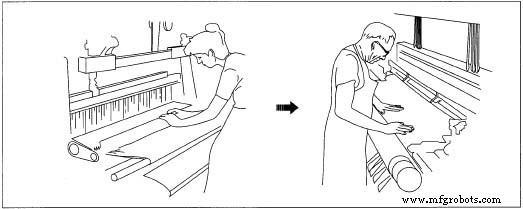
- All sheets, including those sold as white, are dyed in vats with large rollers that press dye into the fibers. After steaming to set color, a resin controls shrinkage. Sheets are rolled and ready for cutting.
Cutting and Sewing
- Automated cutters trim sheets to standard lengths, and sewing machines hem top and bottom edges.
Packaging
- Finished sheets are folded—by hand or machine—shrink‑wrapped, and individually packaged for retail.
Quality Control
Cotton is graded by staple length and overall quality. Longer staples—such as those from Egyptian cotton—yield higher‑grade products. The industry uses nine grades from middling to good; bales with high debris receive lower grades and may impede processing. Plants rely on USDA test data and internal inspections to ensure clean, high‑quality bales. Rovings undergo pre‑spinning QC, and statistical sampling occurs at key stages—spinning, weaving, bleaching, and dyeing—to monitor physical and chemical properties.
Byproducts/Waste
Modern looms generate minimal cotton dust; automatic sweeping removes residual lint. Emission of cleaning, bleaching, and dyeing effluents is tightly regulated under the Clean Air Act and federal water permits. Many large mills operate on‑site wastewater treatment plants to meet EPA standards.
Manufacturing process
- Cotton: Production, History, and Sustainable Practices
- Sheet Music: From Medieval Manuscripts to Modern Publishing – An Industry Overview
- Cotton Candy: From Classic Treat to Modern Production Technology
- Cotton Swab: From Leo Gerstenzang’s 1920s Invention to Modern Manufacturing
- DIY Robot Gripper: Build an Arduino-Driven Plastic Hand
- Key Sheet Metal Operations in Modern Manufacturing
- Kovar® Sheet – Precision Controlled-Expansion Alloy for Superior Hermetic Sealing
- Sheet Metal Punching: A Cost‑Effective Edge for Modern Manufacturing
- Understanding Sheet Metal Punching: Process, Tools, and Applications
- Thin Sheet Metal: Versatile Applications of Stainless Steel