



Cotton: Production, History, and Sustainable Practices
Background
Cotton is a perennial shrub of the mallow family, distinguished by the soft, white fibers that surround its seed bolls. After harvest, the sticky seeds are removed, and the clean, carded fibers are spun and woven into the familiar cotton fabric that dominates global apparel. Approximately 50 % of the world’s textile fiber is cotton, prized for its breathability and moisture‑absorbing qualities in warm climates.
In the United States, short‑staple cotton grown in the “Cotton Belt” (California, Alabama, Arkansas, Georgia, Arizona, Louisiana, Mississippi, Missouri, New Mexico, North Carolina, Oklahoma, South Carolina, Tennessee, and Texas) accounts for nearly five million bales annually. Collectively, these states produce roughly 16 million bales each year—second only to China—and generate about $122.4 billion in revenue, the highest for any U.S. crop.
Beyond textile fiber, cotton seeds yield oil used in salad dressings, snacks, cosmetics, soap, candles, detergents, and paint. The remaining hulls and meal serve as animal feed, while cellulose by‑products feed fertilizer, fuel, tire cord, paper, and cardboard manufacturing.
History
Cotton cloth dates back at least 5,000 years in the Andes, and by 3000 B.C. it was cultivated and woven in ancient India, China, Egypt, and Pakistan. Though not native to Western Europe, Arabic traders introduced it to Spain around A.D. 800. By the fourteenth century, Mediterranean growers shipped fiber to the Netherlands for spinning and weaving. In the late 1700s, British inventions—water‑powered spinning machines—revolutionized textile production. Samuel Slater’s replication of this technology in Rhode Island marked the birth of the U.S. Industrial Revolution.
Two pivotal innovations spurred U.S. cotton cultivation: the cotton gin, invented by Eli Whitney in 1793, and mechanized spinning. The gin dramatically reduced seed removal labor, enabling plantation owners to expand cotton acreage using enslaved labor—a factor that intensified North‑South tensions leading to the Civil War. Machine spinning in New England made calico widely available, but high labor costs prompted a shift of textile mills to the South, where cheaper labor was available. Today, much cotton is woven abroad where labor costs are lower, and polyester blends are common, though cotton remains indispensable for its natural qualities.
Raw Materials
To transform cotton bolls into usable fiber, growers need seed, pesticides (insecticides, fungicides, herbicides), and fertilizers. U.S. cotton has a lengthy growing season—up to seven months—so planting occurs early (February in Texas, up to June in northern states like Missouri). Optimal growth requires warm, well‑drained, crumbly soil with at least 160 frost‑free days, ample moisture, and a latitude between 30° N and 30° S. Excess rainfall or high winds near harvest can damage bolls and over‑hydrate fibers, jeopardizing storage quality. A viable operation typically spans ~2,000 acres, producing ~1.5 bales (≈750 lb or 340 kg) per acre.
The Production Process
- Spring field preparation: mechanical cultivators clear weeds, plow, and form rows to optimize soil conditions and reduce pest pressure.
- Seed planting: machines deposit cottonseed 1.9–3.2 cm deep, using hill‑dropped or drilled methods adjusted for local climate.
- Emergence: seedlings typically sprout 5–7 days post‑planting, forming a full stand within 11 days, provided soil moisture and temperature are adequate.
- Flowering: after ~6 weeks, flower buds (“squares”) develop, bloom in creamy yellow, and fall after ~3 days, leaving an ovary that matures into a green boll.
- Boll development: over 55–80 days, the boll expands, pushing seeds outward. Fibers grow to ~6.4 cm in length and thicken over six weeks. Ten weeks after first bloom, fibers split the boll, releasing the cotton. Each boll contains 3–5 cells, each with ~7 seeds.
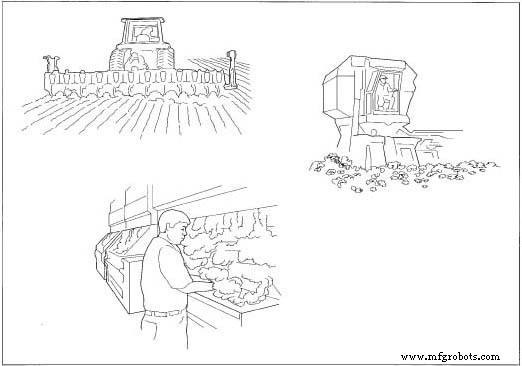
- Defoliation: leaves are removed—often chemically—to prevent trash contamination, moisture buildup, and staining of fibers.
- Harvesting: mechanized pickers or strippers detach cotton, ensuring moisture content stays below 12 % to avoid spoilage. Multiple passes may be required as crops mature unevenly.
- Storage in modules: harvested cotton is stored in 13–15‑bale modules, protected from weather until ginning.
- Ginning: cotton is cleaned, de‑seeded, and baled. High‑capacity gins can process 60,500‑lb (≈27 kg) bales per hour.
- Bale preparation: cleaned fiber is compressed, banded, and wrapped (cotton or polypropylene) to maintain moisture balance during transport.
- Quality assurance: each bale receives a gin and warehouse ticket; USDA samples assess color, leaf content, strength, fineness, reflectance, fiber length, and trash. Results determine bale value and are publicly available.
- Warehouse storage: bales await sale to mills for further processing.
Quality Control
Effective cotton production demands vigilant pest management, precise chemical use, and strict moisture monitoring at harvest. Soil tests guide nitrogen levels to deter pest attraction. Mechanical equipment—planters, harvesters, and pickers—must be calibrated to avoid seed loss and trash contamination, ensuring efficient yields and high fiber quality.
Byproducts and Waste
American cotton growers apply, on average, 5.3 oz (151 g) of chemicals per pound of processed cotton, representing 25 % of all pesticide use in U.S. agriculture. Pests like the boll weevil and various rots necessitate extensive chemical control, raising concerns about wildlife toxicity and soil persistence. Organic cotton farming reduces chemical inputs but typically yields less fiber per acre, requiring larger plots or cost reductions elsewhere. Extension services are partnering with farmers to integrate biological control and reduce residual toxins in soil and waterways.
Manufacturing process
- The Decline of U.S. Manufacturing Labor: Causes, Consequences, and Future Solutions
- The Comprehensive Guide to Bed Sheets: History, Materials, and Modern Manufacturing
- Cotton Candy: From Classic Treat to Modern Production Technology
- Cotton Swab: From Leo Gerstenzang’s 1920s Invention to Modern Manufacturing
- Mastering Labor Hour Estimates for Maintenance Planning
- Bridging the 3D Printing Skills Gap: Insights from the 2024 AMUG Conference
- Proven Strategies to Cut Labor Costs and Boost Your Bottom Line
- Leveraging Robotics to Close the Supply Chain Labor Gap
- Smart Automation for High-Mix, Low-Volume Turning: Boost Efficiency & Flexibility
- Cobot Fleets: A Proven Solution to Labor Shortages