



Cotton Candy: From Classic Treat to Modern Production Technology
Cotton candy is a light, airy confection that mimics the texture of spun cotton. It is created by melting refined sugar and spinning the molten syrup into fine strands, which are then collected on a cardboard tube or bundled into a continuous cloud. First invented over a century ago, cotton candy remains a staple of fairs, amusement parks, and ballparks. As automation advances, the market for this nostalgic treat is poised for significant growth.
Background
Cotton candy is a staple at carnivals and amusement parks, typically sold as a large mass wrapped around a cardboard cone. Its distinctive fibrous texture is the result of both the sugar composition and the spinning process. Production begins with granulated sugar, which melts into a thick, viscous syrup. The spinning extruder then throws fine strands of this syrup outward; as they cool, they harden into fibers that resemble cotton. When gathered on a cone, the strands are loosely packed, allowing air to be trapped and giving the candy its characteristic lightness.
History
While sugar confections have existed for millennia—dating back to ancient Egypt—the modern form of cotton candy emerged in the late 19th century. The invention of sugar refining in the 4th century made sugar accessible beyond the elite, setting the stage for mass candy production. By the 1800s, specialized machinery began to appear, allowing larger‑scale manufacture. The first commercial cotton candy machine was introduced in the late 1800s; it featured a rotating heating core within a large pan. Portable and efficient, it quickly became a popular treat at circuses, fairs, and baseball stadiums.
Until the 1970s, cotton candy was produced only in small batches, limited by manual equipment. The 1972 patent of an automatic cotton candy machine revolutionized the industry, enabling continuous production and packaging. This breakthrough paved the way for the mass‑produced confection we know today.
Raw Materials
Refined sucrose, sourced primarily from sugarcane or sugar beet, is the key ingredient. In cotton candy manufacturing, the sugar is processed into a specialized “floss” grade that promotes fiber formation. The sweet, crystalline structure of sucrose is critical for both texture and flavor.
Images of the extrusion process illustrate the transformation: 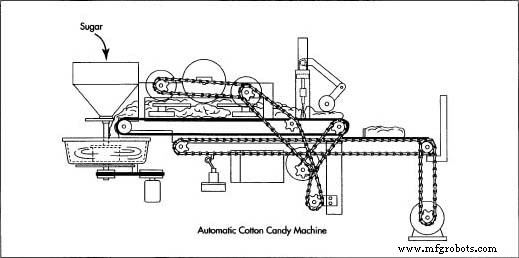 After processing the sugar granules into extruded strands, the cotton candy is pulled onto a conveyor belt and transferred into a sizing container, where the strands are combined into a continuous bundle.
Color and flavor are added to create the iconic varieties. Since sugar is naturally white, food‑grade dyes such as Red 40, Yellow 5, Yellow 6, and Blue 1 are used to achieve the spectrum of hues—pink, blue, purple, yellow, red, and brown. Flavors range from bubble‑gum and vanilla to natural extracts like fruit and honey. Both natural and synthetic flavorants (e.g., methyl anthranilate, ethyl caproate) are employed to deliver consistent taste.
Packaging must prevent moisture ingress, which can cause the candy to become sticky. High‑molecular‑weight plastic bags with low moisture‑vapor transmission rates are standard, ensuring a six‑month shelf life under proper storage.
The Manufacturing Process
Cotton candy is produced using two main machine types: semi‑automatic units for single servings at venues, and fully automated lines for bulk production. Both share a common workflow described below.
Sugar Processing
- 1. Granulated sugar is fed into a stainless‑steel hopper with a tapered bottom that directs the sugar into an extruder. The extruder houses a rotating metal cylinder with perforations and an integrated heating element.
- 2. Inside the extruder, the sugar melts into a viscous syrup. The spinning cylinder forces the syrup through the holes, creating fine strands that immediately cool and solidify. These strands are collected in a surrounding pan, where moisture is minimized to prevent clumping.
Candy Collection
- 3. In small‑batch machines, an operator wraps a cardboard cone around the collection pan; the sticky strands adhere to the cone and are ready for sale. Automated lines transfer strands to a conveyor belt and funnel them into a sizing container.
- 4. The sizing container shapes the bundle into a uniform slab using rollers coated with a non‑stick finish (often Teflon). Minimal pressure preserves the airy structure.
Cutting
- 5. The molded slab is moved to a vertically‑mounted blade that slices the candy into consistent segments. Immediately after cutting, rollers keep the pieces from sticking to the blade and maintain their shape.
Packaging
- 6. The cut mass is fed into an automatic packaging unit, where it is sealed in a plastic bag or alternative container. A coding system stamps each bag with batch data, ensuring traceability. Finished bags are boxed, palletized, and shipped to retailers. The entire cycle—from raw sugar to boxed product—takes only minutes.
Quality Control
Quality assurance begins with rigorous testing of incoming ingredients. Labs assess physical attributes—particle size, color, odor, and flavor—as well as chemical parameters to guarantee consistency. Packaging undergoes inspection for odor, moisture‑vapor transmission, grease resistance, and appearance. Properly manufactured cotton candy typically retains a six‑month shelf life under proper storage.
After production, final product samples are evaluated against established standards. Sensory panels of trained assessors compare color, flavor, texture, and aroma to reference samples. Instrumental tests supplement sensory data, ensuring that each batch meets the company’s quality benchmarks.
The Future
Since its debut, cotton candy’s core concept has remained unchanged; progress has largely come from machine innovation. Future developments are expected to focus on increased automation, computer‑controlled processes, and energy efficiency, enabling safer and more cost‑effective production. Simultaneously, the palette of colors and flavors will expand, offering novel sensory experiences that appeal to modern consumers.
Manufacturing process
- Candy Cane: History, Production, and the Sweet Science Behind the Classic Holiday Treat
- Candy Corn: From Tradition to Modern Production
- Cotton: Production, History, and Sustainable Practices
- Jawbreaker: The History, Ingredients, and Craft of a Classic Hard Candy
- The Comprehensive Guide to Bed Sheets: History, Materials, and Modern Manufacturing
- Cotton Swab: From Leo Gerstenzang’s 1920s Invention to Modern Manufacturing
- The Sweet Science of Gummy Candy: From History to Modern Production
- M&M® Candy: From Invention to Modern Production
- DIY Candy Dispenser with Arduino: Build a Smart Snack Machine
- Fanuc Robots Enhance Accuracy in Candy and Prescription Picking