



Candy Corn: From Tradition to Modern Production
Background
Candy corn is a signature fall confection shaped like a kernel and layered in a classic white‑orange‑yellow color scheme. It is primarily composed of corn syrup, honey, and sugar, and contains no added fats, giving it a light, marshmallow‑like texture. The candy’s triangular form and three‑stripe pattern have made it a staple of American autumn celebrations for over a century.
Production volumes are staggering: one major manufacturer reports 4.3 billion pieces annually, and nationwide consumption averages about 20 million lb (9.1 million kg) of candy corn each year—roughly 8.3 billion kernels.
Technically, candy corn falls under the “mellow creme” category of confections—candy that is free of oils and fats but still delivers a sweet, marshmallow‑like flavor. It is created through a process called starch casting, where liquid candy is injected into cornstarch molds and then left to set for at least a day before packaging.
History
While the precise inventor of candy corn remains unclear, records indicate that it entered the American market in the 1880s. By the early 20th century, the Goelitz Candy Company of Illinois—founded by German immigrants—had become a leading producer. Although Goelitz no longer holds a monopoly, the basic manufacturing method has stayed largely unchanged, evolving from hand‑poured fondant to fully mechanized production lines.
In recent decades, candy corn has expanded beyond its autumn roots. Seasonal variants now feature color schemes tailored to holidays—red, pink, and white for Valentine’s Day; green and white for St. Patrick’s Day; and green and red “reindeer corn” for Christmas.
Raw Materials
Key ingredients include corn syrup, sugar, honey, salt, soy protein, gelatin, artificial flavors, and colorants. A glaze of oil and wax is applied at the end of production to give the candy its characteristic sheen. Cornstarch, though integral to the molding process, does not become part of the final product; it is used to form the triangular molds and later recycled.
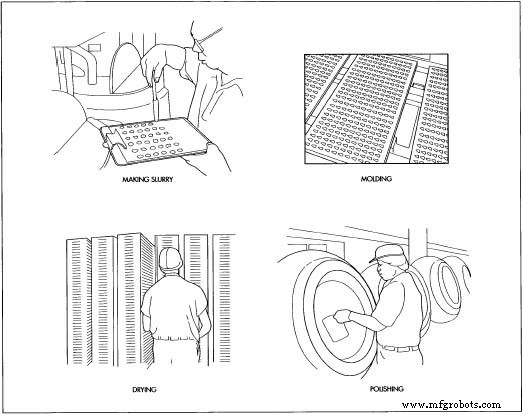
The Manufacturing Process
- Trays are stacked on a conveyor into the Mogul machine, where specially treated cornstarch is poured and leveled to form the triangular molds.
- In the dye chamber, hundreds of triangular impressions are created. Separately cooked candy slurries—white, orange, and yellow—are prepared in dedicated kettles.
- Each cornstarch impression receives the white tip, then the orange stripe, and finally the yellow base in precise, automated injections.
- Wet candy corn is transferred to dry rooms for 24–36 hours (up to 48 hours in high‑humidity conditions) to reach optimal moisture levels.
- After drying, the Mogul flips the trays, ejecting the candy from the molds. Cornstarch is sifted, dried, and returned to the machine for reuse.
- Polished using a rotating drum with a confectioner’s glaze, the candy corn is given a bright, glossy finish.
- Finally, the polished pieces are weighed, bagged, sealed, and boxed for distribution.
Quality Control
Quality is monitored at every stage. Visual inspections discard misshapen kernels before polishing. Equipment is meticulously maintained to prevent downtime. Microbiological testing checks for E. coli, salmonella, and staphylococcus. Each candy batch undergoes rigorous testing for color accuracy, density, viscosity, and melting point, ensuring consistent texture and flavor.
Byproducts and Waste
Production generates minimal waste. Excess cornstarch is fully sifted, dried, and recycled. Candy slurries that fail color or texture standards are corrected or melted back for reuse. Any fallen candy is discarded, preserving product integrity.
Manufacturing process
- Candy Cane: History, Production, and the Sweet Science Behind the Classic Holiday Treat
- Jawbreaker: The History, Ingredients, and Craft of a Classic Hard Candy
- Popcorn: History, Production, and Future of America’s Iconic Snack
- Corn Syrup: Production, Uses, and Industry Insights
- Cotton Candy: From Classic Treat to Modern Production Technology
- The Sweet Science of Gummy Candy: From History to Modern Production
- M&M® Candy: From Invention to Modern Production
- DIY Candy Dispenser with Arduino: Build a Smart Snack Machine
- Understanding Corn Planters: Enhancing Seed Placement and Yield
- Fanuc Robots Enhance Accuracy in Candy and Prescription Picking