



The Art and Science of Caramel: History, Production, and Quality Control
Background
Caramel is celebrated as small, buttery brown squares wrapped in cellophane, yet it also graces candy bars and popcorn with its sweet, chewy texture. The ideal caramel strikes a balance—sweetness without being overly soft. Manufacturers refer to overly moist caramels as 'short' and very chewy ones as 'long.' Though caramel shares the basic sugar‑syrup‑water foundation common to many confections, it uniquely incorporates milk solids and fats, setting its texture apart from hard candies, which become glass‑like when cooled. Caramels are softer because they are cooked to a lower temperature—around 245 °F (118 °C), the firm‑ball stage—and retain more moisture. This lower temperature allows caramel to be extruded or molded at room temperature, making it versatile for use in candy bars and other sweets.
What defines caramel is the Maillard reaction between milk proteins and sugars under heat. In a conventional process, sugar syrup is cooked to the desired moisture level, combined with fat and milk, then heated until the mixture turns from milky white to rich brown. The aroma of gently caramelized milk solids signals proper flavor development. If the mixture is heated further—approximately 290 °F (143 °C)—it becomes toffee, a harder candy that cracks when broken.
Chocolate is a beloved complement to caramel, but even without it, caramel shines in treats like Snickers, caramel apples, and Milk Duds. When not used in a bar, caramel can be poured, scored, and cut into squares for plain consumption. Common varieties include vanilla, chocolate, maple (using molasses and brown sugar), and cream caramels. While most Americans know mass‑produced caramels, artisanal confectioneries are rising, offering gourmet versions made in small batches.
Caramels can also be homemade with relative ease, making them a favorite project for home bakers.
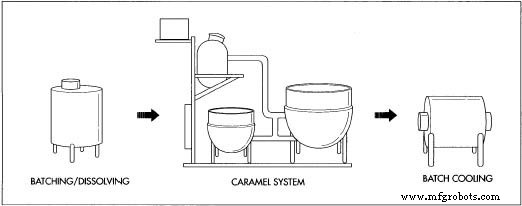 During caramel production, ingredients are matched, machine‑mixed, cooked steadily, cooled, extruded, and formed into small caramel squares.
History
The origins of caramel trace back to early sugar use, though the first sweet treats were likely honey. Arabs and Chinese made candied fruits and nuts by coating them in honey, a process that predated refined sugar. During the Middle Ages, refined sugar was scarce and expensive, making candy a luxury. By the 17th century, Americans began boiling sugar and water in deep kettles, creating hard candies; the addition of fat and milk gave rise to the first caramels.
In the early 19th century, the use of beet sugar in candy production expanded, but hard candies remained dominant. By the mid‑1800s, the United States boasted nearly 400 candy manufacturers, many producing caramels in small shops. Milton Hershey, born in 1857 in Pennsylvania, founded the Lancaster Caramel Company in 1886 before turning to chocolate. His early success with caramel laid the groundwork for what would become a global chocolate empire. Other long‑standing brands, such as Goetze’s Candy Company (established 1895), continue to specialize in cream caramels.
Early production involved copper kettles over gas flames, with confectioners using candy thermometers to monitor temperatures. Caramel batches were poured onto marble slabs, cooled, and scored into squares. Modern manufacturers now employ vacuum‑cooled batch cookers that accelerate cooling with minimal manual intervention. Brach’s Confections remains one of the largest U.S. caramel producers.
Raw Materials
Ingredient lists vary by manufacturer and caramel variety. A typical mass‑produced vanilla caramel includes milk (or sweetened condensed milk), corn syrup, sugar, oil, whey, calcium carbonate, salt, flavorings, butter, and sometimes additional fats like vegetable oil, molasses, or corn starch. Milk is essential; its solids undergo Maillard reactions to create caramel flavor. Corn syrup adds sweetness and prevents graininess by keeping the sugar dissolved. Butter provides superior taste but is costly, so many producers use a blend of butter and cheaper fats. Flavored caramels adjust the ingredient mix accordingly.
The Manufacturing Process
Mass production of caramels relies on sophisticated equipment, though the core steps remain consistent: batching, cooking, cooling, extrusion, and molding.
- All ingredients are weighed and automatically loaded into a batching machine. The liquid and dry components mix in an upper tank, where computer‑controlled propellers ensure precise blending.
- After mixing, the slurry flows into a lower tank where steam heat brings it to the target temperature. Gear‑driven agitators dissolve solids, while surface scrapers remove any burned proteins that settle to the bottom. These solids are redistributed to maintain homogeneity.
- The heated mixture moves to a heated surge tank, then into a stainless‑steel scraped‑surface heat exchanger for final evaporation. A variable‑speed motor drives a scraper system that forces the syrup through a narrow, steam‑jacketed passage, promoting rapid moisture removal.
- The thickened batch is transferred to a steam‑jacketed caramelizing tank. Here, continuous recirculation exposes the mixture to steam, ensuring even caramelization. A discharge valve directs the caramel to the next stage.
- At about 240 °F (116 °C), the caramel must be cooled. A large cooling wheel—four feet wide and twelve feet in diameter—coats the caramel film in a thin, 1/8‑inch (3.2 mm) layer. As the wheel turns, the caramel solidifies into a manageable sheet.
- A batch roller draws the film into a rope, which is then cut into uniform pieces. Each caramel is automatically wrapped, weighed, and sealed into bags before being packed into cartons for shipment.
Quality Control
Automated machinery demands meticulous calibration. Too much sugar yields a grainy texture; excessive moisture makes the caramel too gooey, while insufficient moisture or over‑cooking produces a long, chewy product. Temperature precision is critical; a difference of a few degrees can alter texture.
Experienced master caramel makers, especially those working on small, artisanal batches (30–50 lb or 14–23 kg), rely on sensory evaluation—visual, olfactory, and tactile—to detect subtle variations that could compromise quality. Even with automation, human oversight remains indispensable.
Ingredient quality is paramount. Corn syrup, milk, and other components undergo rigorous supplier testing to meet industry standards. Only the highest‑grade ingredients are used to ensure consistency and safety.
Manufacturing process
- What is VMC Machining? An Expert Overview of Vertical Machining Centers
- Expert Guide to Aluminum Laser Marking: Precision, Durability, and Industry Applications
- MIG vs. TIG Welding: Selecting the Right Arc Welding Technique for Your Project
- Comprehensive Guide to Laser Marking: Types, Benefits, and Applications
- Key Considerations for High‑Volume Swiss Machining
- CNC Prototyping Guide: Precision, Speed, and Cost‑Effective Production
- Expert Shaft Manufacturing: Precision Processes & Custom Solutions
- Fiber Laser Marking: Precision, Speed, and Versatility for Modern Industries
- Electropolishing vs. Passivation: Choosing the Right Stainless Steel Finishing
- The Art and Science of Caramel: History, Production, and Quality Control