



Cherries: Varieties, Nutrition, and Global Production
Background
Cherries come in two primary forms: the luscious sweet cherry, Prunus avium L., and the tart variety, often called the pie or tart cherry, Prunus cerasus L.. Sweet cherries boast a richer sugar profile and slightly higher calorie count—about 80 calories per 100 g—while tart cherries contain roughly 60 calories, thanks to a higher acidity level. Both types are excellent sources of vitamin C, carbohydrates, water, and small amounts of fiber, protein, vitamin A, thiamin (B1), riboflavin (B2), niacin, calcium, phosphorus, iron, and potassium.
Wild cherry species have been cultivated for centuries, giving rise to a vast array of cultivars and hybrids engineered for hardiness and flavor. The fruit thrives across Asia, Europe, and North America, with Iran, Turkey, the United States, Germany, and Italy leading global production. Together, these ten countries produce over 1.1 million short tons (more than one million metric tons) of cherries each year.
Beyond the fruit, cherry trees offer a range of products. The fragrant blossoms herald spring in places like Washington, DC, and Door County, Wisconsin, drawing tourists worldwide. Historically, bark, leaves, and seeds have been used medicinally; the cyanogenic glycosides present in these parts require careful preparation to avoid toxicity. Native American communities, for instance, have brewed teas from leaves to soothe colds and coughs, while some modern studies explore cherry stalk tea for kidney health. The fruit’s red hue has long symbolized purity, tracing back to ancient myths involving the Maya goddess Maya and the Buddha’s mother.
History
The sweet cherry originated between the Black and Caspian Seas in Asia Minor. Bird droppings likely carried the seeds across the Bosphorus into Europe before the rise of human civilization. Ancient Greeks were the first to cultivate the fruit, and Romans later incorporated it into the diet of legionnaires, helping spread the tree throughout Western Europe. English colonists brought cherries to the New World before 1630, but early American orchards struggled in the east. Spanish missionaries introduced sweet cherries to California, and pioneers, fur traders, and settlers subsequently propagated both sweet and sour varieties across the continent.
Today, the United States produces more tart cherries than sweet because the former are less finicky and more tolerant of weather extremes. Growers now have access to a diverse palette of cultivars that match specific soils and climates. 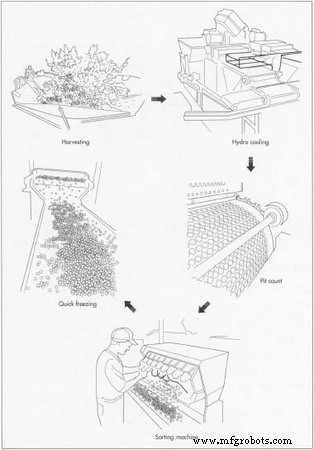 Cherries are harvested mechanically with a tree shaker that gently dislodges fruit from the canopy. Once collected, they are promptly processed or shipped—either frozen, canned, or sold fresh—depending on market demand.
New cultivars of both sweet and tart cherries continue to emerge, offering improved hardiness and yield. German varieties, in particular, have shown remarkable success in U.S. orchards.
Raw Materials
Cherries prefer deep, well‑drained loam and cooler climates, requiring approximately 1,000 chilling hours annually. Their late spring bloom reduces frost risk compared to peaches or apricots, but late frosts can still harm yield. Excess rain during harvest may crack especially sweet cherries, whereas tart varieties are more resilient to humidity. Selecting healthy rootstock from reputable nurseries and ensuring adequate bee pollination are essential. Bees are introduced each spring to ensure full pollination, and hives are usually rented annually. Foliar fertilization, along with targeted pesticide and fungicide application, supports healthy growth and disease control.
The Production Process
Soil preparation
Optimal pH for cherry orchards is around 6–7. Orchard managers routinely test soil pH and adjust with amendments as needed. While fertilizers can boost vigor, excessive use may delay flowering and fruit set, so balanced application is crucial.
- 1. Rootstocks are selected for lineage and suitability to local soil and climate. A notable German rootstock, Gisela, enables dwarf trees that yield high volumes and mature early.
- 2. In regions like the Pacific Northwest, some cultivars produce limited branching. Regular pruning creates a central canopy that receives ample light and airflow, essential for fruit development. Sweet cherry trees typically reach commercial fruiting after 5–6 years and can produce fruit for up to 30 years; tart cherries mature in about 3 years and yield for 20–25 years.
Fungicides and insecticides
Timing of fungicide and insecticide applications varies by orchard. A first fungicide spray often coincides with bloom to prevent leaf spot, while insecticides targeting borers may be applied biweekly until harvest.
- 3. Bees are essential for pollination. Growers release hives at bloom to ensure sufficient pollen transfer; typically 25‑50 % of blossoms must set fruit for a commercially viable crop.
- 4. Fruit ripens over ~60 days from bloom. Growers monitor for frost and moderate rainfall—too much rain can cause cracking. Maturity assessment shifts from visual color cues to mechanical pull tests using a gauge to determine the ease of fruit removal.
- 5. Mechanical tree shaking is employed for processing cherries. The shaker lifts fruit from the tree in five seconds, dropping it onto a protective cover. This method is efficient for large volumes but demands careful operation to avoid damage to young trees.
- 6. Post‑harvest, tart cherries are plunged into cold water and transported to processing facilities for washing, destemming, pitting, and freezing within hours. Sweet cherries destined for fresh markets are hydro‑cooled or rinsed, sorted by size and color, boxed, and shipped within two weeks to preserve quality.
- 7. After harvest, growers apply a protective spray to foliage to prevent leaf spot and perform post‑harvest pruning. A gradual cooling period—known as hardening off—prepares trees for winter conditions.
Quality Control
Maintaining a profitable cherry crop hinges on several precision practices: frequent soil pH and nutrient testing (often coordinated with state university extension services); selecting rootstock matched to local conditions; adhering to EPA regulations for pesticide application; securing adequate pollination; and executing gentle mechanical shaking during harvest. Pruning and canopy management ensure optimal light and air circulation, directly influencing yield and fruit quality.
The Future
The cherry industry faces several emerging challenges. Federal regulation of supply—particularly for tart cherries—could limit market availability and stabilize prices. Recent Michigan harvests have seen so‑low prices (as low as $0.05 per pound) due to oversupply, underscoring the need for market‑adjusted production controls. Growers are exploring value‑added products: combining tart cherry pulp with lean meats, producing dried or yogurt‑covered cherries, and creating specialty cereals to diversify revenue streams.
Other pressures include labor intensity, high equipment costs (a cherry shaker can exceed $175,000), and land value escalation. Younger generations often view orchard management as financially risky, leading to orchard closures and conversion of prime farmland to residential development.
Manufacturing process
- What is VMC Machining? An Expert Overview of Vertical Machining Centers
- Expert Guide to Aluminum Laser Marking: Precision, Durability, and Industry Applications
- MIG vs. TIG Welding: Selecting the Right Arc Welding Technique for Your Project
- Comprehensive Guide to Laser Marking: Types, Benefits, and Applications
- Key Considerations for High‑Volume Swiss Machining
- CNC Prototyping Guide: Precision, Speed, and Cost‑Effective Production
- Expert Shaft Manufacturing: Precision Processes & Custom Solutions
- Fiber Laser Marking: Precision, Speed, and Versatility for Modern Industries
- Cherries: Varieties, Nutrition, and Global Production
- Cherry's Industrial Equipment Celebrates 35 Years of Innovation & Excellence