



Chess: From Ancient Origins to Modern Manufacturing – An Expert Overview
Background
Chess is a two‑player board game that has captivated minds for over 1,400 years. It is played on an 8×8 grid of 64 alternating light and dark squares. Modern pieces were first carved from wood or stone; today they are produced at scale by injection molding and lithographic printing.
The goal is to deliver checkmate—forcing the opponent’s king into a position where escape is impossible. White moves first. Players alternate turns until checkmate, resignation, or a draw occurs. Decades of literature cover opening theory, middlegame strategy, and endgame techniques.
History
Scholars trace chess’s roots to the sixth‑century AD in the Indian subcontinent, where it evolved from chaturanga—a game depicting the four branches of the ancient army. The name "chaturanga" is Sanskrit for "four divisions".
From India, chaturanga traveled through the Middle East and Asia, reaching China around AD 750 and Korea/Japan by the eleventh century. Chinese chess uses a 9×10 board with a mid‑board barrier, making it a slower variant. In Persia it was called shatranj, and the Moors introduced it to Iberia, where it spread across Europe and Russia by the tenth century.
The game earned the moniker "royal game" as monarchs, poets, and scholars documented their matches. The notation system that emerged allowed players to record and analyze games, leading to the first chess puzzles and the development of theoretical concepts such as checkmate patterns.
The fifteenth‑century saw major reforms: castling, the two‑square initial pawn advance, and the transformation of the counsellor into the queen—now the most powerful piece. These changes, coupled with the publication of instructional texts by masters like Ruy López and Damiano, propelled chess to widespread acclaim.
By the early nineteenth century, piece shapes and rules had largely stabilized. The twentieth century brought a surge in competitive play, the founding of chess federations, and the crowning of world champions. The first computer program appeared in 1960, and in 1996 Deep Blue defeated reigning champion Garry Kasparov, marking a milestone in artificial intelligence.
Design
Chess pieces have ranged from austere, utilitarian forms to lavishly decorated sets. Before AD 600, sets were plain; later, elaborate carvings depicted royalty and warriors. Islamic prohibition of figurative art in the ninth‑tenth centuries led to simple clay or stone pieces, increasing accessibility and focus on gameplay.
In Europe and Russia, ornate sets became status symbols. The modern Staunton pattern was introduced by Nathaniel Cook in 1835 and patented in 1849. Endorsed by top player Howard Staunton, it became the international standard; today, all official tournaments require Staunton‑style pieces.
A standard set contains 32 pieces—16 per side—including eight pawns, two rooks, two knights, two bishops, one queen, and one king. Piece size varies by set, but the king is tallest, followed by the queen; pawns are the shortest. The rook’s form has evolved from ship‑like to castle turret to chariot‑warrior.
The board is a square of 64 alternating light/dark squares arranged in eight files (columns) and eight ranks (rows).
Manufacturers create a steel mold—a polished cavity—into which liquid plastic or molten metal is injected. A two‑part mold yields a finished piece once the material cools and the mold opens. Release agents, tapered design, and slight oversizing compensate for shrinkage.
Raw Materials
Historically, chess pieces have been fashioned from ivory, glass, wood, clay, pewter, stone, and various metals. Contemporary sets are predominantly plastic, chosen for colorability, heat stability, and impact resistance. Common polymers include polymethyl methacrylate (PMMA).
Colorants—soluble dyes, pigments, titanium dioxide for white, iron oxides for other hues—give pieces their visual appeal.
Fillers enhance durability; plasticizers increase flexibility; reinforcements like fiberglass improve strength; UV stabilizers, heat stabilizers, antioxidants, and manufacturing aids are also incorporated.
The Manufacturing Process
A typical production line comprises mold creation, piece production, board fabrication, and final assembly. While small‑scale producers may still hand‑carve sets, mass producers follow a standardized workflow.
Making the pieces
- Design sketches guide mold creation. Craftsmen construct wire frames, then shape clay around them to capture the desired silhouette.
- A plaster mold is cast from the hardened clay. From this, a steel die is machined, enabling precise replication. In some lines, a single injection mould forms all 32 pieces in one cycle.
- Plastic pellets are fed into an injection‑molding machine. They are melted under high pressure, then injected into the steel mold. While the plastic cools under pressure, it hardens into a finished piece, which is ejected once the mold opens.
Making the board
- Board construction depends on the raw material. Mass‑produced sets use cardboard cut to exact dimensions, then printed with high‑resolution plates. Ink is applied via rollers; each color layer is dried before the next step.
- After printing, a clear polymer coating protects the surface and imparts a glossy finish.
Final assembly
- Components are gathered in the packaging area. Pieces, board, and instruction booklet are placed in a box. The box then travels to a shrink‑wrapping station.
- A thin film is heated to shrink tightly around the box. Finished packages are boxed, palletised, and shipped to distributors.
Quality Control
Quality assurance occurs at every stage. Line inspectors conduct visual inspections to verify dimensions, shape, and finish. Defective parts are remelted and re‑moulded to meet specifications.
The Future
Emerging trends point to smarter, more immersive chess sets. Computer‑controlled boards enable single‑player AI opponents of grandmaster caliber. Future variants may feature multidirectional movement, multiple players, and novel board geometries, expanding the game’s tactical horizons.
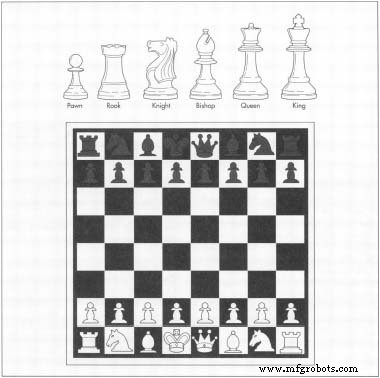 Chess pieces and a chessboard set up.
Manufacturing process
- Pinball: History, Design, and Manufacturing of a Classic Arcade Game
- The Soccer Ball: From Ancient Games to Modern Innovation
- The Evolution and Craftsmanship of American Football: From Ancient Games to Modern NFL Standards
- DIY Arduino USB Gaming Controller – Build Your Own High-Performance Gamepad
- Interactive Joystick Game with Arduino and LED Feedback
- Pixel Chaser: Interactive One-Tap LED Game with Arduino Nano
- DIY LED Roulette Game – Build a One‑Person Arcade with Arduino Nano
- Binary Switch Game – Arduino UNO Project
- Build an Arduino Tic‑Tac‑Toe Game on a Touchscreen: A Step‑by‑Step Tutorial
- Build an Arduino Memory Game (Simon Clone) – Step‑by‑Step Tutorial