



The Soccer Ball: From Ancient Games to Modern Innovation
Background
Games resembling modern soccer have been played worldwide for millennia. The earliest documented example is China’s tsu‑chu, attributed to Emperor Huang‑Ti in 1697 B.C. According to historical records, the game involved a leather ball stuffed with animal hair and cork, and teams competed to propel it through goal posts. Japan’s kemari and a North African ceremonial game from the 7th B.C. share similar features, suggesting a widespread cultural fascination with ball‑kicking sports.
In classical antiquity, the Greeks played espiskyros, a kicking and throwing ball game on a marked field. The Romans adapted these games, creating follis, a lightweight ball filled with hair that players kept airborne with their hands, and harpastum, a more aggressive version where ball‑carriers were tackled. Harpastum gained popularity among Roman soldiers and spread throughout Italy and the Empire, eventually reaching Britain and influencing the development of early football.
Early British ball games likely used inflated animal bladders; folklore mentions the use of human or animal skulls in ceremonial rites. By the 14th century, football had become a chaotic street pastime, prompting King Edward II to outlaw the sport in 1314. Despite the ban, the game persisted, evolving into an upper‑class pastime in the 19th century. The 1862 codification of rules by English public schools led to the formation of the English Football Association in 1863, standardizing the sport and giving rise to the term “soccer.”
Soccer’s global spread paralleled the British Empire. Railway workers introduced the game to Argentina and Uruguay, and the International Federation of Association Football (FIFA) was established in 1904 to harmonize rules worldwide. By the late 1990s, soccer had become the most popular sport on Earth, supported by a vast equipment industry.
Raw Materials
The modern soccer ball is a composite of synthetic leather panels—typically polyurethane or polyvinyl chloride—stitched around an inflated rubber or synthetic bladder. Older balls were made of genuine leather and closed with cotton laces, whereas contemporary models feature a valve for inflation. Panels are backed with polyester or a poly‑cotton blend and bonded with latex adhesive. A standard match ball must be between 27 in (68.6 cm) and 28 in (71.12 cm) in circumference, weigh 14–16 oz (0.392–0.448 kg), and be inflated to 15 psi (6.8 kg/cm²).
The Manufacturing Process
Soccer ball production consists of two main components: the inner bladder and the outer covering. Many manufacturers now produce the entire ball under a single roof, though outsourcing still occurs for certain steps.
1. Lining the Cover Material
Synthetic leather sheets are layered with 2–4 cloth layers, depending on the ball’s intended durability. A latex adhesive is applied, and the backing is pressed into place. Cheaper models use two layers; premium balls use four for added strength.
2. Cutting the Panels
Once the adhesive dries, the sheets are fed through a die‑cutting machine that produces 32 hexagonal panels and punches stitch holes.
3. Imprinting the Panels
Selected panels undergo silkscreen printing to imprint the manufacturer’s logo with fast‑drying paint.
4. Making the Bladder
The bladder, made from natural or synthetic rubber, is heated and forced into a mold. After cooling, it is trimmed and partially inflated to remove wrinkles.
5. Stitching and Final Assembly
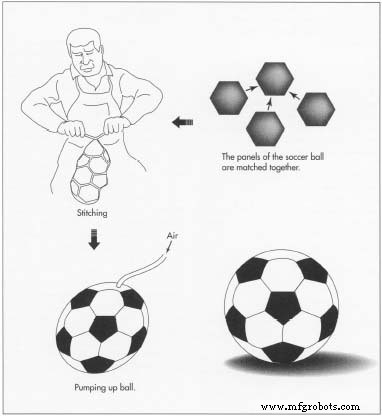
Stitchers assemble the 32 panels around the bladder by hand, following a precise pattern. After the final seams are sewn, the bladder is inserted and the ball is sealed. Inspectors pump the ball to confirm no punctures, weigh and measure it, then deflate and package it for shipment.
Quality Control
Quality assurance occurs at every stage: bladders are inspected upon removal from molds, panels are checked after backing, and printed panels undergo visual inspection. The assembled ball is scrutinized for stitch integrity, inflated to the correct pressure, weighed, and measured before clearance for shipping.
The Future
While the ball’s shape, size, and weight are governed by international regulations, manufacturers continue to refine materials for improved performance. Innovations include testing butyl bladders for better durability and exploring softer, more pliable synthetic leathers. Advances in textile treatments aim to enhance ball feel and consistency.
Beyond materials, the industry is addressing ethical manufacturing. The mid‑1990s revelations of child and prison labor in stitching prompted global scrutiny. In response, leading brands established human‑rights departments, centralized production to eliminate subcontracting, and invested in automated stitching technologies. Modern machines now produce high‑quality balls suitable for professional play, reducing reliance on manual labor and improving working conditions.
Manufacturing process
- Amber: From Ancient Resin to Scientific Treasure – History, Properties, and Modern Uses
- The Guillotine: History, Design, and Legacy
- Basketball: From Naismith’s 1891 Invention to Modern Production Techniques
- Chess: From Ancient Origins to Modern Manufacturing – An Expert Overview
- Silicon: Properties, Production, and Market Outlook
- The Ukulele: From Portuguese Roots to Modern Craftsmanship
- The Complete Guide to the U.S. Chicken Industry: History, Production, and Quality Control
- Compost: The Ultimate Soil Enrichment Solution
- Gelatin: From Ancient Protein to Modern Applications – Production, Uses, and Safety
- The Evolution and Craftsmanship of American Football: From Ancient Games to Modern NFL Standards