



Millwright Careers: Wages, Skills, and Advancement Opportunities
A skilled trade for those who are organized, precise, and problem-solve under pressure
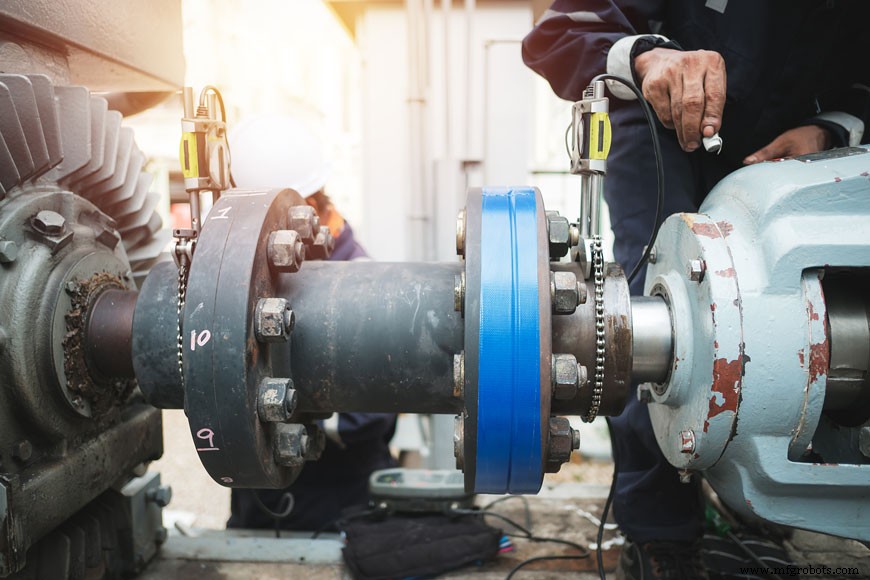
Reliance Foundry is known for bollards, but we also specialize in industrial wheels. We work with millwrights who need a high degree of confidence in the quality of parts. After the purchase order is in, it’s often the millwright we talk to about specification—yet millwrighting is often not well understood as a career. To honor those we work with, we thought we’d shine a light upon the profession.
What is a millwright?
Historically, a millwright was a mechanic that kept a mill’s machines running smoothly. Today, the millwright definition has expanded. It includes industrial mechanics in all sectors who install, maintain, repair, and disassemble industrial machines. As machines evolve and engineering advances, the millwright’s expertise has expanded. This is a varied and interesting trade with many specialties.
How much does a millwright make?
Potential millwrights may be curious about average compensation and regional job availability.
We’ve pulled (updated) information out of the Bureau of Labor Statistics, OES May 2020 data, to look for changes in the profession..
- The national median wage for millwrights was $57,260 in 2020
- In 2018, this was $55,060. According to the US Inflation Calculator, this suggests that wages for millwrights is tracking slightly ahead of inflation.
- The 2020 national 90th percentile wage for millwrights was $83,690. (Top wages are important: millwrights learn on-the-job, and so there are both apprentices and journeymen in the wage data. We’ve picked 90th percentile wages to reflect experience and specialty.)
- 04% of workers are millwrights, using available state-by-state data!
- Millwrighting is a GROWTH career. The US Bureau of Labor expects opportunities in millwrighting and related fields to grow 19% from 2020-2030, faster than other fields.
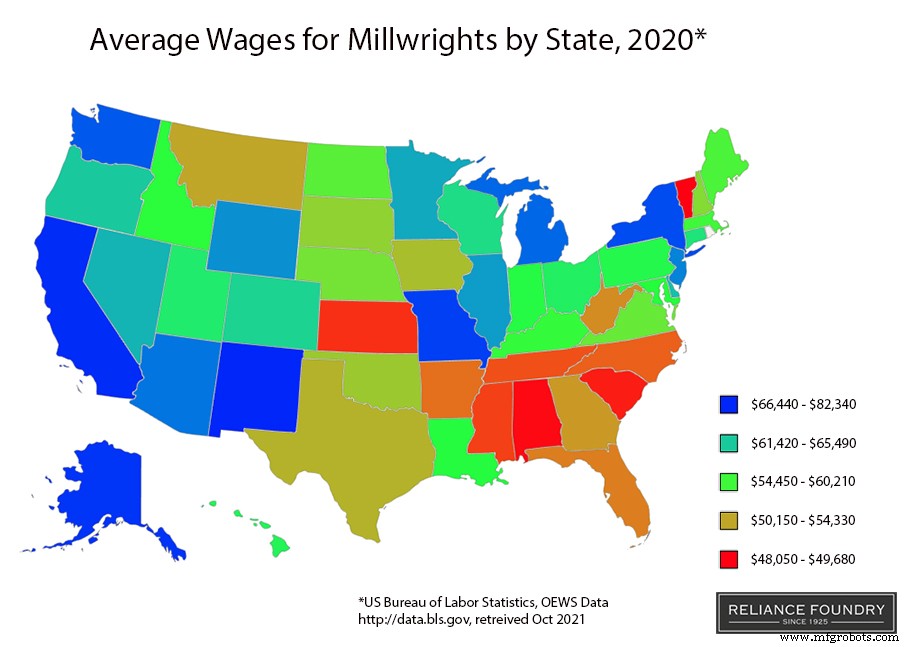
Interesting facts from 2020’s data:
- Median Wage
- Kansas has the lowest median wage ($46,970)
- New Mexico boasts the highest median wage ($87,430)
- Only 0.02% of New Mexican workers are millwrights, lower than the national average. Higher wages may be due to small workforce and higher demand.
- 10th Percentile Wage
Annual wages are made of hourly wages times 2080 hours per year. This means those in the 10th percentile would include new apprentices but not part-time senior millwrights making a high hourly wage.- Tennessee has the lowest starting wages for millwrights ($31,500)
- New Mexico has the highest ($56,300)
- West Virginia has the most millwright jobs as a percent of total employment, with one millwright per 1,000 workers. The runners up are Louisiana and Alaska. (In 2018, Alaska led the pack for millwrights per 1000 jobs, with Louisiana as the first runner up. Millwrights are often employed in oil and gas plants.)
- Connecticut has the fewest millwright jobs as a percent of total employment, with only 6 millwrights per 10,000 workers.
- In 2018, Longview, WA was the town with the greatest number of millwrights per capita. It is a manufacturing town and Weyerhaeuser and Kapstone were major employers. Longview fell 15 spots and has been replaced per capita by Decatur, IL. The major employers in Decatur are Caterpillar and Archer Daniels Midland (ADM), both machine manufacturers with need of millwright expertise. In the population of 70,000 people, 5 of every 1000 working people are millwrights.
- What’s in the name? Decatur, AL comes in 4th for metro areas with greatest number of millwrights per capital, with 3.7 millwrights per every 1,000 working people. This Alabama city also has many factories: Vulcan Materials, Daikin, and the United Launch Alliance are major employers. ULA produces rocket components for space flight.
- However, in absolute terms, the metropolitan area that includes Chicago, Naperville, and Elgin continues to employ the highest total number of millwrights. This City of Millwrights comes in close to the top in per capita employment with 3.6 millwrights per every 1,000 workers, but given a larger population simply has more people. Further, the number of jobs has grown. In 2018 there were 1490 industrial mechanics working in the region. In 2020 that number grew to 1580.
What does a millwright do?
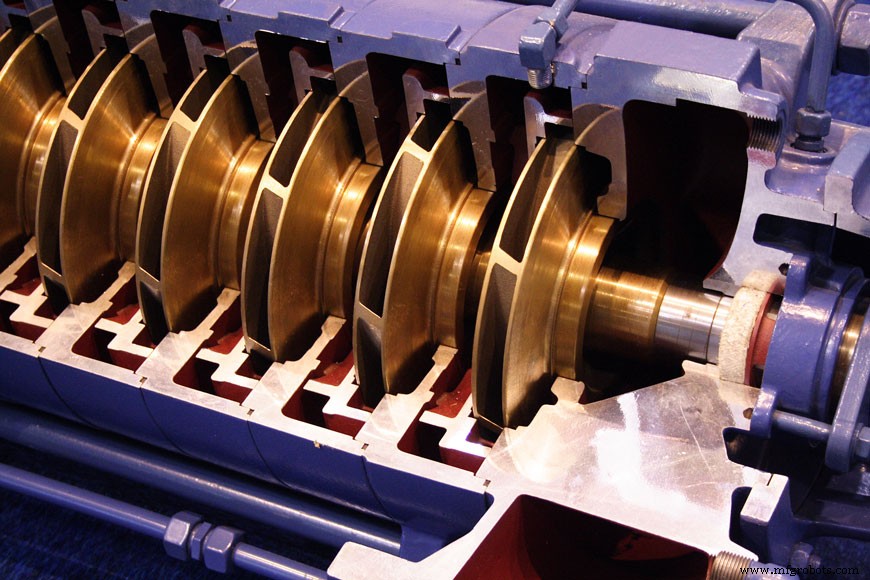
Millwrights install, maintain, repair, dismantle, and reassemble machinery in industrial and construction settings. Their work must be precise or there will be strain of misalignment or ill-fitting that can harm or destroy complex mechanical systems. As industrial mechanics, millwrights often have expertise in fields including:
- Machinery alignment, installation, repair
- Machining
- Welding
- Precise fitting of bearings, gears and shafts, motors, and couplings
- Vibration analysis
- Rigging
- Scaffolding, aerial lifts
- Lift trucks/forklift certification
- Blueprint reading, electrical and mechanical design
- Conveyors, carousels, ASRS systems, monorails, bulk conveyors
- Pumps, valves, and seals
- Material handling, MSDS
- Software programs and packages, new avenues into robotics
Personal qualities required for millwrights
Factories, power plants, mills, and refineries are dependent on their machinery. They rely on millwrights to keep their businesses productive. This can be a stressful environment, and millwrights rely on certain personal qualities. They must be able to:
- think through a problem, taking necessary time
- problem solving is often done under pressure, while everyone else is upset that a critical machine is down
- read detailed plans and prints, and translate them into working knowledge of unfamiliar machines
- troubleshoot mechanical systems
- problem-solve, estimate time, and communicate with their team
- stay organized
- work with precision
- value and promote safety
- be strong, coordinated, and have excellent fine-motor skills
How does someone become a millwright?
There are many different paths to becoming a millwright.
Over the course of a millwright’s career, most aim to achieve Journeyman or Red Seal status. This requires a four-year apprenticeship that combines on-the-job training and classes.
However, a journeyman millwright will have been working in the field for many years before certification. Getting an apprenticeship is the first step, but getting hired in that role can be a challenge. To find an apprenticeship, candidates must build a strong resume in related mechanical work. Making connections within the industry is also very helpful.
Pre-apprenticeship educational programs are available at many technical colleges. Often listed as “industrial mechanics” courses, these lay a foundation for working as a mechanic within a factory. However, they are not the only way into the field.
Some millwrights start as shop-hands and laborers. These can be given an apprenticeship based on experience, attitude, and aptitude. When supervising journeymen see potential in a young worker, they may offer an apprenticeship, even if the worker hasn’t had any prior trades education.

Contacting a union that represents millwrights is another excellent first step for the would-be industrial mechanic. Unions have a good view of the current local workforce and what employers need. Union representatives may look at the hopeful’s resume and recommend steps to build it up. They might direct an interested jobseeker into pre-apprenticeship education or suggest a shop-hand position. If the candidate looks ready, the union may simply suggest places to apply. Not all millwrights are within the union, but for those mechanics interested membership, the union is an excellent resource.
For a motivated job-seeker, it’s worthwhile to contact employers working in appealing sectors and let them know your interest. Factories often create long-term plans. A great candidate may be hired at an entry-level position so that they can be tested or tried before apprenticeship.
In competitive markets, those with a pre-apprenticeship program under their belts may still start as a laborer. Practical experience is not a good thing in this profession. It gives both the worker and the company a chance to evaluate whether the career is a good fit, and to see what skills need brushing up.
What tools does a millwright need?
A recurring theme on the subreddit r/millwrights is that the first and most important tool for millwrights is good boots. Eye protection is also often mentioned.
After that, careful assessment of the physical demands and hazards of each new site are vital. A millwright’s best tools are mind and body. Everything else is replaceable.
Expertise and preference determine what’s in a millwright’s toolbox. Since tools can be lost or stolen, some millwrights prefer mid-grade tools. Others like the confidence they have in top end tools, or enjoy treating themselves at the Snap-on truck when they have the money.
Starting with mid-grade is the most common approach. Many inexpensive basic tools will last for decades.
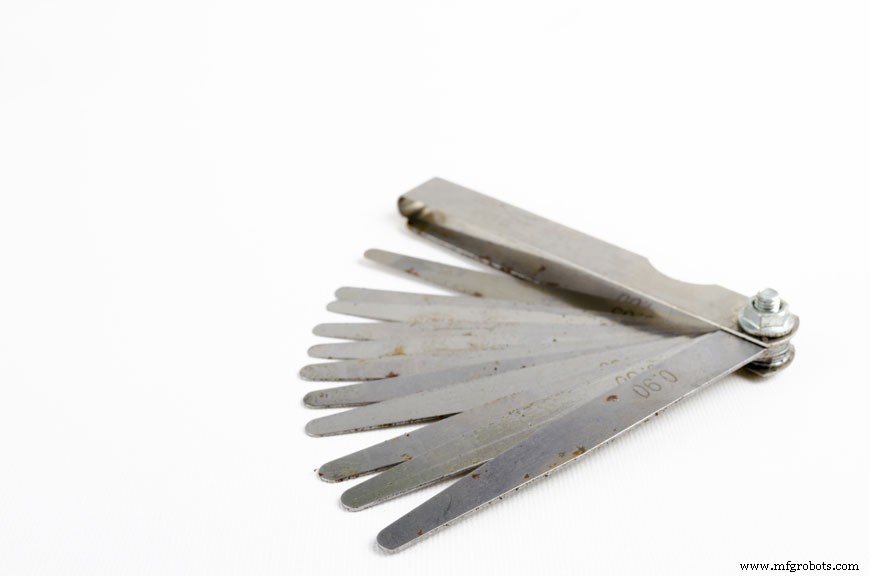
Over the course of a career, education and worksites will dictate what to buy and when. First-year millwright apprentices’ tool lists often include:
- measuring and leveling devices of many types
- socket sets
- wrenches
- screw drivers
- Allen keys
- pliers
- sleever bar(s)
- files
- vice grips
- hammer(s)
- utility knife
The future of millwrighting in the US
According to the Bureau of Labor Statistics Employment Projections, the millwright profession will grow more rapidly than other sectors between 2020-2030. Average growth of all professions during this time is predicted to be 7.7%. However, millwrights are projected experience a 10.3% increase in employment. (This differs slightly from the above 19% number which includes related fields of “industrial machinery mechanics” and “machinery maintenance workers” which are often on the training path for millwrighting.)
Rates of retirement and workers transitioning to other fields means that BLS expects 4,400 new hires per year.
Another change in the millwrighting industry is the computerization and robotization of factories. There are opportunities for millwrights who learn skills in these areas.
Manufacturing process
- Top 5 Azure Careers: Highest Salaries & Demand
- 10 Proven Dos & Don’ts to Launch a Successful Cloud Computing Career
- Upgrading and Configuring IoT Devices with AWS Jobs: A Practical Guide
- Manufacturing Careers: Secure Jobs, No College Debt
- Doggie Walk Bags: How Smart Marketing Boosts Sales & Protects Jobs
- Essential Machine Shop Math: Key Formulas & Strategies for CNC & Traditional Machining
- Navigating the Future: Staying Ahead of Automation’s Job Displacement
- Robotics & Automation: Driving Job Creation in Manufacturing
- Why a Career in Welding & Custom Metal Fabrication Is Rewarding: Skills, Growth, and Certification Opportunities
- Welding & Fabrication: Build a Rewarding, Lucrative Career