



Achieve Superior Aluminum Casts: Optimal Melting & Pouring Temperatures for Unmatched Quality
Aluminum casting temperature has great effects on the aluminum alloy mechanical properties as well as determines the quality of aluminum casting parts. The article analyzes its two main parameters including melting temperature and pouring temperature of aluminum in the sand casting process and specifies the optimal temperature to fabricate the best aluminum casting quality pieces.
As one of the third largest abundant elements on the Earth, aluminum casting has a wide range of applications in both industrial and non-industrial fields, from automotive, transportation, building, outdoor furniture, aviation, to kitchen accessories.
As the world need tends to require high precise details and fewer casting defects, it is called for aluminum foundries have to control and calculate tightly the technical related issues to manufacture good casting products that match customer requirements.
Aluminum casting is defined as the process of melting aluminum alloys, pouring the molten aluminum into the molds, and cooling. In which, specific aluminum casting temperature including melting temperature and pouring temperature is one of the topmost vital factors that directly and indirectly affect the final aluminum casting quality.
Hence, it is crucial to well aware of the melting and pouring temperature of the aluminum alloys that you want to melt and cast.
In that article, we will help you clear these considerations.
Aluminum Melting Temperature
Effects of Aluminum Melting Temperature on the Casting Quality
As one of two aluminum casting temperature parameters, the melting temperature has a great effect resulting the quality of aluminum casting parts.
The melting temperature provided to liquidfy metal has to be sufficient, not too low, and not too high to obtain the best casting quality.
If the aluminum melting temperature is not sufficient (low melting temperature) can result in casting defects like aluminum casting shrinkage because the fluid is solidified before it is filled to the mold cavity.
Oppositely, if the aluminum melting temperature is excessive (high melting temperature) can cause the presence of hot cracks in the molds and lately formation of porosities in the casting parts.
Therefore, it is required casters to calculate the exact melting temperature range of aluminum in used not only to ensure the input material quality but also to calculate the proper pouring temperature later.
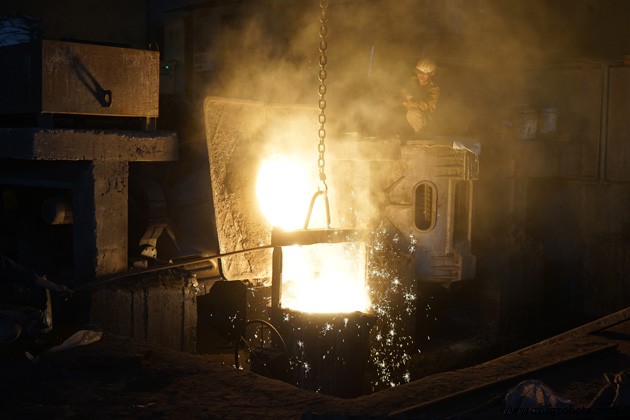
Pure Aluminum Melting Temperature
The melting temperature of metal depends on its purity. It is applied to specify aluminum melting temperature too.
As cited on many researches, pure aluminum comes in some specific types depending on the content of aluminum.
Particularly, the melting temperature of three pure aluminum types showed as the table 1:
Manufacturing process
- Build a Multi‑Sensor Temperature & Light Monitoring System with Raspberry Pi & DS18B20
- Sand Casting: Process, Features, and Industrial Applications
- Enhancing Productivity & Quality in Continuous Casting Machines
- From Furnace to Mold: The Precision of Metal Casting
- Aluminum Castings: From Rim Production to Aerospace Applications
- Achieve Superior Aluminum Casts: Optimal Melting & Pouring Temperatures for Unmatched Quality
- Enhancing Aluminum Die-Casting Quality: 5 Proven Strategies
- Aluminum Casting Techniques: A Comprehensive Comparison
- Key Factors Influencing Anodized Aluminum Part Cost, Color, and Quality
- Aluminum Heat Treatment: Processes, Benefits & Applications