



The Dulcimer: History, Design, and Craftsmanship of a Timeless Instrument
Background
The dulcimer is a family of stringed instruments that has captivated listeners for centuries. Two distinct forms share the name: the fretted, hour‑glass‑shaped Appalachian dulcimer, and the rectangular hammered dulcimer. Each has its own construction, playing technique, and cultural heritage.
The Appalachian dulcimer, typically with three to five strings, is plucked or bowed and is best known in the United States as the Mountain dulcimer. Its simple, tunable design makes it a popular choice for folk musicians and beginners alike.
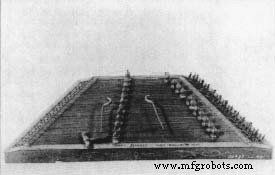
The hammered dulcimer, by contrast, is a trapezoidal zither that can span up to three octaves. It is played with lightweight hammers—long‑handled spoons—striking sets of strings tuned to a diatonic or chromatic scale.
History
Both dulcimers emerged independently across Europe and the Middle East as instruments for folk music. The hammered dulcimer’s lineage traces back to ancient Persian citars or santirs, instruments that accompanied classical Persian music. Through trade routes such as the Silk Road, the design reached Spain by the twelfth century and later China, where it is known as the yangqin.
In France, the hammered zither evolved into the tympanon, struck with leather‑covered hammers. The 18th‑century inventor Pantaleon Hebestreit produced the famed pantaleon with 186 strings, but its popularity waned as the piano rose to prominence.
Immigration brought hammered dulcimers to North America, where they were sold in catalogues such as Montgomery Ward and Sears Roebuck in the 19th and early 20th centuries. Notably, Henry Ford listed the instrument among his favorites, sparking a modest revival in the early 1900s. Today, the hammered dulcimer remains a staple of early‑music ensembles and folk festivals.
The Appalachian dulcimer’s ancestry lies in the Scandinavian and Germanic traditions that settlers carried to the New World. Swedish humle, Icelandic langspil, Norwegian langleik, German scheitholt, and Dutch hummel all contributed to the hour‑glass shape and fretted design that characterise the modern Mountain dulcimer. The French Epinette des Vosges further influenced the instrument’s evolution.
Design and Construction
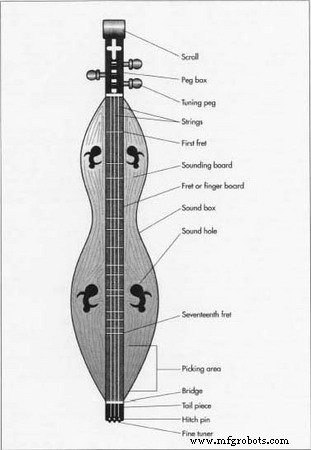
Crafting an Appalachian dulcimer begins with selecting a soundbox size that balances volume and tonal range. Larger, deeper boxes produce louder, lower tones. Typical dimensions are 6‑8 in (15.2‑20.3 cm) wide and up to 2 in (5.08 cm) deep. The soundboard—often walnut, spruce, or pine—must have a grain that extends the full length of the box to maximise resonance.
Sound holes, while primarily decorative, play a vital role in acoustics. Slotted or elongated holes—similar to violin f‑holes—allow the soundboard to vibrate more freely, enhancing sustain and projection.
Manufacturers start by drawing a half‑size pattern on paper or cardboard, then fold it to create a mirror image. This template guides the cutting of the wood, which is usually a hard, dense material such as cherry, black walnut, or mahogany. Finish wood for the outer shell is chosen for its beauty and tonal qualities.
After cutting, each side panel is softened in a steam cooker for roughly 20 minutes, then clamped between custom‑made dies to achieve the precise curves. The boards are glued together, with an oak backing added for structural support. Internal braces are inserted at the joints and along the center to reinforce the frame while preserving resonance.
The tuning head is carved from three layers of finish wood, spaced 1 in (2.54 cm) apart to accommodate the pegs. Typically, four rosewood pegs are used, each tapered to allow fine tuning. The head is mortised into the instrument’s body, and a reinforcing block secures the connection.
The soundboard is cut to extend 0.125 in (0.32 cm) beyond the sides, then glued and clamped to the sides of the soundbox. A soundbar—equal in length to the soundbox plus 0.5 in (1.3 cm)—is constructed from three semi‑hollow pieces of wood. The bridge, usually made of hard maple, floats on the soundbar, allowing the player to adjust string tension for optimal tone.
Frets are laid out using calculated string lengths, then hammered into place with precision. Standard guitar strings—typically 12‑string guitar strings—are used for consistency and availability.
Materials
High‑quality dulcimers use a variety of woods. The outer finish may be walnut, spruce, pine, or yellow poplar, while the body often features cherry, black walnut, or mahogany. Tuning pegs are traditionally Brazilian rosewood; older instruments may use ebony or metal. Frets were historically made from silver, steel, brass, ivory, or bone; contemporary instruments use nickel‑silver or brass.
Quality Control
Because each dulcimer is handcrafted, quality control rests with the maker’s skill and attention to detail. A well‑constructed instrument will exhibit tight joints, even tone, and visual symmetry. The final sound is the ultimate judge of craftsmanship.
The Future
Interest in folk traditions and early‑music performance has sparked a resurgence in dulcimer popularity. Kits for building your own instrument are widely available, making the dulcimer an accessible entry point for musicians of all levels.
Modern makers continue to innovate with new materials and construction techniques, ensuring that the dulcimer remains a vibrant instrument for future generations.
Manufacturing process
- How to Choose the Right Instrument Knobs for Your Equipment
- The Saxophone: History, Design, and Modern Manufacturing
- The Tuba: From 19th‑Century Innovation to Modern Craftsmanship
- The Craftsmanship and History of the Guitar: From Ancient Roots to Modern Masterpieces
- Meramec Instrument Transformers: Premium Current Transformers for Power Applications
- Kravox Wireless Motion & Touch Sensor Kit – Precision Instrumentation for Arduino
- ÉireComposites Partners with OIP to Build Ireland’s First Carbon‑Fiber Satellite Optical Instrument
- Precision Instrumental Analysis of Steel, Slag, and Raw Materials
- Advanced UV Photoemission Tool Detects Surface Contaminants for Reliable Aerospace Bonding
- Four Key Factors Influencing Instrument Air Quality