



The Evolution and Production of Motorcycles: From History to Modern Engineering
Background
In 1901, Engineering magazine noted that motorcycles were initially seen as niche entertainment for mechanical enthusiasts, questioning their lasting appeal.
As of 2023, the U.S. alone housed four million motorcycles, serving as primary transport, recreational rides, racing machines, or prized antiques, underscoring that the novelty endures.
History
Motorcycles evolved from the human‑powered bicycle. In 1861, French bicycle maker Pierre Michaux and his sons Ernest and Henri fitted a velocipede with cranks and pedals, creating the first motor‑powered cycle. The Michauxes quickly became Europe’s largest velocipede producer with a factory in Bar‑le‑Duc.
That same year, L.G. Perreaux developed a steam‑powered “velo‑a‑vapeur” engine, patented in 1868, while Sylvester Howard Roper in Roxbury, Massachusetts, pursued a similar concept in the United States.
In 1879, Giuseppe Munigotti patented the first gasoline‑burning four‑stroke engine for motorcycles, though it remained theoretical. German engineers Dr. Nicolaus Otto and Eugen Langen were building stationary four‑stroke engines that ran on coal gas, and Gottlieb Daimler adapted the technology for gasoline, enabling a vehicle to travel ~25 miles on a gallon. Daimler later shifted focus to automobiles, founding Daimler Benz, the company behind modern Mercedes‑Benz.
Over the next three decades, innovators refined these designs. In 1901, Swedish immigrant Carl Hedstrom fitted an Indian bicycle with a 1.75‑hp single‑cylinder engine, launching the legendary Indian motorcycle. Harley‑Davidson followed in 1903, with William Harley and Arthur Davidson building their first machine from borrowed tools in Milwaukee.
Other early manufacturers—Royal, Merkel, Yale, Reading‑Standard, Rambler, Tribune, and Curtiss—expanded the field. By 1904, manufacturers began producing sturdier frames, larger engines, and reinforced forks, solidifying the distinction between motorcycle and bicycle. The sidecar, inspired by its bicycle counterpart, gained popularity as a passenger accessory.
In 1905, manufacturers prioritized power. Hedstrom introduced a 500 cc twin‑engine bike with twist‑grip throttle and ignition, while “free‑engine” devices simplified starting. Variable gearing improved hill performance, and chain drives became standard, laying the groundwork for modern motorcycles.
Motorcycles grew in popularity throughout the 20th century. World War II temporarily reduced civilian production, but the military’s demand for lightweight, collapsible bikes spurred innovations. Royal Enfield produced the Flying Flea for parachutists, and Excelsior’s Welbike, later sold as the Corgi, popularized the post‑war scooter in Europe.
The 1950s were a “golden age” for motorcycles, popularized by cultural icons such as James Dean in “Rebel Without a Cause.” By 1960, Japanese manufacturers—Honda, Yamaha, Suzuki, and Kawasaki—rose to prominence, a status they hold today.
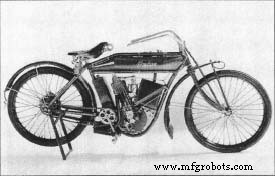 An Indian motorcycle made by Hendee Manufacturing Co. of Springfield, Massachusetts, circa 1911. (From the collections of Henry Ford Museum & Greenfield Village, Dearborn, Michigan.)
In 1911, the U.S. offered a robust domestic motorcycle market. Hendee Manufacturing Co. produced a single‑cylinder, 3.5‑hp loop‑framed bike that weighed 140 lb (63.6 kg) and rode on 23.5‑inch wheels. Priced at $225, it exemplified early American engineering. Founded in 1901 and closed in 1953, the brand left a legacy: today, Indian motorcycles still command a dedicated following, with estimates of 50,000 bikes on the road.
Early handbooks advised riders to keep speed below 10 mph in towns, avoid open mufflers to prevent unsettling horses, and maintain composure during mishaps—reminding that safety and etiquette were paramount.
Nancy EV Bryk
Raw Materials
The motorcycle body is primarily constructed from metal, plastic, and rubber. The frame and wheels are metal; plastic overlays may be applied to the frame, and tires are rubber. Seats use synthetic materials such as polyurethane. The power system comprises a four‑stroke engine, carburetor, choke, transmission, and drum brakes. The transmission includes a clutch with steel ball flyweights and metal plates, a crankshaft, gears, pulleys, rubber belts or metal chains, and a sprocket. The electrical system contains a battery, ignition wires, coils, diodes, spark plugs, headlamps, taillights, turn signals, and a horn.
A key engine component is the aluminum‑alloy piston, prized for its light weight and thermal conductivity, fitted with cast‑iron piston rings. The crankshaft, crankcase, and cylinder barrel are typically aluminum or light alloy, while the cylinder barrel is cast iron or alloy.
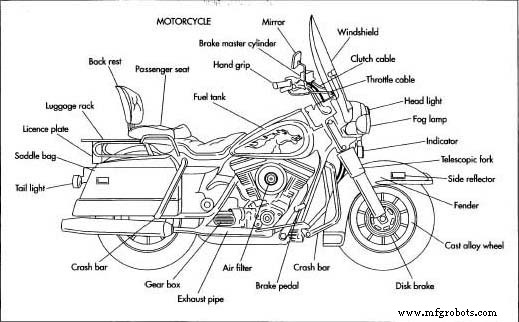
The Manufacturing Process
- Raw materials and components arrive daily by truck or rail under a just‑in‑time system, delivering them directly to the assembly point.
- The frame is fabricated in the welding department using computer‑controlled processes. Tubular metal and sheet‑metal shells are formed, welded—by manual, automatic, or robotic means—and assembled into a sturdy chassis.
- In the plastics department, small resin pellets are melted and injected into molds under high pressure, producing body trim parts through injection molding.
- Metal and plastic parts are powder‑coated in paint booths, a process similar to automotive finishing, ensuring a uniform, durable surface.
- Painted components travel via overhead conveyors or tow motors to the assembly line.
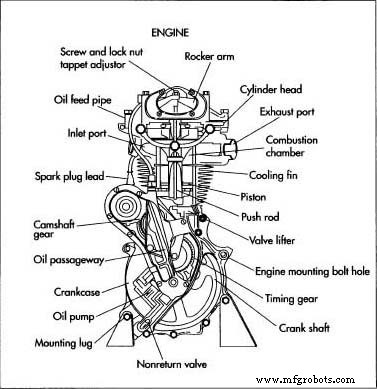 A motorcycle engine.
 - The engine mounts on the frame, and subsequent components—wheels, brakes, wiring, footpegs, exhaust, seats, saddlebags, lights, radios—are installed as the motorcycle progresses along the line.
- Complex models, such as the Honda Gold Wing, require as many parts as a midsize car, demonstrating the intricate assembly required.
Quality Control
At the line’s end, inspectors perform visual checks of paint and fit. They also feel the bike with gloved hands to detect surface defects. Each motorcycle undergoes dyno testing: acceleration from 0‑60 mph, braking, gear shifting, wheel alignment, lighting functions, horn operation, and emissions. Only units meeting international performance and safety standards pass. Final inspections precede boxing and shipping worldwide.
The Future
Motorcycles continue to captivate collectors and riders alike. While new models will keep emerging, the value of classic bikes is expected to climb. 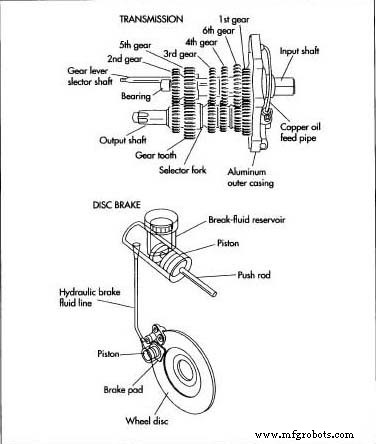 A motorcycle transmission and disc brake system.
Manufacturing process
- Stirling Cycle Engines: A Comprehensive Overview of Design, Efficiency, and Applications
- Inside the Design and Production of a Modern Fire Engine
- Jet Engine: Design, Materials, and Manufacturing Excellence
- Engine Starter Motor: How It Works & Why It Matters
- Exploring Diesel Engines: Definition, Efficiency, History, and Types
- Key Components of an Internal Combustion Engine
- The Complete Guide to Petrol Engines: How They Work and Why They Matter
- How Cylinder Count Shapes Modern Engine Performance
- Engine Configuration: A Comprehensive Guide to Types and Features
- Engine Lathes Explained: History, Features, and How They Differ from Standard Lathes