



Inside the Design and Production of a Modern Fire Engine
Background
The term ‘fire truck’ is a generic label for any vehicle used in firefighting. Technically, a ‘fire truck’ carries ladders and is designed to access elevated sections of a building or to deliver a high‑stream of water. A ‘fire engine’ houses the pump and is the core of a firefighting apparatus. A ‘fire wagon’ stores large volumes of hose, and a ‘fire apparatus’ is the umbrella term for all these vehicles. This article focuses on the manufacturing of a fire engine, a machine that has evolved from bucket brigades to sophisticated, engine‑powered platforms that keep communities safe.
Early firefighting relied on bucket brigades and hand‑pumped piston engines that drew water from tanks or ponds. Leather hoses with copper rivets were common until cotton hoses appeared in the 1800s. The first wheeled apparatus was still horse‑drawn, and volunteer fire departments operated it. The rise of property insurance spurred insurers to invest in better equipment, leading to the steam‑powered piston pump of the 1860s. By the early 1900s, the centrifugal pump replaced older designs, and the internal combustion engine became the standard power source for fire engines.
Design
Designing a fire engine starts with a detailed analysis of the local fire load and terrain. The National Fire Protection Association (NFPA) provides guidelines that help balance response speed, equipment storage, and vehicle maneuverability. Firefighters themselves contribute valuable operational insights during the design phase.
Most apparatuses are purchased by municipal or county governments. Smaller departments may spend up to a year on the approval process due to funding constraints, while larger departments can move more quickly. Fire engines typically cost between $50,000 and $750,000, depending on size, equipment, and customization.
While the basic combination pumper remains a staple, specialized units—such as airport crash trucks, rural tankers, and ladder trucks—address specific hazards. The following sections describe the manufacturing process for a standard combination pumper used in small and medium‑size communities.
The Manufacturing Process
Building a fire engine is a highly customized operation. A dedicated team fabricates the body and assembles the truck frame. A separate crew finishes the body, after which a third group installs electrical, hydraulic, and fire‑fighting equipment and conducts rigorous testing.
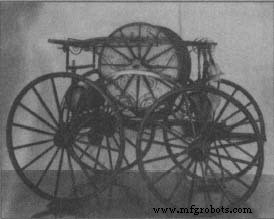 This 1835 volunteer fire company’s hose cart from Cleveland featured sterling silver fittings, a mark of its status.
(From the collections of Henry Ford Museum & Greenfield Village)
This 1835 volunteer fire company’s hose cart from Cleveland featured sterling silver fittings, a mark of its status.
(From the collections of Henry Ford Museum & Greenfield Village)
Early American cities faced devastating fires, prompting the creation of volunteer fire companies and a suite of protective inventions. These companies reflected the social, ethnic, and demographic makeup of their communities. Pride in uniforms and equipment was a public display of status, and competitions among companies sometimes led to conflicts that distracted from fighting the fire.
Chassis
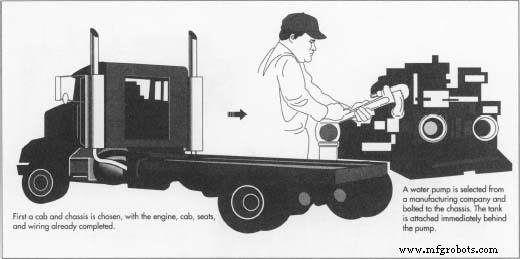
- Choosing the right chassis is critical. A ‘bare’ frame includes only the engine, axles, springs, steering, and brakes, while a ‘cab and chassis’ model comes pre‑installed with a cab, seats, and wiring. Builders typically source chassis from established manufacturers such as General Motors, Ford, International, Freightliner, or Peterbilt, customizing suspension to support the average 35,000‑pound (15,890 kg) apparatus.
Body
- After the frame arrives, the body—often called the coach—is fabricated from 0.06‑inch (1.5 mm) sheet steel. Sheets come in 48‑inch (1.2 m) and 96‑inch (2.4 m) lengths, or as rolls weighing 2,000 lb (908 kg) and more. Cutting and bending are performed with shearing machines and press brakes. Holes for electrical and piping systems are punched at this stage. The body is typically MIG‑welded, with doors and access panels bolted for easy replacement. Rust‑inhibiting sealers protect the metal, and interior panels are pre‑painted before assembly.
Pump
- The pump is the engine’s heart. Most modern pumps are centrifugal units that can deliver 1,000 gallons (3,785 L) per minute, sufficient for residential or small commercial fires. Pumps are cast iron with bronze impellers and steel gears. The pump is mounted centrally and driven by a power‑take‑off from the truck transmission—known as a midship arrangement—to reduce vibration and improve reliability.
Tank
- Water tanks are typically made of polypropylene, holding between 500 and 1,000 gallons (1,892–3,785 L). They are bolted to the frame behind the pump and connected with galvanized steel piping. Tanks come in square, round, or oval shapes and may include baffles to reduce sloshing. Some rural units install a quick‑dump valve that can release 1,500 gallons (5,677 L) in 45 seconds, allowing a portable tank to be filled on a tanker truck.
Assembly
- Once the body is finished, it is mounted over the pump and tank using neoprene or rubber vibration strips. Equipment compartments are integrated into the side panels, with doors and covers protecting hoses, nozzles, forcible entry tools, and breathing apparatus. Hose beds hold 50‑foot (15 m) sections of 2.5‑inch (76 mm) hose, connected to form up to 1,000‑foot (305 m) lines. Short suction hoses are stored in specialized troughs because they cannot be collapsed.
- The attack line beds, positioned in front of the tank, contain pre‑connected 1.5‑inch (38 mm) hoses with nozzles ready for deployment. A one‑inch (25 mm) booster hose on a power roll‑up reel serves for cleaning, cooling, and extinguishing small fires.
- Ladders, often aluminum but heavy, are stored on racks beside the curbside equipment. Power racks lower ladders to waist height, but firefighters typically lift them manually when responding.
Painting
- After the body is assembled, holes are drilled and cut, and the exterior is washed and sanded. A primer surfacer fills scratches, and a sealer improves paint adhesion. The NFPA recommends yellow or fire‑engine red for maximum visibility. Enamel or synthetic paints with hardening agents resist embers and wear. Stainless steel fasteners secure ladders and accessories after painting.
Installing Wires
- A modern fire engine incorporates radio systems, cellular devices, computers, and more. Several hundred feet of wiring run to power warning lights, sirens, radios, bay lights, generators, floodlights, and pump controls. Dual battery systems are wired after painting, and the pump operator’s control panel is installed with pressure gauges and valves.
Quality Control
Once all components are installed and tested, the builder submits the truck to an independent inspection agency. The agency operates the apparatus in a realistic scenario, running the pump at full capacity for two hours to confirm performance. A successful inspection results in a certificate of performance—often a legal requirement for delivery.
The Future
Emerging technologies are reshaping fire engines. New tank materials offer higher strength and lower weight, increasing water capacity. Some large departments integrate advanced computers and cellular communications to manage hazardous material data, structural information, and district geography. Perhaps the most transformative innovation is the use of Class A foam. On‑board foam concentrate tanks and mixing proportioners allow firefighters to deploy foam that absorbs heat more effectively than water. When combined with a separate air compressor, the compressed‑air foam system (CAFS) projects the foam stream farther, clinging to surfaces like shaving cream. These advancements, coupled with improved training and equipment customization, enable firefighters to tackle a broader range of incidents with greater efficiency.
Manufacturing process
- Stirling Cycle Engines: A Comprehensive Overview of Design, Efficiency, and Applications
- Fire Hose: Evolution, Types, and Modern Manufacturing
- Fire Hydrants: Design, Manufacturing, and Their Role in Urban Fire Safety
- The Evolution and Production of Motorcycles: From History to Modern Engineering
- Fire Extinguishers: Types, Design, and Future Trends
- Jet Engine: Design, Materials, and Manufacturing Excellence
- Ensuring Fire Truck Readiness: A Comprehensive Inspection Guide
- Engine Starter Motor: How It Works & Why It Matters
- Exploring Diesel Engines: Definition, Efficiency, History, and Types
- The Complete Guide to Petrol Engines: How They Work and Why They Matter