



The Piano: From Ancient Roots to Modern Mastery
Background
The piano is one of the most celebrated and widely loved instruments in musical history. With the widest tonal range of any single instrument, it is a foundational tool for composers and performers alike—whether played solo or as accompaniment for voices and other instruments. Technically, the piano is also the most intricate musical device, comprising more than 2,500 individual components.
As a stringed instrument, the piano’s architecture is divided into five primary structural and mechanical sections—whether built as a grand (wing-shaped) or upright. These sections include the outer case (or cabinet), the soundboard with its ribs and bridges, the cast‑iron plate, the strings, and the integrated key, hammer, and action mechanism. Within the case, the rim and keybed are critical for mounting the keys and action. The soundboard, reinforced by ribs and bridges, magnifies the vibrations produced by the strings.
The cast‑iron plate, positioned over the soundboard and the pinblock, provides the strength needed to anchor the strings under high tension. Nose bolts and perimeter bolts secure the plate to the braces and inner rim of the case. The piano typically houses 220–240 strings, attached to hitch pins along the curved edge of the plate and to tuning pins across the front of the piano, roughly parallel to the keyboard. The action—keys, hammers, and the intricate mechanism—remains one of the most sophisticated aspects of piano design.
Size classifications are traditionally indicated by the instrument’s shape and dimensions. Grand (wing) pianos range from 4 ft 7 in to 9 ft 6 in (1.4–2.9 m) in length. The “baby” grand measures 5 ft 1 in to 5 ft 2 in (1.52–1.57 m). Smaller grinds are termed “apartment” size. Larger models include the medium grand and concert grand. Upright pianos, whose design has remained largely unchanged since 1935, vary from 36 to 52 in (91–132 cm) in height, with standard categories—spinet, consolette, console, studio, and professional—ascending in size. The aesthetic of the cabinet is often chosen to complement a room’s décor, with a variety of finishes available.
History
The piano’s lineage traces back to early stringed instruments such as the harp, psaltery, and dulcimer, which were plucked, struck, or bowed in ancient civilizations. The harpsichord introduced keys to plucked strings in the seventeenth century, while the clavichord combined keys with struck strings, laying the groundwork for the pianoforte.
Bartolomeo Cristofori, an Italian instrument maker, is credited with inventing the first pianoforte in 1700. Cristofori’s design featured hammers that struck the strings via a momentum-driven action, allowing dynamic control over volume—a feature absent in the harpsichord. The hammers were checked by back‑checks to prevent rebound, enabling sustained tones. The instrument quickly gained favor: Johann Andreas Silbermann refined it in France, and Frederick the Great’s patronage helped popularize it in Germany. Johann Sebastian Bach endorsed the pianoforte in 1747.
By the late eighteenth century, the piano had eclipsed the harpsichord in prominence. Cabinetmakers began crafting elaborate cases, and the square piano emerged in the mid‑century. Musicians began writing pieces specifically for the piano, rather than adapting harpsichord repertoire. Piano manufacturing entered America in 1775, where innovations in hammer design and action improved tonal quality and responsiveness. Jean‑Henri Pape of Paris patented 137 improvements between 1789 and 1875, while John Broadwood of England developed mechanized production methods that reduced costs.
From 1825 to 1851, Europe and the United States filed over 1,000 patents for stronger, more expressive pianos. The mid‑nineteenth century saw the rise of the modern piano, thanks to the introduction of the cast‑iron plate for structural strength and the fanned (over‑strung) scale, which positioned bass strings across the treble range for optimal resonance. Steinway & Sons refined this technique by 1870, aligning string crossings with the soundboard’s most resonant zone.
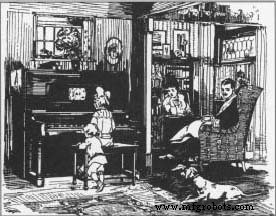 Advertisement for a Beckwith player piano from the 1915 Sears Roebuck catalog.
(From the Collections of Henry Ford Museum & Greenfield Village.)
In the early twentieth century, the player piano gained widespread popularity, offering families the ability to enjoy music without extensive practice. These instruments featured built‑in mechanisms activated by foot pedals or electricity, using perforated paper rolls to perform a diverse repertoire. Advertisers promoted them as family entertainment and cultural enrichment tools, leading to the sale of over two million player pianos by the end of the 1920s. While some parents hoped the technology would inspire musical skill, many found the convenience of “perfection without practice” reduced the incentive to learn by hand.
Music rolls catered to all ages and tastes—tunes for young adults, nursery rhymes for toddlers, sonatas for classical enthusiasts, and multilingual rolls for ethnic communities. Coin‑operated player pianos became staples in hotels, dance halls, and restaurants, providing continuous music that enhanced atmosphere and revenue. However, the late 1920s saw a decline in player piano popularity as phonographs and radio emerged as strong competitors for leisure time and entertainment budgets.
Jeanine Head Miller
Steinway’s C. F. Theodore introduced the continuous bent rim, improving sound transmission by harnessing the acoustic properties of long wood fibers. This innovation was applied across grand, upright, and square models. By 1911, 301 piano builders operated in the United States. Production peaked in the 1920s but fell sharply during the Great Depression. Today, approximately 15 manufacturers remain in the U.S., while Japan leads worldwide production.
The piano’s design has remained largely unchanged since the late 1800s, though manufacturers experiment with materials and manufacturing processes. Below is an overview of the traditional manufacturing workflow, with distinctions noted for upright production and hammer‑to‑string angle variations.
Raw Materials
Pianos are constructed from premium materials chosen for both aesthetics and acoustic performance. Long‑fiber maple forms the rim, offering strength and resilience, while spruce provides the necessary lightness and durability for braces. Additional woods contribute to patterns and structural components. Metal is employed for the cast‑iron plate and other hardware. Sand—modified with bentonite and coal dust—serves as a mold filler. Molten iron, typically pig iron with steel and scrap additions, is cast to achieve the required tensile strength. High‑tensile steel wire, produced by specialized mills, becomes the piano’s strings.
Design
Scale engineers—trained specialists—design the piano’s specifications, selecting materials, and defining part interactions. A critical design consideration is the instrument’s structural integrity under tension. Each of the 220+ strings exerts 160–200 lb per square inch (11.2–14 kg per square cm) of force. The piano must perform consistently while remaining stable over time as environmental changes affect its diverse materials.
The cast‑iron plate must support this tension, covering only a small portion of the soundboard. It must be as massive as necessary for strength yet as light as possible to preserve sound quality. The plate’s geometry is tailored to the string layout, bridge placement, and string paths. Because iron is brittle, the plate features strategically placed holes on the curved side to prevent cracking from thermal stress and to allow sound to rise from the soundboard. Scale engineers create a prototype, draft it to scale, and develop a wooden pattern that guides the final cast.
The Manufacturing Process
Bending the Rim of the Case
- Steinway’s rim‑bending method—still in use—begins by gluing together up to 22 layers of long‑fiber maple, each up to 25 ft (7.62 m) long. These layers are shaped in a metal press to form a continuous rim. Both inner and outer rims undergo this process. The rims are stored in braces to preserve shape, then seasoned under controlled temperature and humidity until they reach the target moisture content. The bent inner rim is then fitted with the cross block, pinblock, cross braces, keybed, and backbottom—each glued and doweled into place.
- The cabinet is finished for both acoustics and aesthetics. The wood is sanded to allow even stain absorption, bleached to homogenize veneer appearance, pre‑stained, and finally stained. Wood fillers and washcoats may be applied, followed by a series of lacquer coats. Special glazes (for antiquing or other effects) are added, and the cabinet is allowed to dry for up to 21 days before hand‑rubbed to its final finish.
Making the Structural Components
- The piano’s framework—comprising the pinblock and cast‑iron plate—supports string tension. Braces are made from selected spruce; the pinblock (or wrestplank) is constructed from bonded layers of rock maple, quarter‑sawn or rotary‑cut to maximize grain orientation for the tuning pins. The pinblock contains one hole per string, up to 240 holes, drilled precisely.
- The cast‑iron plate is forged in a dedicated foundry. Using a wooden pattern designed by the engineer, match plates for top and bottom halves are produced. Sand molds are made from these match plates, and molten iron is poured, then allowed to cool in a controlled process that yields a plate weighing approximately 600 lb (272.4 kg). After cooling, the plate is sandblasted to remove excess sand, transported to a drill room where holes for tuning pins, nose bolts, and hitch pins are drilled. The hitch pins are inserted, and any casting imperfections are ground away. The plate is then hand‑sanded, primed, and painted.
- During assembly, the cast‑iron plate is repeatedly lowered and raised within the piano frame to accommodate the pinblock, rim, soundboard, and bridges.
Creating the Soundboard
- The soundboard—a thin spruce panel—underlies the strings and cast‑iron plate, resting on the rim braces. It is 0.25–0.375 in (0.635–0.95 cm) thick. Spruce is first air‑dried, then kiln‑dried to a precise moisture content. Strips 2–5 in (5.08–12.7 cm) wide are glued together, pressed, and dried. A pattern is superimposed, and the board is trimmed to grand piano dimensions.
- The soundboard’s curvature, known as the crown, is achieved by fitting lightweight spruce or sugar‑pine ribs beneath the board. Ribs are cut along the grain, fitted, and glued using a rib press that accurately positions them and forces the board into the desired curvature. The ribs are feathered at their ends and secured to notches in the piano’s framework, ensuring the crown aligns precisely with the design.
- Two bridges transfer string vibrations to the soundboard. The long bridge supports treble strings; the short bridge carries bass strings that fan across the treble range. Bridges must align closely with the soundboard’s grain, curve with the crown, and bear the downward pressure of the strings. They are crafted from solid hardwood (hard maple in American pianos, beech in Europe) or laminated wood, with laminations oriented perpendicular to the soundboard to avoid damping. Bridges are glued to the soundboard and secured with capped screws and soundboard buttons. The bridges are notched on both sides where strings cross, allowing the strings to strike a small section of the bridge and vibrate freely. Pins are inserted into the bridge, and strings are threaded between them.
Stringing and Tuning
- Piano strings are produced by specialized mills and consist of carbon‑steel wire. Bass strings are wound with copper (loading) to increase mass and length, enabling practical pitch without requiring 30‑ft strings. Treble strings are short, unwound, and grouped in threes to form a single note. Scale sticks serve as standards, indicating the required diameter for each string; up to 17 different wire gauges may be used in a single piano. Strings are handled with care, as they remain straight and never wind on rolls. After stringing, metal bars and brass studs called agraffes secure the strings near the tuning pins, while other bars position them near the hitch pins.
- Tuning pins are forged from steel wire, cut to length, shaped at the ends, and tumbler‑processed to smooth edges. Swags that fit tuning hammers are formed at the top, and holes for the strings are drilled. Pins are cleaned, nickel‑plated to resist rust, and threaded to allow smooth turning during tuning. They undergo controlled heating (blueing) to oxidize the threads, ensuring a secure grip in the pinblock. Specialized machines insert multiple pins simultaneously through the cast‑iron plate into the pinblock, after which they are fitted by hand.
Constructing the Keyboard and Action
- Keyboards, key frames, and action mechanisms are produced by specialty manufacturers. Keys pivot on two or three rails covered with felt to reduce noise. Guide pins are inserted into the front and middle rails. Keys are made of lightweight wood, kiln‑dried, and coated with black or white plastic (historically ivory or ebony). Plastic covers are molded in groups, then cut individually. Holes are drilled beneath each key to accept guide pins. Capstan screws on the back edges of the keyboard secure the action. After 88 keys are assembled, they are sanded, polished, and the black keys are stained before caps are glued on. The keys are then matched to the keyframe, washers are placed over guide pins, and the keys are mounted.
- The piano’s voice hinges on the quality of its hammers. Over the centuries, materials have ranged from elkskin to rubber; today, hammers are covered with premium wool felt graded for density. Felt is produced by carding, combing, folding, and compressing wool into tapered strips. The thinnest felt is used for treble hammers, while thicker felt is applied to bass hammers. Each hammerhead has a wooden core, with an under‑felt and top‑felt bonded using resin. Hammerheads are cut from long strips, then sliced into individual hammers by hand or automation. A fully assembled hammer set is installed in the piano, and a trained voicer adjusts the sound. The action is calibrated to match the hammer feel.
- Final components—including pedals and trapwork, the fallboard or key cover, music rack, hinges, top lid, and support sticks—are meticulously assembled to ensure tight fit and eliminate rattling that could compromise sound quality.
Quality Control
Quality assurance permeates every stage of piano manufacturing, as the instrument’s sensitivity demands precise interaction among its parts and materials. Scale engineers’ designs are validated by metallurgists who analyze the cast‑iron plate’s composition—carbon, sulfur, phosphorus, manganese—and monitor molten iron temperatures (typically 2,750 °F / 1,510 °C). String production undergoes tests for elasticity, resiliency, and tensile strength.
The Future
While the core manufacturing process has remained stable for a century, scale engineers continually explore innovations. Recent developments include vacuum casting of cast‑iron plates, producing smoother finishes that eliminate the need for extensive grinding.
Manufacturing process
- The Harp: From Ancient Roots to Modern Masterpieces
- Player Piano: Merging Acoustic Tradition with Automated Precision
- Master Python Strings: Creation, Formatting, and Manipulation
- Mastering Java Strings: Creation, Methods, and Best Practices
- C Strings: How Null-Terminated Character Arrays Work
- Master MATLAB Strings: Easy Creation & Usage Guide
- Mastering Strings in C#: Best Practices & Tips
- Mastering Python Strings: Creation, Access, and Manipulation
- Build a Portable Capacitive Touch Piano with Arduino – Step‑by‑Step Guide
- Build a Mini Piano with Arduino UNO – Step-by-Step Tutorial