



From Chemistry to Office Staple: The Story and Production of Post‑It Notes
Background
Sticky notes – or Post‑It notes – have transformed how we jot ideas. Their ease of use, lack of fasteners, and non‑damaging adhesive make them a staple on desks, computers, files, and even refrigerators.
Introduced by 3M in 1980, the first Post‑It pads quickly became the company’s best‑selling product. By 1984 sales surpassed $100 million, and by 1995 the market was estimated at $500 million, placing sticky notes among the world’s top office supplies alongside Scotch tape, copy paper, and file holders.
History
The journey began with chemist Spencer Silver, who, in the mid‑1960s, experimented with a novel polymer from Archer Daniels Midland. By deliberately deviating from standard polymerization ratios, Silver discovered a partially adhesive material – the first “tack” that held surfaces together yet allowed easy removal.
Silver’s breakthrough was initially idle until 1970 when he met biochemist Robert Oliveira in 3M’s System Research Group. The pair explored applications, but the adhesive’s tendency to stick more to itself posed a challenge. In 1974, corporate scientist Arthur Fry realized its potential when bookmarks kept slipping out of the choir hymnal – an image of the moment is shown below.
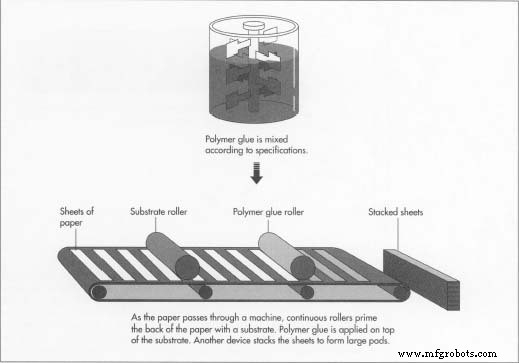
Fry, working from his basement, engineered a machine that applied a primed substrate to paper and layered the adhesive, producing the first tear‑off pads. Despite initial resistance, the prototype was tested in 3M’s Denver facility, where employees embraced the convenience.
After a rocky launch in 1977, the product was rebranded “Post‑It” in 1978, and national distribution began in 1980. Subsequent years saw a proliferation of colors, sizes, and pre‑printed headings such as “copy,” “rush,” and “FYI.” Competition grew, yet 3M maintained dominance thanks to its proprietary polymer and brand equity.
Raw Materials
The foundation of a sticky note is simple: paper, typically yellow, bonded with 3M’s proprietary polymer adhesive. This adhesive enables the notes to stick temporarily yet be repositioned without leaving residue.
The Manufacturing Process
Preparing the Glue
- 1. The polymer adhesive is blended and fed into a machine that applies it to paper.
Preparing the Paper
- 2. For pre‑printed pads, headings are inked onto large sheets before priming.
- 3. Continuous rollers prime the paper’s backside, then coat it with the adhesive.
Forming the Pads
- 4. Stacked sheets are bound into large pads, each bearing the 3M logo.
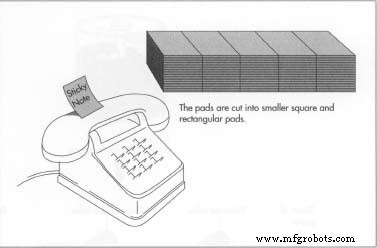
- 5. Pads are sliced into standard sizes ranging from 1.5 × 2.0 in (3.8 × 5.1 cm) up to 8.5 × 11 in (22 × 28 cm).
Packaging
- 6. Pads are labeled, wrapped in plastic, bulk‑packed, and shipped to distributors.
The Future
Post‑It notes remain indispensable in offices and homes alike. While competitors have entered the market, 3M’s proprietary polymer continues to underpin more than 300 applications, from medical bandages to reusable décor kits, ensuring the sticky note’s relevance for years to come.
Jack Wilkins, 3M’s Commercial Tape marketing director, once said: 'Once people started using them it was like handing them marijuana. Once you start it, you can’t stop.'
Manufacturing process
- 5 Proven Product Design Principles to Make Your App Unforgettable
- Hyperbolic Functions: Fundamentals and Applications
- The Harmonica: History, Construction, and Future
- Cisco and Emerson Strengthen Industrial IoT Partnership at Nashville’s Emerson Exchange
- IXON IoT Platform – May 2020 Release Notes
- 4 Essential Tips for a Successful Scheduled Maintenance Shutdown
- Key Considerations for Selecting and Maintaining Transformer Oil
- SW North America Opens 40,000‑Sq‑Ft Michigan Plant to Strengthen Automotive & Aerospace Footprint
- August 2019 Highlights: Sunnen & ANS Partner to Advance Triboconditioning Technology
- Vocademy’s Maker Skills Academy – 6‑Month Hands‑On Career Program Begins July 2019