



The Harmonica: History, Construction, and Future
Background
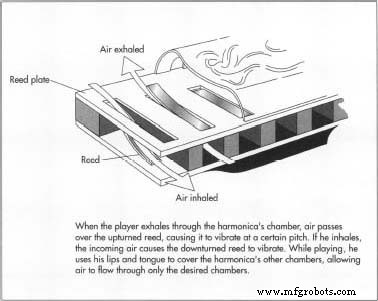
The harmonica, also called the mouth organ, is a compact, hand‑held instrument that produces music by forcing air through precisely spaced reeds. The pitch of each note is determined by the length and thickness of the reed. Tracing its lineage back to the ancient Jew’s harp and the Chinese sheng, the harmonica has earned nicknames such as the blues harp, pocket piano, and Mississippi saxophone. From its 19th‑century origins, it has become integral to genres ranging from classical and folk to country, rock, blues, and jazz.
History
Although the exact origin of the harmonica is unclear, the first patent was granted to Christian Friedrich Buschmann, a German teenager, for a 10 cm mouth organ with 21 chromatically arranged blow reeds. The instrument quickly spread across Europe under various names—including mundharmonika, mundaeoline, psallmelodikon, and symphonium.
In 1826, Bohemian craftsman Joseph Richter produced a design that would set the standard: ten holes and twenty reeds on two separate plates, allowing distinct blow and draw notes. The double‑plate construction, set on a cedar comb, was tuned to a diatonic seven‑note scale.
Decades later, German clockmaker Matthias Hohner began crafting harmonicas in his kitchen in 1857, producing 650 instruments in his first year with family and a single paid worker. By 1862 he had branded the reeds and introduced the instrument to North America, where its portability and affordability made it a favorite of cowboys and African‑American blues musicians. Legendary blues players such as Sonny Terry, James Cotton, Charles Musselwhite, and William Clarke have all showcased the harmonica’s expressive power.
The harmonica entered mainstream popular culture in the 1930s, with boys’ harmonica bands touring vaudeville stages. Luminary Larry Adler performed with major symphonies, while the Harmonicats sold 20 million copies of “Peg o’ My Heart” in the late 1940s. In the 1960s, a group of 105 amateur players in Levittown, Pennsylvania, formed the “Largest Uniformed Harmonica Band in the United States.” The instrument’s blues heritage influenced countless white rock‑and‑roll artists, and folk icon Bob Dylan popularized mounting the harmonica on a neck strap so he could play guitar and piano simultaneously.
Today, manufacturers produce five primary styles: diatonic, diatonic tremolo‑tuned, diatonic octave‑tuned, chromatic, and orchestral accompaniment. The single‑reed diatonic is the most common, featuring 10 holes and 20 reeds—10 blow and 10 draw. Tremolo models use paired reeds tuned to the same key, while octave‑tuned diatonics pair reeds an octave apart. Chromatic harmonicas cover a full 12‑note octave, including sharps and flats. Orchestral versions may provide all blow notes or a combination of blow and draw notes and can be designed to play chords.
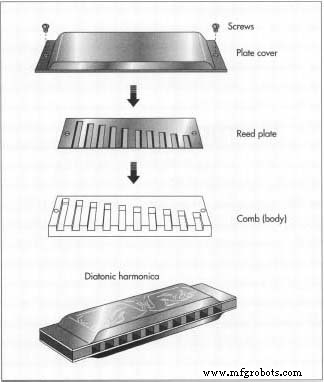
Raw Materials
Early harmonicas had wooden combs, but most modern instruments use injection‑molded plastic. High‑end models may incorporate metal alloys, lucite, or silver, each imparting a distinct tonal quality. Marine‑band and blues‑harp types are still produced from moisture‑resistant softwood, whose semi‑hardness yields a warm sound while resisting swelling.
Reeds are precision‑tapered strips of brass alloy (copper and zinc). The reed plate and cover plate are also machined from brass.
Screws and rivets secure the comb, reeds, reed plate, and cover plate.
The Manufacturing Process
While most components are produced by machine, final assembly remains a skilled, hand‑crafted process.
Creating the Comb
- Wooden combs are cut from a solid block and carved with descending channels. Plastic combs are created by injection molding: the polymer is heated, injected into a mold, cooled, and ejected.
Making the Reed Plate and Reeds
- The reed plate is stamped and milled to create slits that align with the comb’s channels. Reeds are cut, tapered, and riveted at one end to the plate, leaving the other end free.
Tuning the Reed Plate
- Artisans manually tune each reed. Using a tuning fork, they file the base to lower the pitch or the free end to raise it.
Attaching the Reed Plate to the Comb
- The reed plate is secured to the comb with nails or screws. Workers use needle‑nosed pliers and a small hammer on a dedicated workbench.
Attaching the Plate Cover
- The stamped and shaped cover plate, bearing the brand and model, is affixed with screws or nails.
Packaging
- Finished instruments are boxed and shipped to retailers.
The Future
In the 21st century, automation and computer calibration are gradually replacing manual steps. Manufacturers claim that computer‑guided assembly extends reed life and yields instruments with tighter seals, enhancing overall durability.
Manufacturing process
- The Harmonica: History, Construction, and Future
- From Chemistry to Office Staple: The Story and Production of Post‑It Notes
- Cisco and Emerson Strengthen Industrial IoT Partnership at Nashville’s Emerson Exchange
- IXON IoT Platform – May 2020 Release Notes
- Non‑Invasive Inspection & Work Order Excellence: A Practical SOP Guide
- Always Document Your Electric Motor Tests for Accurate Analysis
- GE Highlights Top Monitoring & Maintenance Apps of 2010
- Composites Europe Highlights How Process‑Chain Partnerships Accelerate Industry Growth
- Industrial Disputes Act 1947: Objectives, Key Provisions & PDF Guide
- 7 Essential Tips for Designing Your First PCB