



The Evolution and Production Process of Modern Books
Background
A book is generally understood as a written document comprising at least 49 pages that conveys ideas, information, or narratives. Over millennia, the form of the book has evolved alongside advances in communication technology and growing public appetite for knowledge.
The earliest recorded written records were clay tablets from Mesopotamia and papyrus scrolls from Egypt, both dating back to about 3000 B.C. Simultaneously, Chinese scholars produced bound volumes made of wood or bamboo strips tied together with cords, with examples from 1300 B.C.
The modern book owes its existence to the printing press. While movable type likely emerged earlier in China, the pivotal moment in Europe is attributed to Johann Gutenberg, who, together with Johann Fust and Peter Schoffer, produced the first printed Latin Bible in 1456 using a hand press with movable lead type. Early European books closely resembled hand‑copied manuscripts, leading to the term incunabula—from Latin “cradle”—to describe books printed before 1500. The first book printed in North America appeared in 1640 in Cambridge, Massachusetts, thanks to printer Stephen Day.
Mechanization dramatically increased supply, yet by the nineteenth century the demand outpaced hand‑printing capacity. Innovations such as larger presses, continuous paper rolls, the papermaking machine (1820s), binding machinery (1860), the cylinder press (1840s), and the linotype (1884) accelerated production, enabling mass distribution of books.
Throughout the twentieth century, printing benefited from offset lithography, computerized typesetting, and the advent of the paperback in the 1940s—a cheaper alternative to hardbacks that broadened readership. Though radio and television have altered media consumption patterns, books remain a primary source of knowledge worldwide.
Raw Materials
Book construction uses a range of coated and uncoated paper stocks of varying weights and dimensions. Covers, whether front or back, are typically made from a heavier stock; hardbacks employ durable cardboard, while paperbacks use lighter paper. Covers are often coated or printed with distinctive colors or designs.
Since the nineteenth century, sophisticated machinery—including typesetting machines, sheet‑fed or web‑fed presses, and binding equipment—has underpinned book production.
Design
Design is an ongoing process that begins when the author, editor, and book agent define the book’s scope, tone, target audience, and visual elements such as illustrations, chapter headings, prefaces, forewords, glossaries, indexes, and appendices.
Once the manuscript is complete, a cycle of reviewing, editing, proofreading, revising, and final approval refines the text. Editors and art directors then decide on technical specifications: page size, typeface and point size, paper weight for text and cover, color usage, placement of visuals, and cover artwork.
- Page size and style
- Typeface size and style
- Paper type and weight for text and cover
- Use of color
- Integration of visuals/illustrations
- Cover art and illustrations
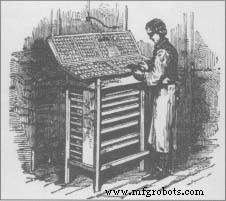 A typesetter, or compositor, works at his type stand in this mid‑nineteenth‑century engraving.
Printers have long been valued for their literacy, manual skill, and access to ideas. Their role placed them at the intersection of intellectual, political, and community life, earning them a reputation as the “intellectuals of the working class.” Their trade language, rooted in Anglo‑European traditions, reflected both technical and social aspects of the craft.
William S. Pretzer
The Manufacturing Process
After the manuscript and design choices are finalized, production commences with typesetting—now typically performed with desktop publishing software and laser printers that achieve professional‑grade output. The resulting “camera‑ready” copy is forwarded to a printer, who photographs the pages to create negatives.
These negatives are transferred by hand onto large sheets known as goldenrods or flats. Each flat accommodates 32 or 64 pages, and the correct sequence is established through imposition—placing pages upside‑down or out of order so that folding restores proper order. Strippers verify alignment using fluorescent lighting.
Proofs, or “blueprints,” are produced by exposing the negatives onto light‑sensitive paper. Publishers scrutinize these proofs; any required changes prompt re‑photography and re‑stripping of the affected pages.
Once approved, the negatives are burned onto thin aluminum sheets called plates. Chemical treatments render the text and images ink‑receptive, preparing them for printing.
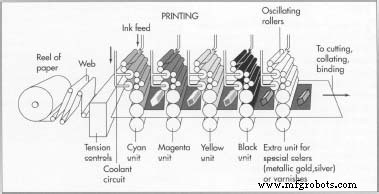
Printing proceeds via offset lithography, letter‑press, or gravure, with the choice influenced by cost, volume, and equipment availability. Sheets are fed through either sheet‑fed or web‑fed presses. Color printing requires separate passes for each of the CMYK inks.
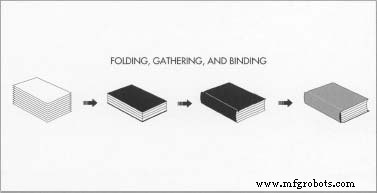
After printing, the sheets are shipped to a bindery. Here, flats are folded into signatures—32‑ or 64‑page sections—assembled in sequence, and bound. Binding may involve sewing, gluing the spine, inserting linen, and trimming edges. The final step encloses the content within the cover, completing the book.
Quality Control
Print shops perform regular checks to guarantee quality. Blueprints are examined for accuracy, and press proofs are reviewed before full runs to adjust exposure or ink density. Spot‑checking of signatures ensures proper folding and stitching, while cover attachment is verified to prevent future deterioration.
Instruments such as densitometers and colorimeters assess color fidelity, paper hygroscopes monitor moisture balance relative to room humidity, and inkometers evaluate ink quality.
The Future
Book production has largely remained unchanged since the early twentieth century, except for the transition from mechanical typesetting machines to desktop publishing. Modern software and high‑resolution laser printers allow authors, publishers, and designers to produce camera‑ready layouts that match or surpass the quality of traditional methods.
Desktop publishing tools—scanners, graphics software, and image editors—enable the integration of photographs, hard‑copy graphics, and digital text into cohesive designs. This shift empowers stakeholders to control layout, reduce costs, and accelerate turnaround.
As desktop publishing becomes increasingly accessible, the publishing industry is poised to adopt these technologies more broadly, ensuring that the art of bookmaking continues to evolve while preserving its core value of delivering knowledge.
Manufacturing process
- The Evolution and Production of Comic Books: From Ancient Art to Modern Industry
- Book Review: Digitise or Die – A Blueprint for IoT-Driven Transformation
- Top 17 Programming Books to Elevate Your Coding Skills in 2021
- Mastering C Structures: Organize Complex Data Efficiently
- C Typedef Explained: Simplify Your Code with Custom Type Names
- Understanding C# Structures: How to Define and Use Value Types
- Musical Board Books: Boosting Mood & Memory for All Ages
- Advanced Strength of Materials: Essential Resource for Engineers
- The Five Essential Books Every 3D Printing Enthusiast Should Read
- Silencio: A 3D-Printed Tactile Poetry Book for Sighted and Blind Readers