



Expert Guide to Lift Table Safety: Protect Workers & Boost Productivity
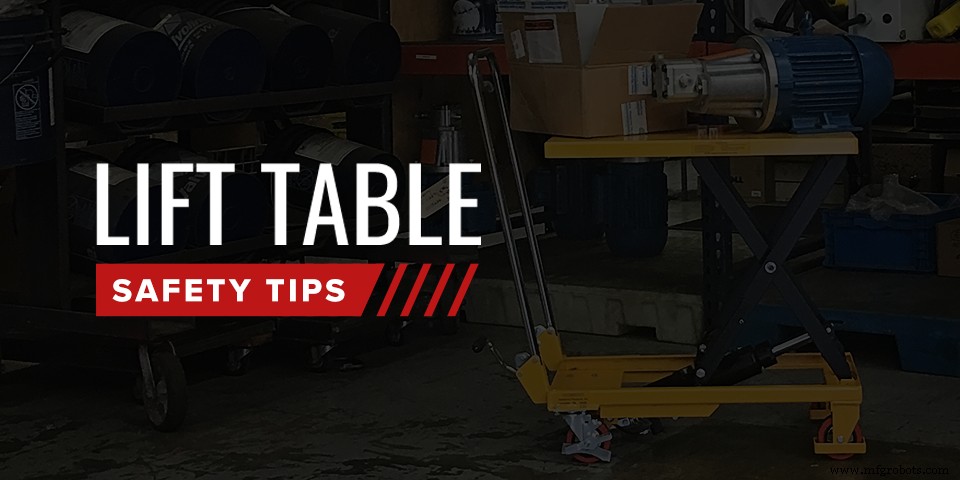
Industrial lift tables are valuable equipment pieces in today’s factories, assembly plants and warehouses. Lift tables greatly increase worker productivity while significantly reducing employee injuries. Using scissor-lift work tables is a win-win for every company, and using a lift table safely is a definite key to that success.
Lift table safety is a serious issue. Correctly used, lift tables decrease injuries associated with muscular-skeletal disorders (MSDs). These are the most common injury form in the American warehousing and storage sector. The United States Bureau of Labor Statistics (BLS) reports that 1.2 million people work in this industry. Warehousing and storage also account for an abnormally high rate of workplace injuries, with 5.1 percent of employees suffering some form of on-the-job injury each year.
Further BLS statistics state that 31 percent of injuries suffered by American freight, stock, and material movers were MSD complications. Most of the 356,910 recorded debilitations were due to strains and sprains caused by overexertion during workplace lifting activities. Without a doubt, many of these painful injuries could have been prevented by the safe usage of lift tables.
Industrial lift tables allow workers to handle material in the power zone. That’s the area between a person’s shoulders and knees where they can avoid exerting themselves through unnecessary bending or reaching. In a joint paper between the U.S. Department of Labor’s Occupational Safety and Health Administration (OSHA) and the National Institute of Occupational Safety and Health (NIOSH) titled Ergonomic Guidelines for Manual Material Handling, these leading authorities identified the power zone as critical to proper ergonomic performance and safety.
What Is Ergonomics?
Ergonomics is the study of how people interact with their physical and organizational environment. Specifically for workplaces, ergonomic science designs equipment and working conditions to fit the worker rather than forcing the worker to fit the job. Ergonomics is all about improving the fit between people, places, and procedures.
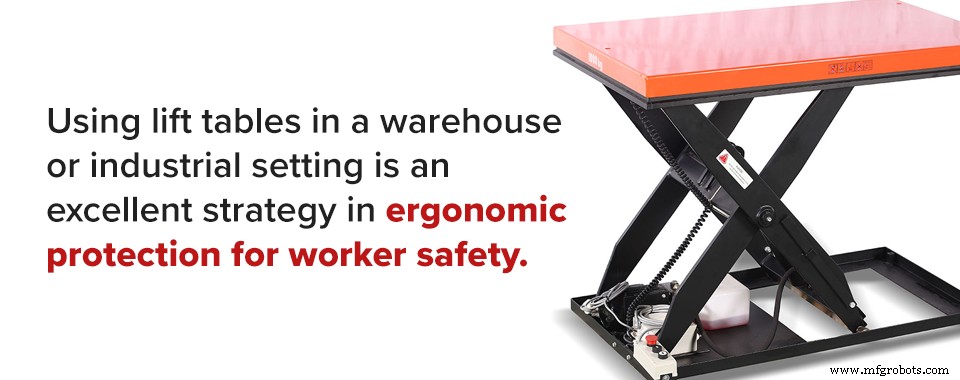
In the Guidelines for Manual Material Handling, OSHA and NIOSH refer to ergonomics as the 6-Es. That involves the best use of equipment, energy, and exertion to effectively, efficiently and effortlessly get the job done. Using lift tables in a warehouse or industrial setting is an excellent strategy in ergonomic protection for worker safety.
Material handling exposes workers to specific injury risks. When safety experts talk about the power zone, they also include what they call the handshake zone. This is the area of reach where overextension results in injuries to the shoulders, back, arms, hands and other body parts. MSDs caused by overexertion result in damage to muscles, ligaments, tendons, blood vessels and nerves.
Many of these time-loss injuries can be mitigated through ergonomic risk management. This involves analyzing and minimizing worker safety risks from repetitive tasks where repeated actions over long periods cause fatigue and injury. Ergonomic risk mitigation examines and reduces these primary factors leading to MSD injuries:
- Awkward postures: Improper bending and twisting motions contribute to bodily strain. Any posture that exceeds the handshake zone or power zone limitations is risky. Lift tables help remove the risk of working in awkward positions.
- Repetitive motions: Constant repetition of material handling motions is another key contributor to safety risk. Repetitive motions are best mitigated through mechanization. Material handling equipment like lift tables is an excellent solution to minimizing repetitive bending motions.
- Forceful exertions: Another dangerous safety risk comes through forceful exertions. Going beyond the handshake or power zone is a leading MSD cause. Using lift tables to bring materials within a worker’s comfortable power and handshake zone reduces MSD injury risk.
- Pressure points: Manual material handling often exposes workers to pressure point risks. These dangers are also called pinch points where workers’ hands and feet become caught between parts or loads. Lift tables bring loads up to a worker’s safe position and eliminate unnecessary risk from pressure point injury.
- Static postures: Maintaining a fixed position or static posture over a prolonged period also presents MSD injury risk. While this is the opposite of overextension, static postures are a real threat to worker safety. Using lift tables allows a worker to be flexible while still avoiding the other main ergonomic risks associated with material handling.
Ergonomic Improvement Types
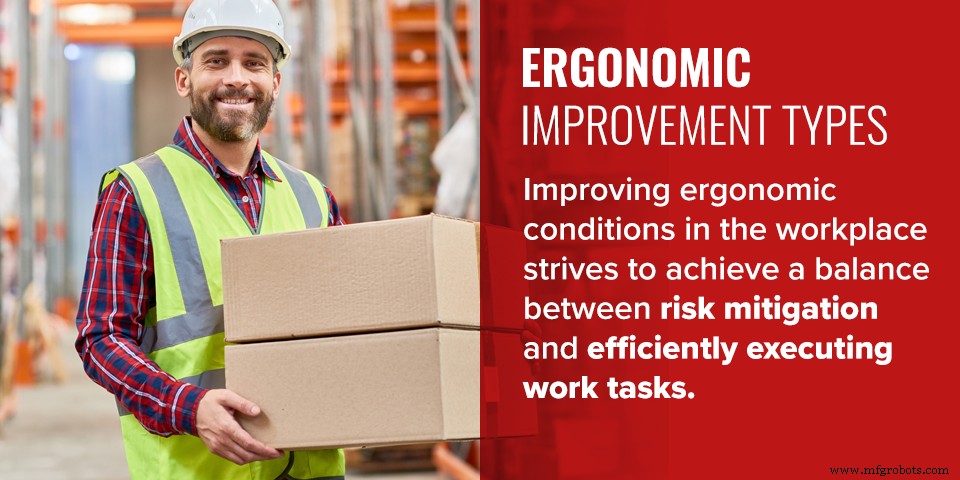
Ergonomic improvements enhance the fit between worker capabilities and the demands of material handling tasks. Improving ergonomic conditions in the workplace strives to achieve a balance between risk mitigation and efficiently executing work tasks. Properly addressed, ergonomic improvements ideally fit the two workplace economic and safety priorities.
There’s no set formula for ergonomic improvement. Many workplace factors contribute to material handling safety, such as temperature and lighting, that put their own stresses on ergonomic strain. These environmental conditions have their own controls and safety measures, but workers’ personal ergonomic requirements require specific mitigation. If you want to improve ergonomic safety fit in material handling operations, these two mitigation types apply:
1. Engineering Improvements
Mechanical processes are a prime way to mitigate MSD and other injury risks. Engineering improvements involve physical intervention and assistance to increase efficiency in material handling tasks. In a factory or warehouse environment, engineering changes can involve replacing or redesigning mechanical equipment to reduce or eliminate unsafe worker exposure to health and safety hazards. Ergonomic equipment like lift tables at workstations is a valuable engineering improvement in the material handling workplace.
2. Administrative Improvements
Besides physically mitigating ergonomic safety risks through engineering improvements, getting workers involved in workplace improvements significantly increases efficiency and reduces body strain that causes MSDs. Administrative improvements can be activities such as having workers observe other workers' behavior and recommend safer methods for material handling.
Administration also involves alternating worker roles through multiple workstations, adjusting schedules and modifying work practices to stay within workers' power and handshake safety zones. Also, training workers on properly operating material handling equipment like lift tables is an excellent administrative improvement.
Using Lift Tables to Improve Workers’ Ergonomic Safety
One of the best methods to mitigate workers' ergonomic safety is through using work tables. Material handling can be a hazardous occupation without proper training or equipment. Typically, material handling tasks involve moving heavy or awkward loads between positions. This duty exposes workers to repetitive tasks that often extend outside of the power and handshake comfort zones.
Mechanical engineering improvements like lift tables promote material handling worker ergonomic safety. Essentially, lift tables raise the work up to a worker's comfort zone rather than forcing them to strenuously extend down or strain to reach out. When material handlers remain in their comfort zone, they seriously decrease the potential for MSD harm. In turn, lift tables improve ergonomic safety.
A key improvement strategy for improving workers’ ergonomic safety is through implementing lift tables. These specialized machines are simple in theory but can be involved in their mechanisms. Lift table types vary in size, shape, and complexity. As such, they require unique operating skills to make sure the material handling safety solution doesn’t become a problem.
Not all lift tables are equal, by any stretch. Lift tables have different mechanisms designed for specific purposes. These are the five basic industrial lift table types found in factories and warehouse applications:
- Manual lift tables: The simplest and most basic lift table type is a manual design. These material handling tools allow the worker or operator to manually operate the scissor-lift mechanism. Manual lift tables are suitable for light loads and limited repetition.
- Mechanical lift tables: Mechanically operated lift tables are a step up from manual lift designs. These medium-duty lifts use mechanical devices to raise the table platform up to the worker’s comfort zone. Mechanisms range from screw and chain drives to rack-and-pinion devices.
-
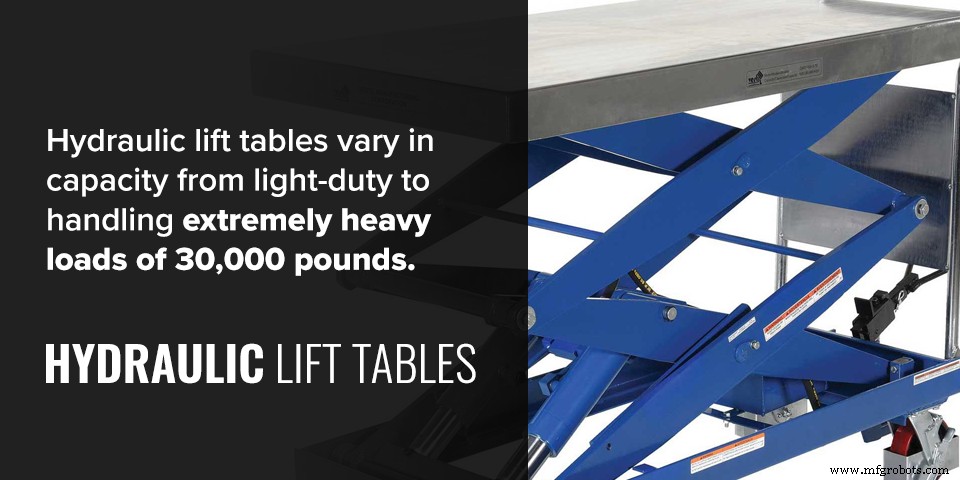
- Hydraulic lift tables: The most common lift table type is hydraulically operated. Compressed oil or other fluid drives a cylinder that raises and lowers the tabletop. Hydraulic lift tables vary in capacity from light-duty to handling extremely heavy loads of 30,000 pounds or more.
- Electric lift tables: Electricity is a common power source for lift tables. Electric lift tables are safe and clean, making them ideally suitable for situations like food and beverage production plants. Because electric lifts don’t require oil or other hydraulic fluids, they lower contamination risk and comply with sanitary regulations.
- Pneumatic lift tables: Air or pneumatic powered lifts are suitable in situations where compressed air is available as an energy source. Pneumatic lifts use inflatable bags or bladders to help raise the work table. Compressed airlift tables have extensive weight capacity and also remove the chance of hydraulic contamination in the workplace.
Aside from the five different mechanical types of industrial lift tables, there are other options available. Corrosion-resistant lift tables constructed of stainless steel inhibit rust and prevent metal contamination. Custom lift tables allow the end-user to have specific features engineered into the design for unique job applications. Regardless of the table type and purpose, they offer common benefits of using lift tables.
Benefits of Using Lift Tables
Industrial lift tables bring an enormous return on investment to any material handling business. Lift tables benefit a factory or warehouse facility in many different ways. These are the primary returns and benefits material handling businesses receive from lift table investments:
- Efficiency: Lift tables improve a material handling facility’s efficiency. Using lift tables limits worker time and strain from reaching beyond the comfort zone. This reduces activities that lead to fatigue and productivity slowdown. Businesses become far more productive in time, and that returns in economic profits.
- Economics: Because lift tables reduce time spent in raising and lowering heavy loads, they also reduce associated handling costs. Another economic benefit is lowered injury rates, which can lower workers' compensation costs. That, in itself, is a benefit well worth investing in.
- Ergonomics: Ergonomic benefits are nearly impossible to place a true value on. Lift tables are vital components in an ergonomically designed workplace. Making a better fit between business handling needs and worker ergonomic requirements is an immeasurable improvement. Lift tables deliver highly important ergonomic benefits to employers and employees alike.
- Versatility: Lift tables are versatile pieces of material handling equipment. There is a wide range of industrial lift table types and options offered in today’s market. Businesses benefit from standard designs like manual, mechanical, hydraulic, electric and pneumatic operating systems. They also benefit from versatile options like stainless steel construction and custom design options.
- Portability: Industrial lift tables can have portable designs. That increases versatility benefits to an extended reach where one lift table can be used in multiple locations about a facility. Portability can extend to outdoor use in some applications. This is a benefit well worth considering when investing in industrial lift tables.
- Stability: Quality lift tables are stable and sold material handling tools. When sourced from a reputable American material handling equipment supplier, lift tables will have industrial-grade construction with stability built-in. Stability benefits everyone and everything in the facility by protecting products and goods and keeping workers safe.
- Safety: One of the biggest benefits of all from buying American-supplied industrial lift tables is improved worker safety. Top-quality lift tables reduce or remove worker strain from extending beyond the power and handshake zone. These improved ergonomic benefits make for a safer workforce. Ergonomic safety also returns the benefit of improved employee morale.
- Morale: Employees equipped with professional material handling equipment like industrial lift tables will be safer, happier and have excellent productivity. That winning combination benefits the facility’s entire morale. In return, everyone in the supply chain benefits from vendors through workers and on to customers. That improved fit is a benefit well worth the initial investment.
Investing in industrial-grade lift tables is a serious step towards ergonomic safety and profitability. Lift tables can be an expensive investment, and purchasing these beneficial production and safety assets requires thought and consideration. Safely operating lift tables also needs careful attention and the right training. It also can use some helpful tips on how to use a lift table safely.

Sanitary Benefits of Stainless Steel Lifts
If you're searching for equipment that reduces the spread of contaminants, you'll want it constructed out of stainless steel — and the same is true for lift tables. If you're in an industry where cleanliness is crucial, like food or pharmaceuticals, you probably want to reduce the chance of viruses or other contaminants spreading while loading or unloading materials. Since stainless steel is the most sanitary type of lift table, it's a top choice for many companies.
Stainless steel is the best choice for a clean work environment because it is:
- Easy to clean: Surfaces that are difficult to clean often lead to time-consuming decontamination and cleaning processes that take up time and open up the possibility of substances being missed. Stainless steel lifts can handle harsh solvents and be cleaned more thoroughly and quickly than other materials. Because they are so easy to clean, companies can reduce the chance of contamination and save time.
- Non-corrosive: Many stainless steel tables are made to be non-corrosive. Stainless steel corrosion-resistant lift tables are built to last for a long time and resist any damage that could allow for contamination. Additionally, non-corrosive stainless steel can be used safely with powerful solvents and cleaners that typically wouldn't be safe on other types of lifts.
- Smooth: When you handle products like food, you need your lifts to be smooth. Loose food can fall out of its packaging, and if there are any crevices or ridges in the lifts, food can stick inside them, leading to rot and possible contamination of future food product. The smooth surface that a stainless steel lift provides can remove the chance of loose food getting stuck in hard-to-see areas.
- Compliant: If you transport and store pharmaceutical or food products, you likely have to meet HACCP regulations and other safety requirements. Since stainless steel is easy to keep sanitary, it's the gold-standard for meeting cleanliness requirements for lift-tables.
With all the benefits of stainless steel lift tables, it's no surprise that the most sanitation-focused companies regularly choose them. Keep your products free from harmful bacteria, debris, dirt, viruses and other contaminants by turning to stainless steel lift tables.
Tips for Using a Lift Table Safely
Although industrial lift tables offer significant safety and ergonomic benefits, they are specialized equipment. If lift tables aren't used correctly, they can be dangerous. A key part of lift table operator safety is understanding the equipment and what’s required to use it safely. Here are tips on how to use a lift table safely:
- Equipment type: Having the right lift table equipment is paramount for workplace and worker safety. It can be dangerous to use the wrong lift in the wrong environment. It can also violate industry regulations, such as using a hydraulic or corrosive lift capable of contaminating a clean environment.
- Right capacity: It’s extremely dangerous to overload a lift table. Exceeding a manufacturer’s recommended maximum capacity could result in the lift table collapsing under load. That could be a disaster to workers involved in operating the lift, not to mention the damage it could do to products being handled or other facility equipment.
- Load placement: It’s also essential to properly place a load on a lift table. Loads placed off the table center or where the load’s center of gravity distribution is unequal to the table’s axis can easily tip and fall to the ground. Savvy lift operators know how to correctly balance a load in proportion to the tabletop, thereby preventing accidental fall-offs.
- Table surface: Industrial lift table tops should have surfaces that have a strong grip. Friction contact is vital to keeping a load secure while it’s being raised, stationary or undergoing a lowering movement. Surfaces that are wet, oily or slippery in any way are accidents waiting to happen.
- Training: No facility worker should be allowed to operate a lift table without adequate training. Training to safely run an industrial lift table should be taught by a competent supervisor or co-worker who demonstrates the lift in action. They should then observe the student working the lift and sign-off when they're satisfied that the worker has the knowledge and skills to safely operate the equipment.
-
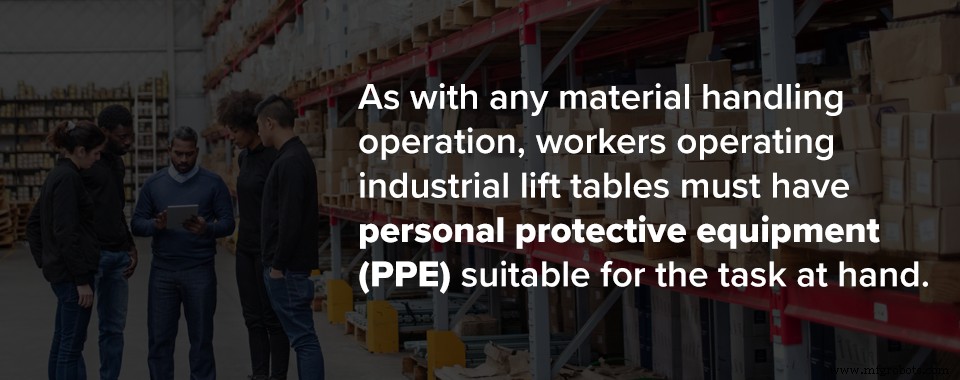
- Personal protective equipment: As with any material handling operation, workers operating industrial lift tables must have personal protective equipment (PPE) suitable for the task at hand. For lift table operators, that will likely be eye and hand protection. PPE might include hearing protection in the case of noisy machinery like pneumatic lift tables.
- Pinch points: Pinch points are any equipment locations where fingers, hands or feet could get trapped. As a general rule, the minimum safe openings to avoid pinch points are 1 inch for fingers, 2 inches for toes, 4 inches for hands, 5 inches for feet and 20 inches for a body. Exposing body parts to smaller openings exposes a worker to severe pinch point injury.
Power source: Industrial lift table power sources can be dangerous if not treated with due respect. Hydraulic fluid, compressed air and electricity are energized power sources. If accidentally discharged, they could severely or fatally injure someone. All industrial safety procedures concerning energized sources make it mandatory to lock-out and tag-out (LOTO) power sources when maintaining or repairing energized equipment.
Maintenance: Most quality-built industrial lift tables require little maintenance. Lift tables are sturdy equipment pieces designed for long operating periods with minimal maintenance. However, it’s critical to keep lift tables properly maintained for peak performance and safe operation. Recommended maintenance tasks and intervals will be unique to the individual lift table and can be found in the manufacturer’s manual.
Manufacturer’s manual: All the information needed to safely operate and maintain an industrial lift table should be in the machine’s owner manual. This information should be in a printed booklet supplied by the factory. If it’s not available in a printed form, the manufacturer should have the equivalent online or in a digital copy. No worker should ever operate a lift table without being familiar with the manufacturer’s manual.
Safe Lift Tables From Cherry’s Industrial Equipment
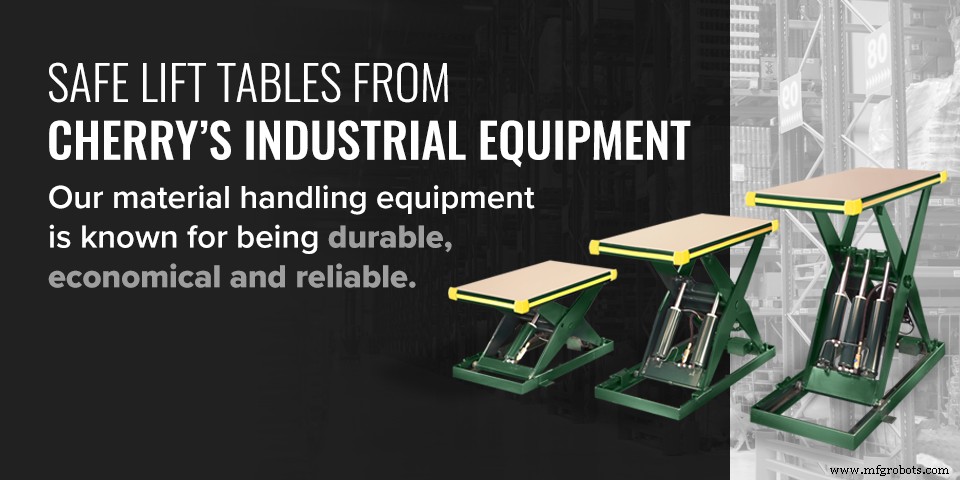
Cherry’s Industrial Equipment is one of America’s prime suppliers for top-quality industrial lift tables. Our material handling equipment is known for being durable, economical and reliable. Cherry’s lift tables are also proven to be extremely safe, provided equipment operators are suitably trained and certified in the particular lift tables operating procedures.
Cherry’s Industrial Equipment has an extensive line of industrial lift tables for every conceivable application. Our lift tables range from light-duty models suitable for small and occasional lifts all the way up to massive machines capable of the most extreme industrial lifts any facility could require. Here is a selection of industrial lift tables available through Cherry’s:
- Manual lift tables: Cherry’s basic and most economical lift tables have a manual design. Manual lift tables are simple to operate and work best in light situations where occasional lifts take place.
- Mechanical lift tables: For medium-duty lifts, mechanical tables are the answer, especially in locations where power sources are unavailable or impractical.
- Hydraulic lift tables: The most common lift tables have hydraulic cylinder operation. Hydraulics are strong and effective lift table power sources that are reliable and ergonomically friendly.
- Electric lift tables: Cherry's electric lift tables are popular in facilities where cleanliness is paramount, and hydraulic fluids might compromise hygienic regulations.
- Pneumatic lift tables: Air-powered lifts are excellent in facilities that have other compressed air equipment already in place.
- Corrosion-resistant lift tables: For facilities where corrosive or rusting conditions can’t be tolerated, stainless steel lift tables are mandatory. Typical examples that use corrosion-resistant tables are pharmaceutical and food supply businesses.
- Custom lift tables: When stock industrial lift tables won’t do, Cherry’s offers you the ideal solution. Partner with Cherry’s Industrial Equipment to have a custom lift table designed and built for you that’s ergonomically safe.
Partner With Cherry’s Industrial Equipment for Safe Industrial Lift Tables
For over 35 years Cherry’s Industrial Equipment has served thousands of industries for all types of material handling needs. We’re a leading supplier of warehouse equipment, such as ergonomically safe lift tables. Whether you're looking for standard products or custom-designed equipment, Cherry's is here to help you solve 100% of your challenges for your unique situation.
Call Cherry’s today at 877-350-2729 or reach one of our material handling specialists online. You will never go wrong with having Cherry's Industrial Equipment as your material-handling supply partner.
Manufacturing process
- Essential Guide to Choosing the Perfect Table for Your Home
- Pool Table – Design, History, and Construction Standards
- Top 6 Essential Warehouse Safety Practices
- Top 5 Crane Lift Safety Guidelines Every Operator Must Follow
- Top 3 Pallet Racking Safety Tips for Reliable Warehouse Operations
- How to Choose the Right Lift Table: A Comprehensive Buyer’s Guide
- Essential Warehouse Safety Guidelines for Managers & Staff
- Proven Food Safety Strategies for Safe Material Handling
- Essential Drum Handling Safety Guidelines for Warehouse and Jobsite Workers
- Proven Safety Guidelines for Heavy Equipment Operations