



Understanding Surface Roughness: Units, Charts, and Measurement Techniques
What is Surface Roughness?
Surface roughness, often shortened to roughness, is a component of surface texture. It is quantified by the deviations in the direction of the normal vector of a real surface from its ideal form.
If these deviations are large, the surface is rough; if they are small, the surface is smooth. In surface metrology, roughness is typically considered to be the high-frequency, short-wavelength component of a measured surface.
However, in practice, it is often necessary to know both the amplitude and frequency to ensure that a surface is fit for a purpose.
Roughness plays an important role in determining how a real object will interact with its environment. In tribology, rough surfaces usually wear more quickly and have higher friction coefficients than smooth surfaces.
Roughness is often a good predictor of the performance of a mechanical component, since irregularities on the surface may form nucleation sites for cracks or corrosion.
On the other hand, roughness may promote adhesion. Generally speaking, rather than scale-specific descriptors, cross-scale descriptors such as surface fractality provide more meaningful predictions of mechanical interactions at surfaces including contact stiffness and static friction.
Although a high roughness value is often undesirable, it can be difficult and expensive to control in manufacturing.
For example, it is difficult and expensive to control the surface roughness of fused deposition modeling (FDM) manufactured parts. Decreasing the roughness of a surface usually increases its manufacturing cost. This often results in a trade-off between the manufacturing cost of a component and its performance in application.
Roughness can be measured by manual comparison against a “surface roughness comparator”, but more generally a surface profile measurement is made with a profilometer. These can be of the contact variety (typically a diamond stylus) or optical.
However, controlled roughness can often be desirable. For example, a gloss surface can be too shiny to the eye and too slippery to the finger (a touchpad is a good example) so a controlled roughness is required. This is a case where both amplitude and frequency are very important.
Surface Roughness Unit
The roughness by arithmetic average (Ra) is the accepted standard and can be measured in English (microinches) or metrics (microns) units. Surface finishes are measured using averaging or profiling instruments. Averaging instruments cannot measure waviness and typically display surface finish values on a meter.
How to Measure Surface Roughness?
Surface roughness is a calculation of the relative smoothness of a surface’s profile. In this case, there’s the use of a numeric parameter – Ra. Ra surface finish chart shows the arithmetic average of surface heights. The heights have been measured across a surface.
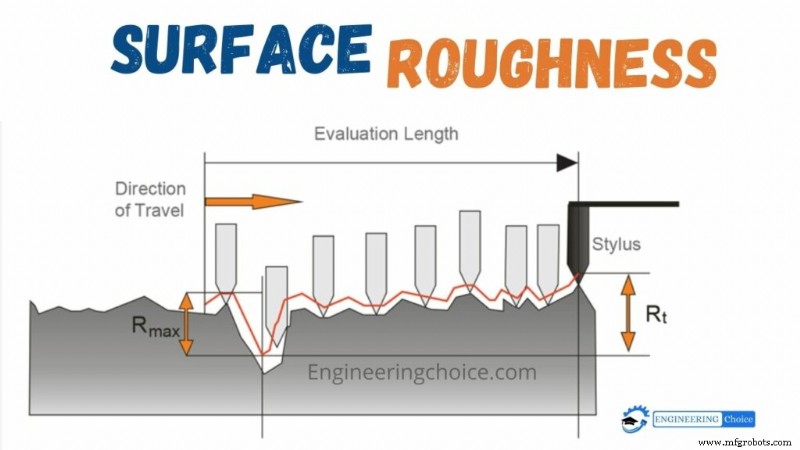
As already mentioned, there are three basic components of a surface. They include the roughness, the waviness, and the lay. Therefore, different factors are affecting the characteristics of surface geometry.
Likewise, there are several measuring systems for surface roughness. Therefore, the systems include:
- Direct measurement methods
- Non-contact methods
- Comparison methods
- In-process methods
The direct measurement methods measure surface roughness using a stylus. Consequently, it involves drawing the stylus perpendicular to the surface. The machinist then uses a registered profile to determine roughness parameters.
Non-contact method methods involve the use of light or sound instead. Optical instruments like white light and confocal replace the stylus. These instruments use different principles for measurement. The physical probes can then be switched with optical sensors or microscopes.
First, the instrument used will send an ultrasonic pulse to the surface. Then, there’ll be altering and reflection of the sound waves back to the device. You can then assess the reflected waves to determine roughness parameters.
On the other hand, comparison techniques employ surface roughness samples. These samples are generated by the equipment or process. Then, the manufacturer uses tactile and visual senses to compare results. The results are compared against the surface of known roughness parameters.
An example of in-process techniques is inductance. This method helps to evaluate surface roughness using magnetic materials. Here, the inductance pickup uses electromagnetic energy. It uses energy to gauge the distance to the surface. Then, the parametric value determined can help find out comparative roughness parameters.
Surface Roughness Chart
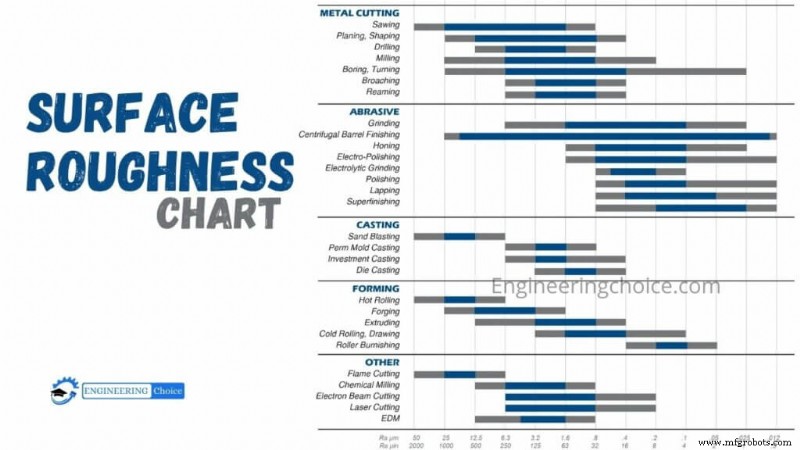
There are wide-ranging variations in finishing and edge conditions. Listed are some of the more common manufacturing techniques and their corresponding Ra surface finish values.
Various Methods of Measuring Surface Roughness
There are different methods and equipment involved in measuring surface roughness. The various methods used to fall into three categories. They are:
- Profiling Techniques. Firstly, we have the profiling techniques. This involves the measurement of the surface using a high-resolution probe. In this process, you should think more of a phonograph needle in line with sensitivity. A typical CNC probe may not be as effective.
- Area Techniques. These techniques measure a finite area of the surface. Therefore, the measurement offers a statistical average of peaks and troughs in the surface. Some examples of these techniques include ultrasonic scattering, optical scattering, capacitance probes, and more. It is easier to automate and execute with area techniques.
- Microscopy Techniques. These qualitative techniques rely on measuring contrasts. The results provide relevant information about peaks and valleys on surfaces.
Manufacturing process
- Understanding Surface Roughness: Units, Charts, and Measurement Techniques
- Understanding Surface Finish: Units, Symbols, and Practical Charts
- Surface Finish & Roughness: Symbols, Charts, and Callouts Explained
- Mastering Surface Roughness: A Practical Guide to Finish Quality in Manufacturing
- Master Surface Finish Measurement: Conversion Chart & Expert Tips from CNCLATHING
- Case Hardening Explained: Enhancing Metal Surface Strength & Durability
- Understanding Surface Finish: Units, Symbols, and Key Charts
- Surface Grinding Explained: Benefits & Applications for Manufacturing
- Mastering Surface Finish: A Guide to Surface Roughness and Its Impact
- Hydraulic Power Unit Explained: Turning Fluid Energy into Mechanical Power