



The Bevel Protractor: How It Works and Why It's Essential
What is Protractor?
A protractor is a measuring instrument, typically made of transparent plastic or glass, for measuring angles. Some protractors are simple half-discs. More advanced protractors, such as the bevel protractor, have one or two swinging arms, which can be used to help measure the angle.
Most protractors measure angles in degrees (°). Radian-scale protractors measure angles in radians. Most protractors are divided into 180 equal parts. Some precision protractors further divide degrees into arcminutes.
They are used for a variety of mechanical and engineering-related applications. One common use is in geometry lessons in schools.
What is Bevel Protractor?
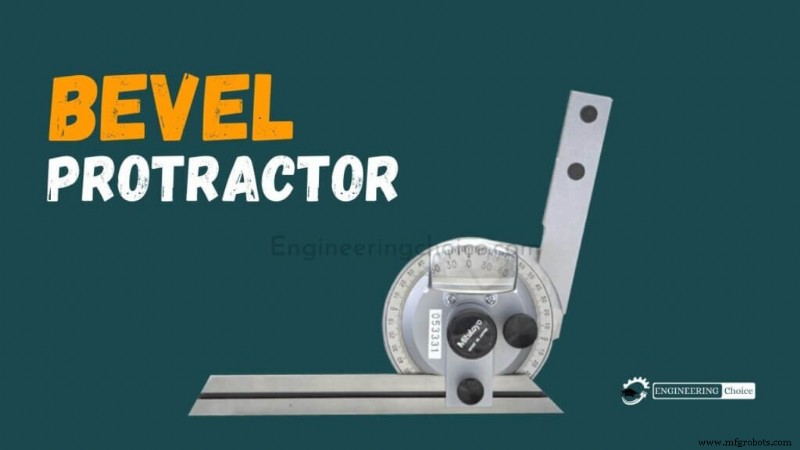
A bevel protractor is a graduated circular protractor with one pivoted arm; used for measuring or marking off angles. Sometimes Vernier scales are attached to give more precise readings. It has wide application in architectural and mechanical drawing, although its use is decreasing with the availability of modern drawing software or CAD.
Universal bevel protractors are also used by toolmakers; as they measure angles by mechanical contact they are classed as mechanical protractors.
The bevel protractor is used to establish and test angles to very close tolerances. It reads to 5 arcminutes (5′ or 1/12°) and can measure angles from 0° to 360°.
The bevel protractor consists of a beam, a graduated dial, and a blade that is connected to a swivel plate (with Vernier scale) by a thumb nut and clamp. When the edges of the beam and blade are parallel, a small mark on the swivel plate coincides with the zero lines on the graduated dial.
To measure an angle between the beam and the blade of 90° or less, the reading may be obtained directly from the graduation number on the dial indicated by the mark on the swivel plate. To measure an angle of over 90°, subtract the number of degrees as indicated on the dial from 180°, as the dial is graduated from opposite zero marks to 90° each way.
Since the spaces, both on the main scale and the Vernier scale, are numbered both to the right and to the left from zero, any angle can be measured. The readings can be taken either to the right or to the left, according to the direction in which the zero on the main scale is moved.
Working Principle of Vernier Bevel Protractor
As the Base Plate (Stock) acts as one of the working edges, and the other working edge will be the blade which is held on the circular plate. as you can see the some of the sample positions of the Vernier bevel protractor are in action.
This Adjustment Blade can be rotated along with the circular plate on the main body. This means the vernier scale on the circular plate will be rotated on the Main scale which is graduated on the Main body as shown below.
The Vernier scale has 12 divisions on each side of the center zero. (It means there are 24 divisions on the vernier scale) The 12 divisions are denoted as 60 min on the vernier scale (Like this 15, 30, 45, 60). That means 12 division = 60 minutes
One division= 60/12 = 5 minute. On the Main scale, the same portion is represented as 23° (12 divisions on the vernier scale = 23° on the main scale). One division on the Vernier scale = 1.91666° = 1° 55′ (one degree 55 minutes).
As similar to the vernier caliper working principle as Zero on the vernier scale moves on the main scale. While taking a measurement, The Zero line on the vernier scale shows the reading on the main scale, called the main scale reading.
At somewhere the divisions on the vernier scale will coincide with the divisions on the Main scale. this reading is noted as the Vernier scale reading. With these values along with the least count of the Vernier bevel protractor, we can calculate the Reading.
Parts of Bevel Protractor
- Swivel plate: The swivel plate rotates over the dial. This swivel plate has a vernier scale which is integrated into it.
- Magnifying Glass: The swivel plate also has a magnifying glass present over the vernier scale. This magnifying glass is used to see the value of the angles in the main scale and the vernier scale more clearly.
- Vernier Scale: The vernier scale is fixed on the swivel plate and it moves with the swivel plate. Vernier Scale gives the remaining angle in minutes. There are 60 minutes in 1 degree. This vernier scale is added in the bevel protractor to increase the precision of angle measurement. In the center, the vernier scale has zero. The vernier scale has 12 divisions on both sides of the zero and each division is 5 minutes. So, there are 60 minutes on each side of zero on the vernier scale.
- Angle locking screw: This angle locking screw is used to lock the bevel protractor at a certain angle so that after locking angle can be measured without any disturbance. angle locking screw stops the swivel plate from rotating with respect to the dial or dial scale.
- Dial: This is the base of the bevel protractor over which the other parts are present. The main scale or the dial scale is marked over this dial.
- Dial scale: This dial scale is the main part of the bevel protractor. It contains the graduated scale of angle from a value of 0 degrees to 360 degrees. In this graduated scale, every tenth degree is numbered. These 360 degrees is divided into four divisions each of 90 degrees.
- Blade: This blade is made up of high carbon steel. This blade is a tapered blade. This blade is either 150 mm or 300 mm depending on the bevel protractor. When the blade is parallel to the stock the zero of the vernier scale matches with the zero of the main scale or the dial scale. One side of the blade has an edge of 45 degrees and the other side has an angle of 30 degrees so that 45 degrees and 30 degrees can be directly measured using these edges.
- Blade locking screw: A blade locking screw is available to lock the blade at a certain place. This screw is used when we set the required length of the blade with the surface of the workpiece.
- Stock: The stock is one of the contacting surfaces in the bevel protractor while measurement of angle. The stock is the integrated part of the dial. As it moves the dial also rotates with respect to the blade and the angle value is changed in the dial scale. The job or workpiece whose angle is to be measured is kept in contact with this stock on one side. The other side of the job surface whose angle is to be measured is kept in contact with the blade. The blade of the bevel protractor travels inside the slot present in the stock.
Advantages Of Bevel Protractor
- It can measure angle very precisely up to 5 arcminutes and can measure angle up to 360 degrees.
- It gives a very accurate measurement.
- It is used to establish and test to bear angles in very close tolerance.
Applications of Bevel Protractor
- Bevel Protractor is used to check V Blocks.
- It is used to check the inside beveled face of the ground surface.
- It is also used for measuring acute angles.
Manufacturing process
- What Is a Toggle Press? How It Works and Why It Matters
- Compression Molding: Process, Benefits, and Applications for Rubber Parts
- Transfer Molding Explained: Process, Benefits, and Variants
- Understanding Vehicle Transmissions: Types, Functions, and How They Operate
- Bevel Protractor Explained: How It Measures Angles and Why It Matters
- Understanding Industrial Clutches: Definition, Function, and Applications
- Understanding Welding: Processes, Techniques, and Industrial Applications
- Wire EDM Explained: How It Works & Why It Matters
- Arc Welding 101: Types, Techniques, and How It Works
- Underwater Welding Explained: How It Works and Why It Requires Specialized Training