



Electrical Discharge Machining (EDM): Mastering Precision in Hard‑Material Fabrication
In high‑precision manufacturing, conventional tools such as drills and end mills eventually reach their limits. When the material is ultra‑hard or the geometry is too intricate for a physical blade, engineers employ a process that feels more like science fiction than traditional shop work: Electrical Discharge Machining (EDM).
Often called “spark machining” or “wire erosion,” EDM has evolved from a niche repair method into a foundational technology for aerospace, medical devices, and automotive components. This guide explains how EDM works, the three main variants, and the strategic advantages that make it indispensable for modern engineering.
What Exactly Is EDM?
Unlike CNC milling or turning, which rely on mechanical shear, EDM is a thermal‑electrical process. Material is removed through a series of rapid, localized electrical discharges—sparks—between two electrodes: the tool (electrode) and the workpiece.
Both electrodes are submerged in a dielectric fluid, typically deionized water or oil. When the voltage exceeds a threshold, the fluid breaks down, allowing a spark to jump the gap. Each spark reaches temperatures of 8,000°C to 12,000°C, vaporizing or melting a microscopic amount of material. The dielectric then flushes the debris and cools the surface, preparing the workpiece for the next discharge.
The Three Pillars of EDM Technology
Modern manufacturing distinguishes EDM into three distinct methods, each optimized for specific shapes and industrial needs.
1. Wire Cut EDM (WEDM)
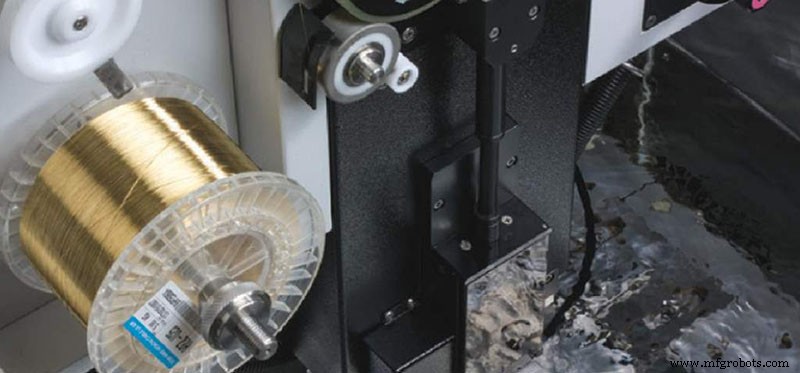
- How it Works: A continuously fed wire—usually brass or zinc‑coated copper—acts as the electrode, following a CNC‑programmed path through the workpiece. Because the wire is constantly replaced, the cutter remains sharp and uniform.
- Best Use Cases: Ideal for producing extrusion dies, blanking punches, and complex 2‑D shapes in thick plates.
- Key Advantage: 5‑axis capability enables tapered cuts and varying top‑and‑bottom profiles with tolerances as tight as ±0.0001 inches.
2. Sinker EDM (Ram or Cavity EDM)
- How it Works: A custom‑machined electrode—often graphite or copper—represents the negative of the desired cavity. The electrode is lowered into the workpiece, “sinking” the spark‑eroded pattern to form blind cavities.
- Best Use Cases: Essential for injection‑molding, creating deep, intricate cavities in steel molds that are unreachable with conventional milling.
- Key Advantage: Produces sharp internal corners and textures that mechanical tools cannot replicate.
3. Hole Drilling EDM
- How it Works: A hollow, rotating tube electrode is used. Dielectric fluid circulates through the tube to flush debris from deep holes, enabling precise drilling in hard materials.
- Best Use Cases: Widely applied to create cooling channels in turbine blades for jet engines and to prepare starter holes for Wire EDM.
- Key Advantage: Drills at steep angles on curved surfaces without bit walking or breakage, maintaining roundness over long depths.
Technical Advantages: Why Choose EDM?
Precision and Surface Integrity
EDM’s non‑contact nature eliminates burrs and mechanical deformation common in milling. The resulting surface finish is exceptionally smooth—often comparable to a high‑quality sandblasted finish—reducing the need for secondary polishing.
Complex Geometry, Zero Stress
Where a cutting tool might bend or snap a thin wall in a heavy block, EDM applies no macro‑force. This allows the creation of delicate lattices, thin ribs, and micro‑features that remain structurally sound.
Hardness‑Independent
In conventional machining, tool wear increases with material hardness. EDM is indifferent to hardness; a spark erodes hardened tool steel as readily as soft aluminum, provided the material is electrically conductive.
Historical Evolution
The spark‑erosion concept dates back to Joseph Priestley in 1770, but practical application began in the 1940s when B.R. Lazarenko and N.I. Lazarenko in the USSR harnessed it for controlled manufacturing. By the late 1960s and early 1970s, the advent of CNC transformed EDM from a manual repair tool into an automated, high‑precision system—paving the way for modern spacecraft components and surgical instruments.
Final Thoughts
EDM machining is the pinnacle of material subtraction where conventional physics falters. While it may be slower than high‑speed milling, its ability to ignore material hardness and fabricate geometries deemed impossible makes it essential for advanced manufacturers. Understanding the nuances between Wire, Sinker, and Hole EDM is the first step toward engineering excellence.
Manufacturing process
- Continuous Casting Mould: The Essential Core for Steel Quality and Production Efficiency
- TeleBall Retro Handheld Game Console – Build Your Own Arduino-Based Breakout & Tennis Game
- Essential Parts of Dual-Column Band Saw Machines
- Electric Arc Furnace Refractory Lining: Essential Materials for High‑Temperature Steel Production
- What Is a Machine? A Comprehensive Guide
- Design for Manufacturing: Clarifying a Critical, Often Misunderstood Principle
- Double‑Column Machining Centers: Key Features, Benefits, and Applications
- Discover Fresh Milk Vending Machines: Convenient, Affordable, and Eco‑Friendly
- Optimizing Blast Furnace Design for Superior Performance and Longevity
- Build a Simple Nixie Tube Clock Using Arduino – Step‑by‑Step Guide