



How Synthetic Lubricants Cut Downtime and Energy Costs for Industrial Operations
TL;DR:
- Synthetic lubricants deliver superior wear protection and thermal stability compared to mineral oils.
- They extend oil drain intervals, reduce maintenance frequency, and lower operating costs.
- Energy savings from reduced friction can cut production costs and carbon emissions.
- Industrial case studies demonstrate significant financial benefits across mining, paper, and ceramics sectors.
- Adopting synthetics supports ISO 50001 energy‑management goals and broader sustainability targets.
- High‑performance oils also ease workforce pressures by decreasing required maintenance visits.
- Despite higher upfront costs, the total cost of ownership is typically lower over the lubricant’s life cycle.

Many operators believe that running equipment smoothly guarantees that the lubricants are performing adequately. While oil and grease represent only a fraction of total operating expenses, their role in preventing wear, heat build‑up, and contamination is critical. A field engineer often discovers that upgrading to a high‑performance synthetic solution resolves a range of operational challenges— from excessive wear to unexpected downtime and abnormal oil consumption.
How Synthetic Lubricants Enhance Equipment Performance
Unlike conventional oils derived solely from refined crude, synthetic base oils undergo advanced chemical synthesis that allows manufacturers to tailor their properties to specific operating conditions. This engineering at the molecular level yields a lubricant with consistent molecule size, higher purity, and superior quality, ensuring reliable performance under extreme loads, temperatures, and chemical exposure.
In addition to its primary function of forming a protective film between metal surfaces, a lubricant must dissipate frictional heat, resist oxidation, and keep wear debris suspended. Synthetic oils excel in all these roles, which translates into tangible operational gains.
Key Advantages of Synthetic over Mineral Oil
- Enhanced wear protection: Robust fluid film and high shear stability prevent metal‑to‑metal contact even under heavy loads and elevated temperatures.
- Wide temperature tolerance: A high viscosity index maintains viscosity across temperature swings, while a wax‑free formulation preserves film integrity at high temperatures and a low pour point ensures fluidity in cold starts.
- Superior oxidation resistance: Slower degradation means the lubricant stays effective longer, extending service intervals.
- Cleaner operation: Reduced formation of varnish, sludge, and deposits keeps filters clear and flow unobstructed.
How Synthetic Lubricants Reduce Maintenance Costs and Downtime
Although synthetic oils carry a higher purchase price, the investment pays for itself quickly through reduced maintenance, extended oil life, and lower energy consumption. In fact, energy savings alone can yield a payback in just over a year, and the cumulative benefits over 15 years far exceed the initial cost.
Our field teams documented €38.5 million in customer savings across the EMEA region within a single year. Highlights include:
- A mining‑metallurgical plant reduced maintenance interventions by 40 % and increased production by 8 %, generating a €160,000 revenue lift after switching to synthetic oil.
- A paper mill tripled oil life in its dryer bearings, realizing estimated annual savings of €90,000.
- A ceramics mill improved gearbox energy efficiency by 2.4 %, translating into annual energy cost savings of €272,000.
Supporting Sustainability and Energy‑Efficiency Goals
While synthetic lubricants consume more resources during manufacturing, the extended drain intervals and reduced energy usage more than offset this. For example, a synthetic solution can extend oil change cycles by up to five times, leading to an estimated 38 % lower cumulative GHG emissions over 15 years (cf. ExxonMobil internal model).
Moreover, the reduced friction achieved by synthetics improves overall energy efficiency, helping operators meet ISO 50001 requirements and comply with the EU Energy Efficiency Directive (EED). Mobil’s recent whitepaper indicates that in‑use energy savings can be 23 times greater than the environmental impact of the lubricant’s production.
Empowering Maintenance Teams
As engineering talent ages and maintenance staffs shrink, high‑performance lubricants become a strategic enabler. By extending oil drain intervals and enhancing reliability, synthetics reduce the frequency of lubrication interventions, allowing teams to focus on higher‑value tasks and remote monitoring.
For instance, an energy customer operating industrial gas turbines reported over 1,300 hours of reduced human‑machine exposure after adopting a synthetic oil.
In addition to product selection, lubricant suppliers typically offer training and tailored guidance to help customers maximize the benefits of synthetic solutions. Regular oil‑condition monitoring further enables proactive maintenance, preventing costly unplanned outages.
Why Synthetic Lubricants Matter
Studies indicate that more than 60 % of machine failures stem from inadequate lubrication. The benefits of synthetic oils can be summarized in four areas:
- Performance: Use the best lubricant for the job to protect equipment.
- Cost savings: Lower downtime and maintenance spend, extended equipment life, and improved energy efficiency.
- Operational efficiency: Optimize performance while supporting sustainability ambitions.
- Workforce safety: Reduce human‑machine interaction and increase overall team value.
FAQs
What are synthetic lubricants used for?
They protect gearboxes, bearings, compressors, turbines, and hydraulic systems by reducing friction, minimizing wear, and improving operational efficiency.
How do synthetic lubricants reduce downtime?
They provide stronger film protection, better thermal stability, and longer oil life, preventing wear, overheating, and mechanical failures that cause production stops.
Are synthetic lubricants more energy efficient?
Yes—by lowering internal friction, synthetic oils enable equipment to run more efficiently, reducing energy consumption.
Which industries benefit most?
Mining, paper manufacturing, cement, ceramics, food processing, power generation, and chemical processing all see significant gains.
How long do synthetic lubricants last compared to mineral oils?
Depending on the application, synthetics can last three to five times longer than conventional oils.
Can synthetic lubricants help with sustainability targets?
Yes—longer drain intervals, reduced energy use, and lower maintenance requirements help lower waste and GHG emissions.
What’s the difference between synthetic and mineral oil?
Mineral oil is refined from crude, while synthetic lubricants are chemically engineered for specific performance traits such as thermal stability, oxidation resistance, and wear protection.
Can synthetic lubricants improve equipment reliability?
Yes—by reducing friction, controlling heat, and protecting against wear, synthetics enhance machine reliability and extend lifespan.
Why is lubrication important in predictive maintenance?
Condition monitoring detects contamination and wear particles early, preventing unplanned downtime.
Are synthetic lubricants worth the higher upfront cost?
Although pricier initially, the long‑term savings from reduced maintenance, lower energy use, extended equipment life, and improved productivity outweigh the upfront expense.
Subscribe to Process Industry Informer
Our bi‑monthly digital magazine, Process Industry Informer, delivers exclusive articles, news, and updates across the process sector, featuring commentary from industry experts Sean Moran, Gavin Smith, and Dave Green. Subscribers also receive:
- Weekly Process Industry Update e‑newsletter
- Regular podcast episodes
- Special offers from our advertising partners
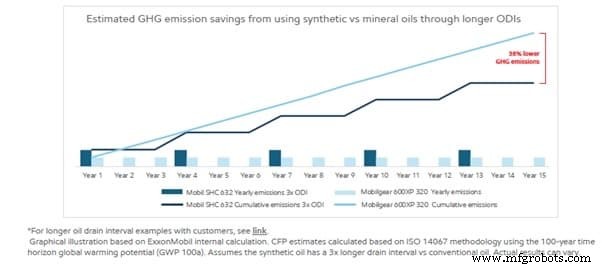
Graphical illustration based on ExxonMobil internal calculation. CFP estimates calculated using ISO 14067 methodology (100‑year GWP). Assumes a synthetic oil offers a 3× longer drain interval versus conventional oil. Actual results may vary.
Equipment Maintenance and Repair
- Work Order Systems: A Professional Guide to Efficient Maintenance
- Fiix Launches: A New Brand for Cutting‑Edge Maintenance Software
- NMC Cat Breaks Ground on New Norfolk Dealership, Opening Spring 2024
- Bridging the Gap: How Maintenance and Production Can Collaborate for Factory Success
- Synergy Behavioral Healthcare Partners with eMaint to Enhance Facility Management
- Comercializadora Fima Limitada & eMaint Light Up: Leading Chilean Lighting & Automation Experts
- Oxitec Partners with eMaint to Advance Sustainable Pest Control
- Free Summer Plant Shutdown Inspections for Cable Carriers & Continuous‑Flex Cables
- SKF Launches Affordable TKSA 31 Laser Shaft Alignment Tool
- Make 2020 Your Most Productive Production Year: Proven OEE, TPM, and Data‑Driven Strategies